



The narrative surrounding decentralized artificial intelligence is facing a critical technical test. While the fundamental landscape continues to expand—with major enterprise integrations scaling decentralized GPU rendering and AI agent networks—the price action for sector leaders Bittensor (TAO) and Render (RNDR) suggests a market that is deeply exhausted.
Following the broader early-summer market flush, both TAO and RNDR are hovering near the bottom of their respective 30-day ranges. The question for traders is no longer about the underlying technology, but about market structure: Are these critical AI infrastructure tokens establishing a healthy base for the next leg up, or is the "AI Trade" officially entering a prolonged, low-volatility summer consolidation?
Bittensor (TAO): Sitting In Lower Half Of 30‑Day Range
Source: tradingview
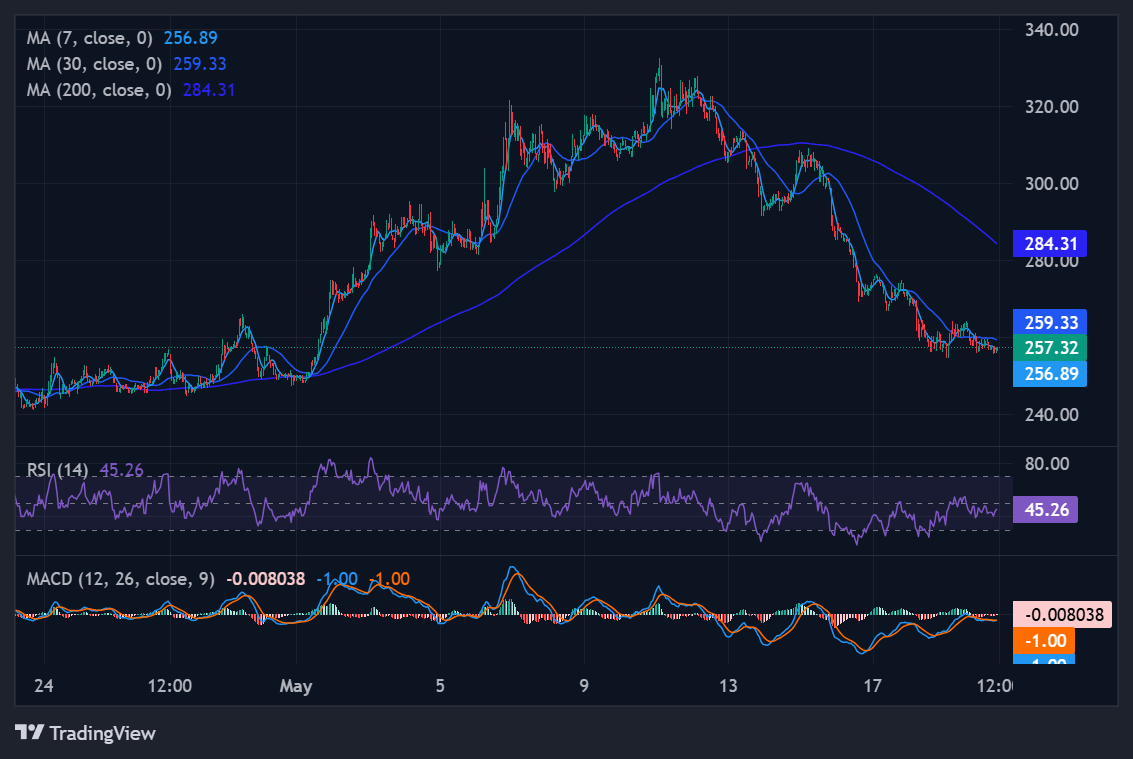
Bittensor represents the ambition of a truly decentralized neural network, but its price chart currently reflects an asset that has lost its short-term momentum.
-
The Compression: Looking at the last 30 days, TAO swung from a low of $244.49 up to $320.37. Currently trading near $260.89, it sits about 18.6% below that recent peak and is trading firmly beneath its short-term moving average proxy (~$278.41).
-
The Fibonacci Trap: TAO is currently stuck under the lowest major Fibonacci retracement level. The 23.6% level sits at $262.40; until TAO can reclaim and hold this price on a daily closing basis, it remains structurally weak in the short term.
-
The Make-or-Break Floor: The immediate support band is $244–$250. As long as TAO stays above the $244.49 swing low, the current 30-day structure can be viewed as an extended retrace inside a larger macro uptrend. However, a clean break below $244 argues that the AI-network trade is entering a deeper correction, not just a shallow reset.
Render (RNDR): Grinding Sideways Just Above First Fib Support
Source: tradingview
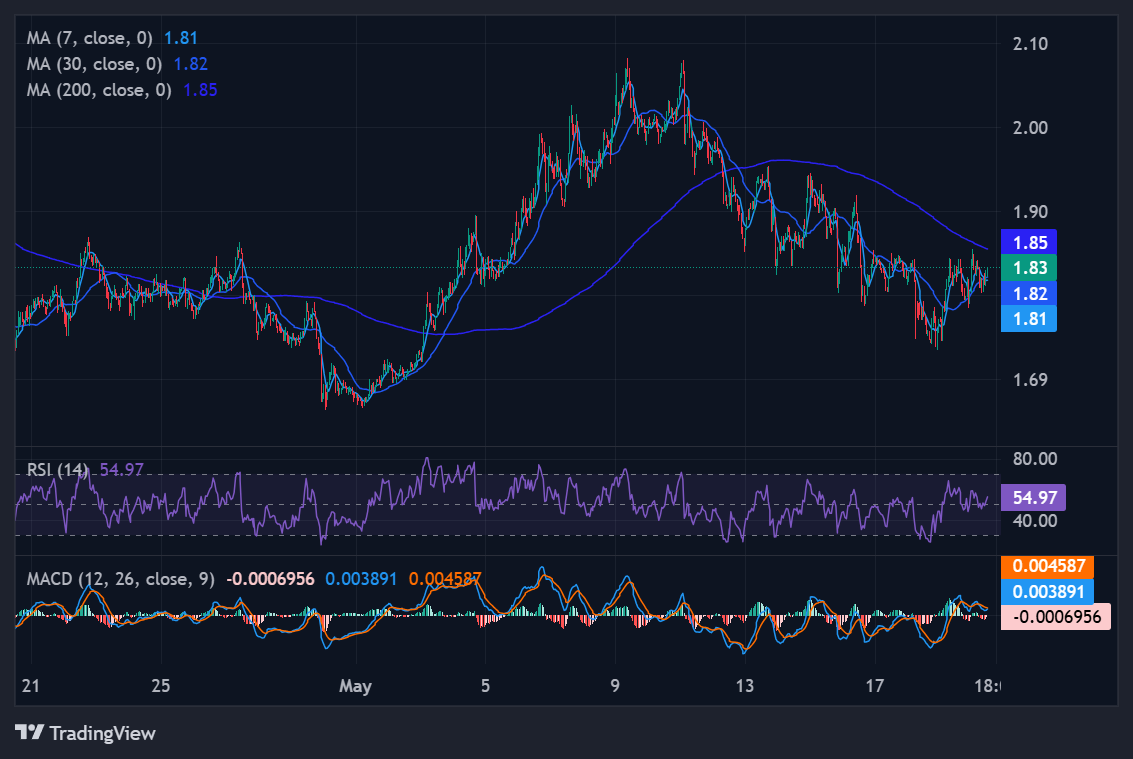
Render, which powers decentralized GPU marketplaces, is showing slightly more resilience than TAO but remains in a tightly coiled, precarious position.
-
The Coiling Setup: RNDR swung from a 30-day low of $1.72 to a high of $2.05. Currently trading at $1.82, it is sitting just above its 23.6% Fibonacci retracement level ($1.80) and slightly below the 38.2% level ($1.85).
-
The Mean Reversion Target: The $1.85 level is critical because it aligns perfectly with the short-term SMA proxy. Reclaiming the $1.85–$1.89 cluster would be the first sign of a genuine mean-reversion bounce.
-
The Breakdown Risk: The $1.80–$1.82 band must hold. If RNDR slips below this, it opens a direct path to retest the $1.72 swing low. A daily close beneath $1.72 would break the 30-day structure entirely, signaling a deep cooldown for AI-GPU infrastructure.
Do TAO And RNDR Signal The Next Leg Or Deeper Consolidation?
The technical data is unambiguous: both assets are currently in a consolidation phase, pinned below their short-term moving averages. The distinction between a "healthy reset" and a "dead summer" will be decided by how they interact with their Fibonacci support levels over the coming days.
They Signal the Next AI-Infra Leg If:
-
TAO successfully defends the $244–$250 floor and grinds back through the $273–$282 supply zone.
-
RNDR bounces cleanly off the $1.80 support and pushes through the $1.85–$1.92 resistance band.
-
This would indicate that institutional buyers are treating these lower prices as accumulation zones before the next wave of AI agent deployments requires massive on-chain compute.
They Signal a Deep Summer Consolidation If:
-
TAO breaks the $244 floor and stalls in the low-$200s.
-
RNDR slips under $1.72 and fails to immediately reclaim it.
-
This scenario tells us that regardless of fundamental adoption, the speculative capital that drove the massive AI run earlier this year is exhausted, and the market is content to let these assets drift sideways while broader risk-fatigue sets in.
Final Verdict: The AI trade is not dead, but it is deeply fatigued. The charts suggest we are at the bottom edge of a holding pattern. Buyers must step in here to preserve the structural uptrend; otherwise, the AI sector is headed for a quiet, grinding off-season.
Disclaimer: This article is provided for informational purposes only. It is not offered or intended to be used as legal, tax, investment, financial, or other advice.