

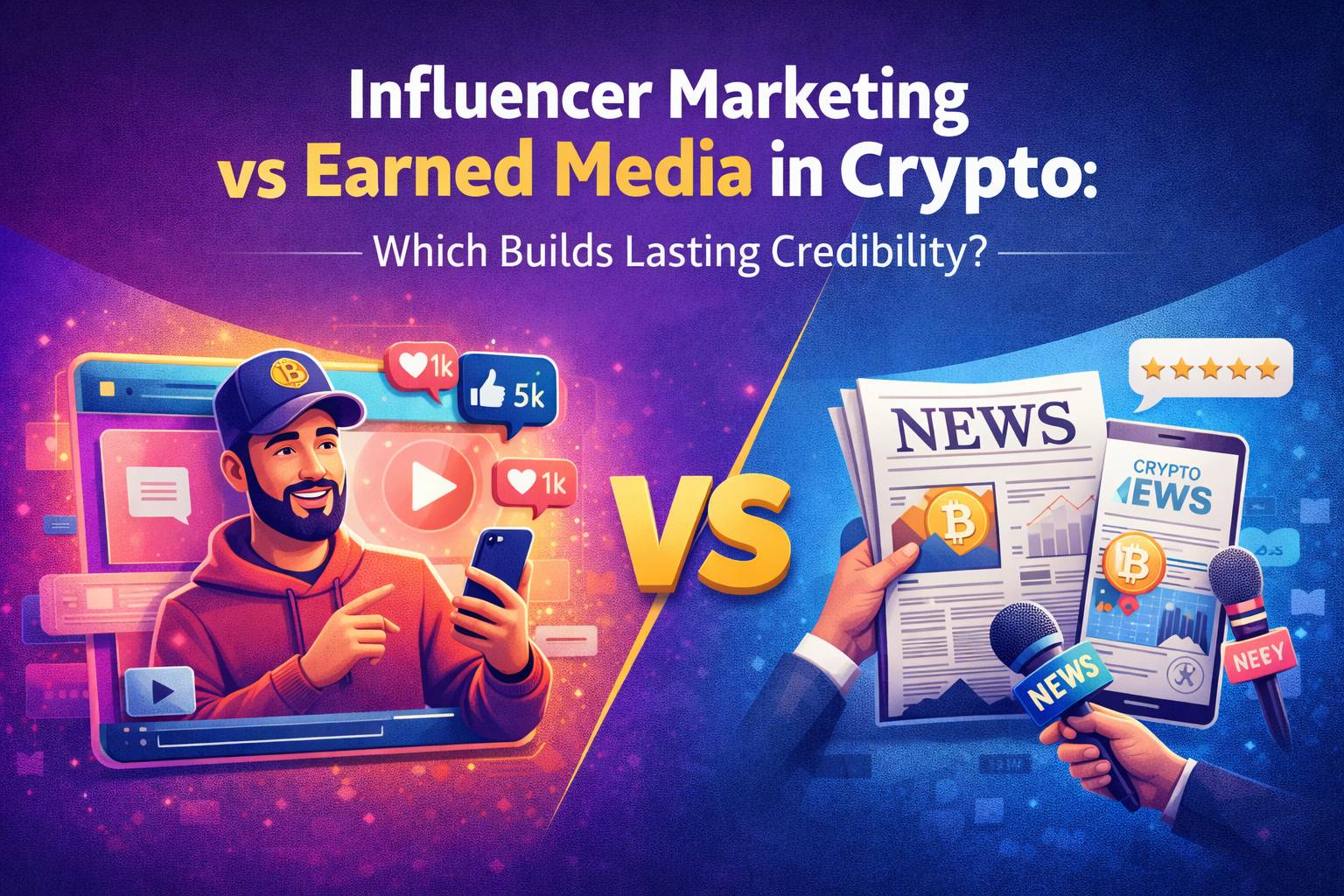
Crypto projects with limited budgets face the same resource question every quarter: spend on KOL campaigns for fast community reach or invest in earned PR for long-term credibility.
The answer depends on timing, goals, and one critical difference most founders overlook. Influencer posts decay within 48 hours. Earned media compounds for months through search indexing, syndication, and AI citation.
This article compares both channels across five dimensions: shelf life, trust signals, investor perception, AI visibility, and cost per lasting impression.
How Each Channel Works
Both channels produce visibility, but through entirely different mechanics and with different shelf lives attached to the output.
Influencer marketing (KOL campaigns)
A crypto project pays a Key Opinion Leader to create content about the product: tweets, YouTube videos, Telegram posts, X threads. The content reaches the KOL's audience immediately. Engagement peaks within 24 to 48 hours, then drops sharply.
The project has limited control over messaging. The KOL's personal style and audience expectations shape how the story is told.
According to the Consumer Insight’s Influencer Trust Index, 74% of consumers trust influencer recommendations, and crypto KOL vs PR decisions often hinge on this trust premium during launch windows.
Earned media (PR)
A PR agency pitches a story to a journalist, who decides whether to cover it based on editorial merit. The resulting article appears in a publication that the journalist's editor approved. It carries no "sponsored" or "paid" label.
The article remains indexed in search engines, gets syndicated across aggregators, and feeds into AI training data. A journalist chose to cover the project.
This editorial selection is what investors and AI systems treat as independent validation. That distinction sits at the heart of earned media crypto strategy.
Outset PR explored this dynamic in its analysis of whether PR cuts marketing costs or drains the budget, showing that earned coverage reduces drop-off across every acquisition channel, including influencer. That distinction sits at the centre of earned media crypto strategy.
The Shelf-Life Gap: 48 Hours vs 12+ Months
The difference between these two channels becomes sharpest when you measure how long each piece of content continues to generate value after publication.
Influencer content half-life
Research published in the Proceedings of the AAAI Conference on Web and Social Media found that the median half-life of a tweet is roughly 80 minutes, and after 24 hours, no relevant number of impressions can be observed for roughly 95% of all tweets.
An X thread peaks within four hours. A Telegram or Discord shoutout gets buried by new messages within hours.
After one week, the visibility value of a KOL post has largely expired. The audience has moved on to the next thing. When founders compare paid vs earned crypto visibility, this decay curve is the variable they underestimate most.
Earned media half-life
A CoinDesk or Cointelegraph article remains indexed in Google for months or years. Each article generates backlinks that build search authority over time.
Syndication spreads the article to CoinMarketCap, Binance Square, Yahoo Finance, and Google News within hours of publication, and those republications stay indexed independently.
AI systems draw from published media when composing answers. An earned article placed today can appear in an AI-generated answer six months from now.
Outset PR's research found that PR opens more doors in influencer outreach precisely because earned coverage creates the credibility layer that makes KOL partnerships more effective. The two channels reinforce each other when sequenced correctly.
How Investors and AI Systems Treat Each Channel
Credibility signals carry different weight depending on who is reading them. Two audiences matter most for crypto projects seeking long-term traction: venture capital investors and AI answer engines.
Investor perception
VCs run media due diligence before investing. Earned editorial coverage in tier-1 outlets signals independent validation. A Forbes article where the founder was interviewed carries more weight than 20 paid KOL posts.
Paid influencer content is visible to investors, too, but they discount it because they know it was purchased. The editorial selection signal is missing.
A founder with consistently earned coverage across CoinDesk, Decrypt, and Business Insider looks fundamentally different in due diligence than one whose media presence consists entirely of KOL shoutouts.
This is why crypto PR vs influencer marketing is not just a marketing question. It is a fundraising question as well.
AI system treatment
Large language models weight editorially selected content from high-authority publications more heavily than social media posts. An earned article in The Block feeds into AI training data and retrieval systems. A KOL tweet typically does not.
Projects with strong earned media footprints appear in AI-generated answers to category queries. Projects with only influencer coverage usually do not.
Outset PR documented that AI referrals now account for 25.6% of referral traffic to US crypto media, confirming that the AI channel is already significant enough to factor into the influencer marketing ROI crypto calculation.
When to Use Each Channel
The right channel depends on the scenario, the timeline, and what the project needs to signal. Here is a breakdown by situation.
|
Scenario |
Best channel |
Why |
|
Token launch needs immediate community awareness |
Influencer |
Speed and direct audience access in the 48-hour launch window |
|
Pre-fundraise credibility building |
Earned media |
Investors verify through media due diligence, not KOL posts |
|
Product launch to a crypto-native audience |
Both |
Earned media for credibility, influencer for distribution |
|
Post-crisis reputation repair |
Earned media |
Editorial coverage rebuilds trust; paid content looks defensive |
|
Community growth in a specific geo |
Influencer |
Local KOLs reach specific language and geo audiences faster than international media |
|
Long-term brand authority and AI visibility |
Earned media |
Compounds through search, syndication, and AI training data |
|
Exchange listing announcement |
Both |
Earned media for institutional confidence, influencer for retail excitement |
How the Two Channels Reinforce Each Other
The most effective approach treats earned media and influencer marketing as sequential, not competing.
-
Earned media first. Place earned editorial coverage that establishes what the project does and why it matters. This creates the credibility foundation.
-
Influencer amplifies. KOLs reference or share the earned coverage with their audiences. A KOL pointing followers to a CoinDesk feature about the project carries more weight than a KOL delivering a paid script. The credibility transfers.
-
Earned media compounds. The initial coverage generates syndication, search authority, and AI citations. Each new earned placement builds on the last.
Outset PR's Press Office model produces the sustained earned coverage that makes influencer campaigns more effective.
The Choise.ai campaign generated 2,729 republications at an average of 50 per article, creating a media density that gave every subsequent marketing channel, including influencer, a credibility boost.
Conclusion
Influencer marketing and earned media solve different problems on different timelines. Influencer posts deliver fast reach that decays within days. Earned media builds authority that compounds for months through search, syndication, and AI visibility.
The strongest strategies sequence earned media first, then use influencer campaigns to amplify validated coverage. The question is not which channel is better. It is the sequence that matches the project's stage, goals, and budget.
Disclaimer: This article is provided for informational purposes only. It is not offered or intended to be used as legal, tax, investment, financial, or other advice.