


As the 2026 decentralized finance landscape matures, the focus is decisively shifting toward sustainable, yield-bearing infrastructure. Real World Assets (RWAs), specifically tokenized U.S. Treasury bills and institutional credit vaults, are demanding robust, battle-tested foundations.
In this ecosystem, Chainlink (LINK) operates as the indispensable "Data Rail," providing the oracle feeds and cross-chain messaging (CCIP) necessary to securely price and route off-chain assets. Maker (MKR) acts as the foundational "Balance Sheet," backing its stablecoin ecosystem with billions in RWA collateral and distributing yield. Together, they represent the theoretical core of DeFi fixed income. However, their 30-day technical structures reveal that the market is treating them as mature, mid-range assets rather than fully re-rated structural monopolies. Are they quietly consolidating before a macro re-pricing, or are they still highly sensitive to rotating narratives?
Chainlink (LINK): Data Rail Mid‑Range, Waiting On A Push
Source: tradingview
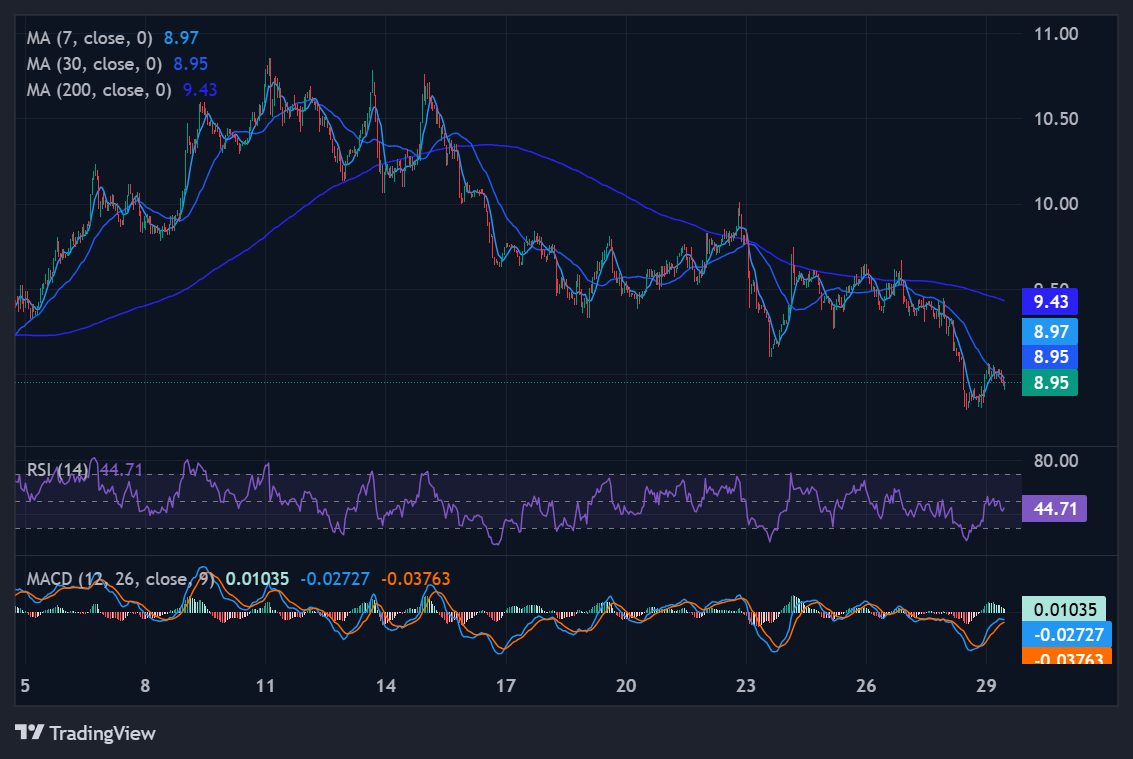
Chainlink is exhibiting a textbook "mid-range consolidation in an up-from-lows trend." It is trading slightly below its 30-day moving average but remains safely above its 200-day baseline ($15.00–$15.50).
The Fibonacci Map ($13.00 to $18.50):
-
23.6% Retracement: ~$14.30
-
38.2% Retracement: ~$15.10
-
50.0% Retracement: ~$15.75
-
61.8% Retracement: ~$16.40
Immediate Support:
-
$15.10 to $15.80: LINK is sitting right on the 50% retracement (~$15.75). This is the "data-rail balance zone." As long as daily closes hold above $15.00, the broader $13.00 to $18.50 upward leg is being actively defended.
-
$14.30 to $14.50: The 23.6% Fib. A deeper but normal retracement. Losing this band would raise questions about the market's willingness to pay a premium for CCIP and RWA oracle flows in the near term.
-
$13.00 to $13.20: The 30-day swing low. A close below this floor confirms the entire recent leg has been fully unwound.
Immediate Resistance:
-
$16.20 to $16.40: The "re-rating trigger" band. This cluster contains the 30-day SMA (~$16.20) and the 61.8% Fib ($16.40). LINK must climb back above this line and hold it to prove it is being repriced for institutional RWA demand.
-
$17.50 to $18.50+: The local high resistance band. Sustained closes above $18.50 are required to signal a macro shift from "solid infrastructure" to "core fixed-income data rail."
The Read: LINK is currently resting safely on its 50% Fib support, but remains pinned under its 30-day average. To be recognized as the definitive data half of the RWA stack, it must defend the $15.10–$15.80 dips, forcefully reclaim the $16.40 line, and push into the $18.50+ territory alongside measurable expansion in tokenized treasuries.
Maker (MKR): Balance Sheet Token In A Wide Channel
Source: tradingview
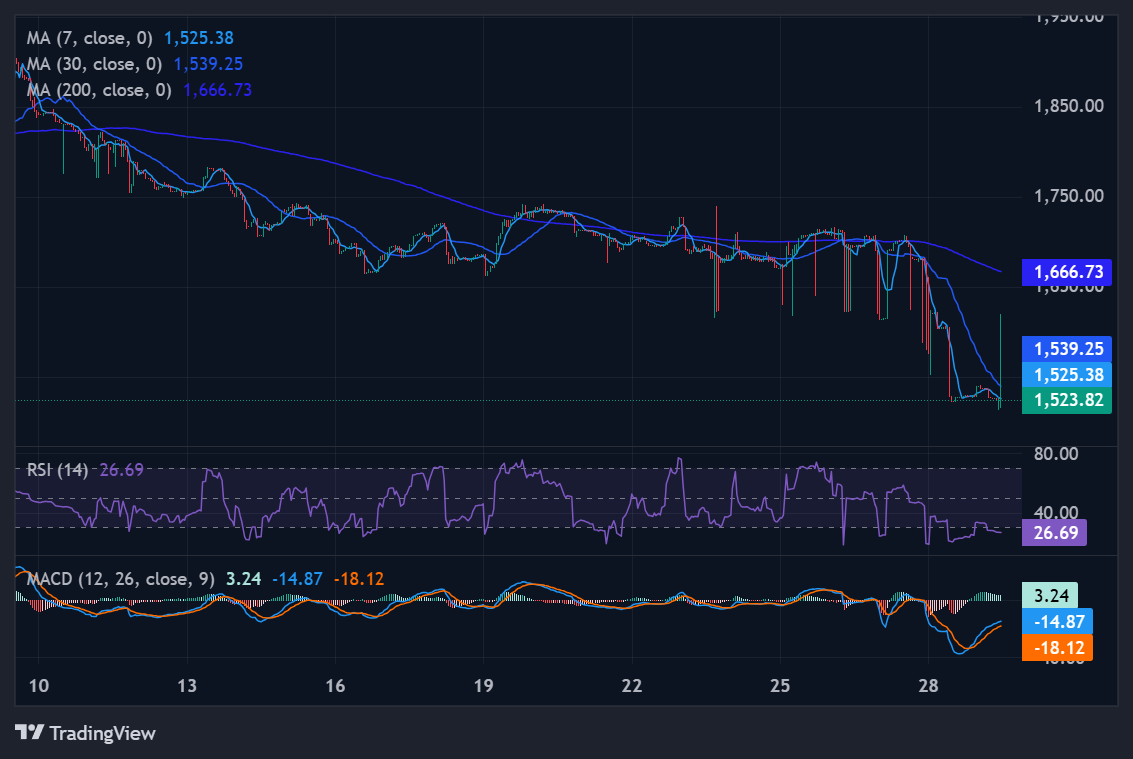
As the balance sheet leg of on-chain fixed income, Maker (MKR) sits directly behind DAI, massive RWA vaults, and protocol-level savings rates. Its chart mirrors Chainlink's posture: mid-range consolidation for an asset that has already experienced a significant historical re-rating.
The Fibonacci Map ($2,400 to $3,200):
-
23.6% Retracement: ~$2,588
-
38.2% Retracement: ~$2,706
-
50.0% Retracement: ~$2,800
-
61.8% Retracement: ~$2,894
Immediate Support:
-
$2,588 to $2,706: MKR is currently hovering just above the 38.2% Fib (~$2,706). This is the primary "balance-sheet support" zone. Holding here suggests the run to $3,200 remains a healthy, structural up-leg.
-
$2,400 to $2,450: The 30-day swing low. A daily close below $2,400 implies the market is no longer willing to pay a premium for RWA vault growth, completely unwinding the recent advance.
Immediate Resistance:
-
$2,800 to $2,894: The critical overhead block. This zone features the 50% Fib ($2,800), the 61.8% Fib ($2,894), and the 30-day SMA (~$2,900). MKR must reclaim and sit safely above $2,900 to confirm its status as the core fixed-income balance sheet, rather than a cyclical governance play.
-
$3,100 to $3,200+: The 30-day high. Sustained closes above $3,200 would mark an aggressive market re-rating of Maker's cash-flow and Treasury bill footprint.
The Read: MKR is in the middle of a wide channel, slightly under its 30-day mean. To be fully recognized as the foundation of DeFi fixed income, it must treat the $2,588–$2,706 band as an unbreakable floor, reclaim $2,900 to pull its moving average higher, and challenge $3,200 on the back of expanding RWA collateral and fee income.
Conclusion: Do LINK And MKR Re‑Price As The “Data + Balance Sheet” Core?
Both charts currently depict "mature mid-range assets with structural importance" rather than fully re-rated, breakaway monopolies.
They Re-Price as the Core of DeFi Fixed Income If:
-
LINK holds $15.10–$15.80, converts the $16.40 resistance into support, and pushes toward $18.50 as Proof of Reserve (PoR) and CCIP flows surge.
-
MKR defends the $2,588–$2,706 support block, reclaims the $2,900 moving average, and sustains time above $3,200 as RWA vault usage and protocol surplus trend upward.
-
Macro sector flows prove that institutional fixed-income capital is definitively defaulting to LINK data and the MKR/DAI balance sheet as their primary structural rails.
They Stay Specialist Infra / Governance Plays If:
-
LINK spends the summer oscillating aimlessly between $14.00 and $17.00 without ever sustaining momentum above $16.40.
-
MKR remains trapped beneath $3,000, repeatedly failing to convert the $2,800–$2,900 resistance band into a true base.
-
The broader market's attention and capital remain heavily concentrated in high-beta L2 governance, restaking, and AI tokens, treating RWA expansion as a slow-moving background narrative.
Final Verdict: The technical levels outline precise "step-up" zones for both assets. The success of the next wave of tokenized T-bills and on-chain yield strategies will ultimately decide whether LINK and MKR finally get paid as the definitive spine of DeFi fixed income, or if they continue to trade as high-quality but range-bound infrastructure.
Disclaimer: This article is provided for informational purposes only. It is not offered or intended to be used as legal, tax, investment, financial, or other advice.