

As we cross the midpoint of Q2 2026, the battle for the definitive Web3 consumer interface has intensified. The legacy debate over transaction throughput has largely been replaced by a focus on User Experience (UX). Protocols are aggressively competing to abstract away the complexities of gas fees, cross-chain bridging, and seed phrases for mainstream users.
In this landscape, Toncoin (TON) leverages its messaging-native integration with Telegram's massive user base, while NEAR Protocol (NEAR) positions itself as the infrastructure layer for full chain abstraction. However, as both networks roll out high-profile wallet integrations and consumer mini-apps, their native tokens face structural questions on the charts. Will TON and NEAR successfully re-price as the premier, user-facing layers of the crypto economy, or will they find themselves underpriced and overshadowed by increasingly polished Ethereum Layer 2 (L2) ecosystems?
Toncoin (TON): Messaging‑Native L1 In Mid‑Range Consolidation
Source: tradingview
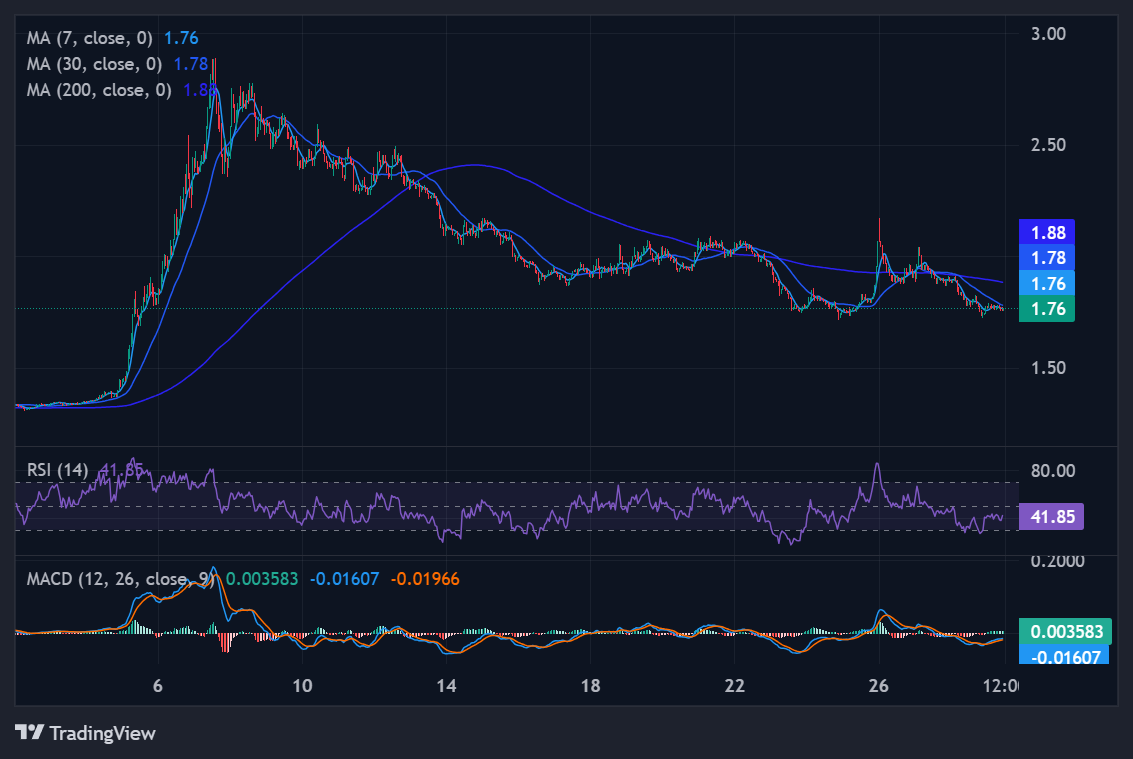
Toncoin’s structural profile over the last 30 days reveals an asset undergoing healthy, mid-range consolidation. While the token remains comfortably above its long-term baseline (200-day SMA at $1.70), it is currently pinning just below its 30-day moving average, awaiting a definitive macro push.
The Fibonacci Map ($1.60 to $2.40):
-
23.6% Retracement: ~$1.79
-
38.2% Retracement: ~$1.91
-
50.0% Retracement: $2.00
-
61.8% Retracement: ~$2.09
Immediate Support:
-
$1.79 to $1.91: This is the primary "Telegram dip-buy" band, containing the 23.6% and 38.2% Fibonacci retracements. As long as TON maintains daily closes above the $1.79 threshold, its medium-term upward structure remains fully intact.
-
$1.60 to $1.65: The 30-day swing low cluster. A clean daily close below $1.60 would signal that the current upward leg has been completely unwound, forcing the market to re-evaluate the near-term monetization of the mini-app ecosystem.
Immediate Resistance:
-
$2.05 to $2.10: The near-term trend-defining barrier. This band holds the 30-day SMA ($2.05) and the 61.8% Fibonacci level ($2.09). TON must reclaim and hold this zone to signal that speculative demand is matching on-chain metric growth.
-
$2.30 to $2.40+: The local high resistance band. A breakout and sustained consolidation above $2.40 (rather than a brief intra-day wick) is required to kickstart a brand new cyclical leg.
The Read: TON is structurally sound but range-bound, sitting directly on its 50% Fibonacci level. To prove it can lead a mainstream UX wave rather than losing ground to Ethereum L2 front ends, dips must continue to find demand above $1.91, and the price needs to systematically convert the $2.05–$2.10 band into an active support floor.
NEAR Protocol (NEAR): Chain‑Abstraction Leader in an Uptrend
Source: tradingview
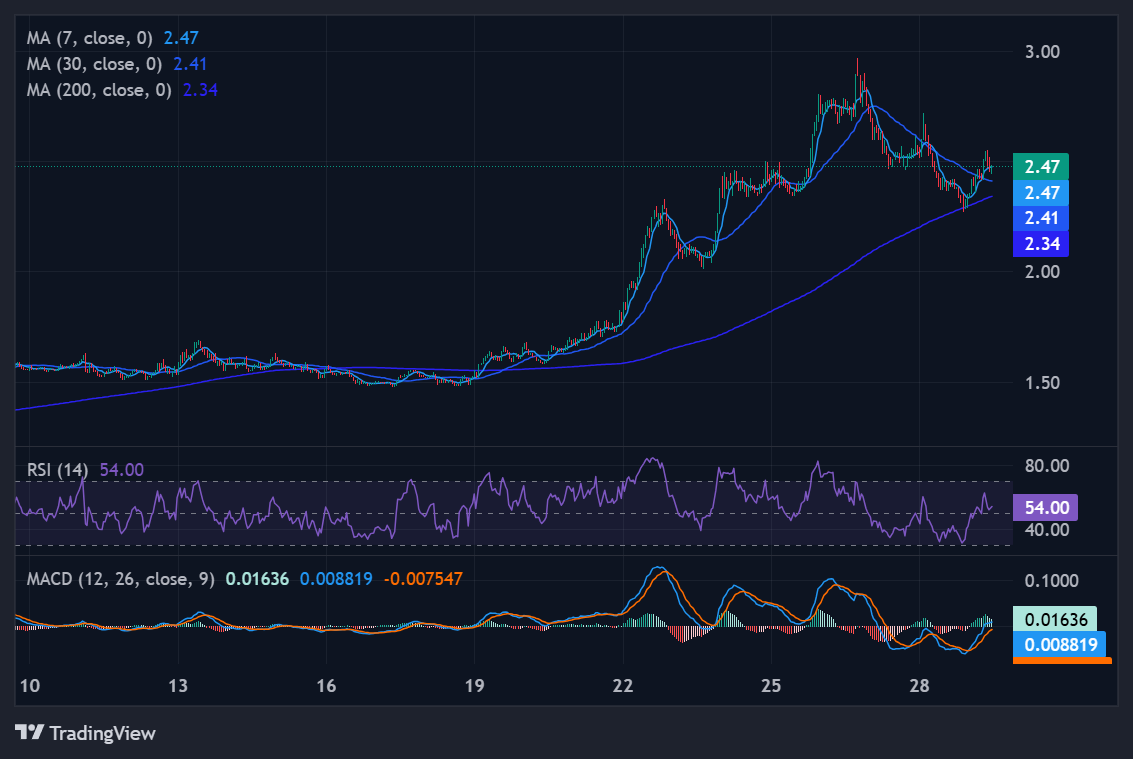
NEAR Protocol exhibits a technically stronger posture than Toncoin in this market window. Trading above its 30-day SMA ($5.30) and well clear of its 200-day SMA ($4.50), NEAR is showing a cleaner, more constructive up-from-lows trend profile.
The Fibonacci Map ($4.20 to $6.20):
-
23.6% Retracement: ~$4.67
-
38.2% Retracement: ~$4.96
-
50.0% Retracement: $5.10
-
61.8% Retracement: ~$5.24
Immediate Support:
-
$5.10 to $5.30: NEAR's immediate "trend support" band. This cluster houses the 50% Fib, the 61.8% Fib, and the 30-day SMA. Maintaining price action above this zone keeps the asset firmly in an active, near-term bull trend.
-
$4.67 to $4.96: The deeper retracement boundary. While a drop into this pocket would be a deeper correction, it would not completely break the macro chart. However, losing $4.67 would raise questions regarding the stickiness of its recent wallet flows.
Immediate Resistance:
-
$5.80 to $6.20: The primary overhead target. The 30-day local high sits at $6.20. Successfully breaking and sustaining value above this level is the pivotal step needed to establish NEAR as a primary macro leader in the chain-abstraction vertical.
The Read: NEAR's chart shows excellent relative strength, trading in its upper-middle range and holding its key short-term moving average as support. To validate its premium valuation, NEAR needs to turn the $5.80–$6.20 resistance zone into a launchpad for higher levels, backed by recurring, transaction-generating usage rather than speculative launch spikes.
Conclusion: Mainstream UX Wave or Underpriced by L2s?
The technical setups reveal that NEAR is currently acting as the near-term trend leader, while TON remains structurally solid but requires a clear breakout past overhead resistance to confirm matching momentum.
They Lead a Mainstream UX Wave If:
-
TON successfully defends the $1.79–$1.91 pocket, reclaims $2.10, and prints sustained daily closes above $2.40 alongside verified expansions in active Telegram wallets.
-
NEAR preserves its trend support at $5.10–$5.30 and breaks cleanly past $6.20, establishing a fresh macro uptrend driven by non-crypto-native user onboarding.
-
Sector rotation shifts capital away from Ethereum L2 rollup governance tokens (e.g., Arbitrum, Optimism, or Base-aligned ecosystems) and directly into these user-facing L1 rails.
They Get Underpriced Versus L2 Front Ends If:
-
TON fails to clear the $2.05–$2.10 moving average and drifts into a prolonged summer range between $1.70 and $2.00.
-
NEAR repeatedly stalls at the $5.80–$6.20 range, eventually breaking its 30-day SMA and sliding back toward its deeper supports at $4.70.
-
Major Ethereum L2 front ends capture the lion's share of retail attention and consumer app liquidity, leaving TON and NEAR trading like high-quality but secondary alternative-L1 options.
Final Verdict: The charts confirm that both assets possess deep structural importance, with NEAR displaying immediate trend advantages. The ultimate winner of the consumer UX narrative will depend on whether these protocols can translate impressive front-end engagement metrics into sustained buy pressure on their native gas assets over the coming 4 to 8 weeks.
Disclaimer: This article is provided for informational purposes only. It is not offered or intended to be used as legal, tax, investment, financial, or other advice.