

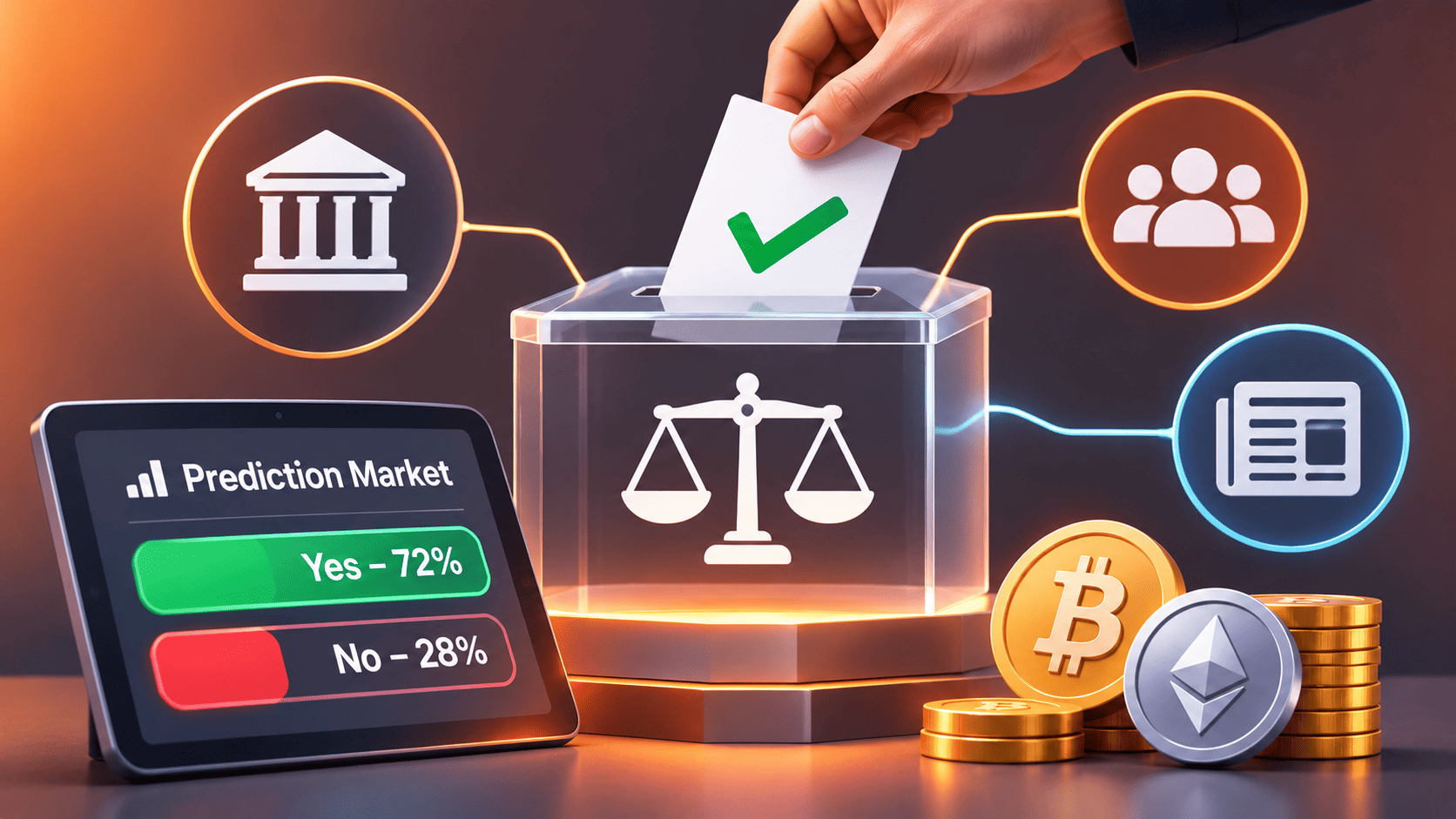
Prediction markets ask simple questions. Will a team win the league, will Bitcoin pass a price, will a game launch on time? The answer can be far harder to settle, especially when an event ends in a grey area.
Every market relies on a resolution process that names who checks the outcome, which sources count and what happens when people disagree.
Here is who settles prediction market outcomes, the main resolution models in use and what to check before buying a position.
Three Resolution Models
Platforms resolve markets in different ways, and the table compares the main models.
|
Model |
Who decides |
Strengths |
Watch for |
|
Platform team |
The operator's own staff |
Quick, clear accountability |
Appeal routes vary |
|
Decentralised oracle |
Proposers and token-holder votes |
Open process, public disputes |
Disputes can take days |
|
Regulated exchange |
Exchange rules under a regulator |
Formal oversight |
Limited market range |
Last verified: November 2026
In the United States, event contracts traded on regulated exchanges fall under the CFTC's oversight, which regulates them by structure, whatever outcome they predict.
Decentralised Resolution in Practice
Oracle systems such as UMA ask an approved proposer to post an answer with a bond. Anyone can challenge it during a two-hour window, and disputed questions go to a token-holder vote.
Such a process makes disputes public, yet it can delay payouts for days when someone contests an outcome.
Resolution Sources Matter
Markets name a source in advance, such as an exchange price at a set time or an official league result. Vague wording, such as "credible reports", leaves more room for argument. Market pages use specialist resolution terms that a glossary can decode.
Checks Before Buying
Read the market rules for the resolution source, the end time and the resolution deadline. Check how ties or cancelled events resolve, since some markets split 50-50 and others void.
Positions can often be sold before resolution, and selling early avoids waiting on a contested outcome, though prices may move against the seller.
Dexsport's Resolution Rules
Dexsport publishes a market period, end time and resolution deadline on every prediction market page, and its team validates results within 24 hours of the event. Some markets name a precise source, such as a Binance XRP/USDT one-minute candle at a set time, with a 50-50 split on an exact tie.
Settlement on Dexsport prediction markets happens only in stablecoins, with each winning share paying one stablecoin dollar. Event contracts appear beside its sportsbook, and a comparison of event contracts next to match odds shows how platforms combine the two.
Conclusion
Platform teams, decentralised oracles and regulated exchanges all settle prediction market outcomes, with different strengths and trade-offs. Named resolution sources, such as an exchange price or an official league result, reduce disputes, while vague wording invites them.
Decentralised systems make disputes public but can slow payouts, and platform teams settle quickly with appeal routes that vary. Dexsport publishes resolution deadlines and validates results within 24 hours, with named sources on many markets.
Read the resolution rules before buying any position. Rules on prediction markets vary by country, so check yours, take part only at legal age and remember that KYC or AML checks may apply.
Disclaimer: The information here is provided for general purposes only and is not legal, tax, investment, or financial advice. Prediction market rules, resolution sources and platform licences change over time and vary by country, so check each market's current rules before you buy. Prediction markets involve risk, and stablecoins carry issuer risk. Please take part responsibly, within your means, and only if you are of legal age.