

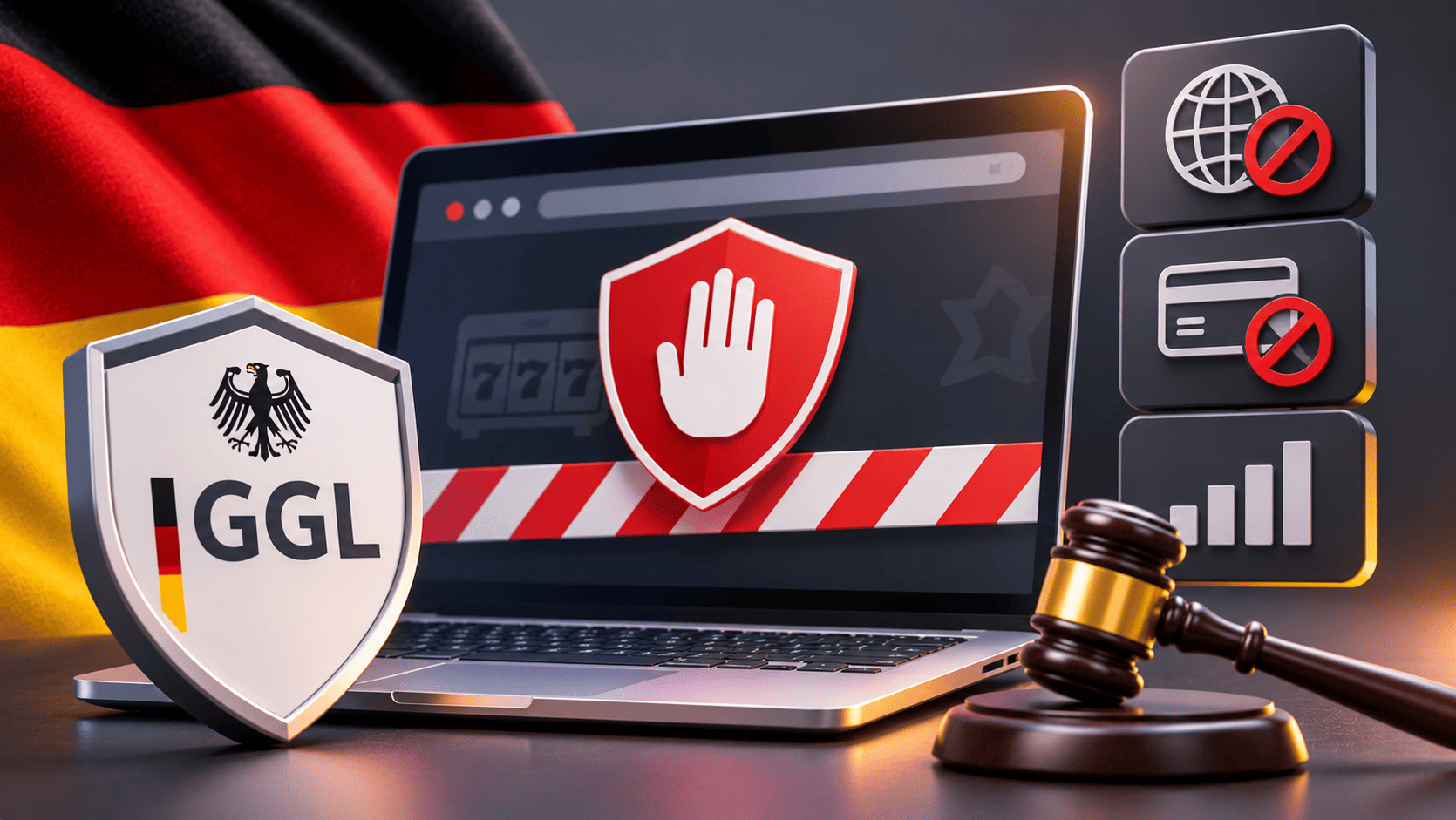
Germany's gambling regulator fights unlicensed sites on two fronts. It orders websites blocked so they cannot load from Germany, and it cuts them off from the payment routes they need to take German deposits.
Both tools have expanded sharply since the GGL began work, though a 2025 court ruling limited how far blocking orders can reach.
Here is how network and payment blocking work, what the latest figures show and what German fans living abroad should take from them.
Two Enforcement Tools
Network blocks and payment blocks attack illegal sites from different angles, and the table compares them.
|
Tool |
Target |
Effect |
|
Network blocking |
Hosts and other intermediaries |
The site stops loading from Germany |
|
Payment blocking |
Banks and payment providers |
Deposits and withdrawals through established routes stop |
|
Prohibition orders |
The operator itself |
Formal ban on offering gambling in Germany |
Last verified: November 2026
The GGL's five-year review counted 1,843 illegal websites blocked from German access by the end of 2025, alongside 178 sites cut off from established payment routes.
Enforcement in Numbers
Prohibition proceedings rose from 68 in 2022 to 287 in 2025, more than four times the earlier figure. The GGL has checked about 6,300 websites for illegal offers or related advertising since it began.
By the end of 2025, 254 illegal providers had stopped offering gambling to German players. The regulator estimates that about 77% of the online gambling market now passes through licensed channels.
Licensed Side
The whitelist held 129 licensed operators with 229 approved websites as of September 2026, and the GGL has revoked two licences so far.
Court Ruling of 2025
Germany's Federal Administrative Court ruled in March 2025 that the GGL lacked a legal basis to order an internet reseller to block gambling sites, since it was not responsible for the content.
The GGL responded by focusing on host providers, whose duties now fall under the EU Digital Services Act.
A Treaty Amendment in Progress
Germany's states agreed a treaty amendment that would let the GGL order access providers to block sites when action against the operator fails. It takes effect the day after the last state ratifies it.
What Blocking Means for Players
Payment blocks can make deposits at unlicensed sites fail or bounce back, and network blocks can make a site vanish mid-session. Players at blocked sites also lose any German route for complaints.
Licence checks before depositing avoid most of those problems, and the steps for verifying a licence take minutes.
Regional restrictions explain why some titles vanish from licensed lobbies.
German Fans Abroad
Germans living abroad follow their host country's law, and GGL blocks affect access from Germany alone. Players at any site should also understand what happens to balances if a licence ends.
Dexsport Lacks a GGL Licence
Dexsport has an Anjouan licence through Dexapp LTD and is absent from the German whitelist. Residents of Germany should use a whitelisted operator.
For German fans abroad where local law permits offshore betting, Dexsport publishes a complaints route through email, negotiation and London arbitration. Dexsport restricts players from Russia and Belarus under its terms.
Conclusion
Germany blocks illegal gambling sites through network blocks, payment blocking and prohibition orders. By the end of 2025, the GGL had blocked German access to 1,843 illegal websites and cut 178 off from established payment routes.
Prohibition proceedings more than quadrupled between 2022 and 2025. Germany's federal administrative court limited blocking orders against access providers in 2025, and a treaty amendment awaiting ratification would restore that power. Offshore books such as Dexsport lack GGL approval for residents.
Residents of Germany should use whitelisted operators. Fans abroad should check the law of their host country, bet only at legal age and remember that KYC or AML checks may apply.
Disclaimer: The information here is provided for general purposes only and is not legal, tax, investment, or financial advice. German gambling law, enforcement figures, treaty amendments and platform licences change over time and vary by country. Residents of Germany should use GGL-licensed operators. Betting involves risk, so check the law where you live. Please bet responsibly, within your means, and only if you are of legal age.