

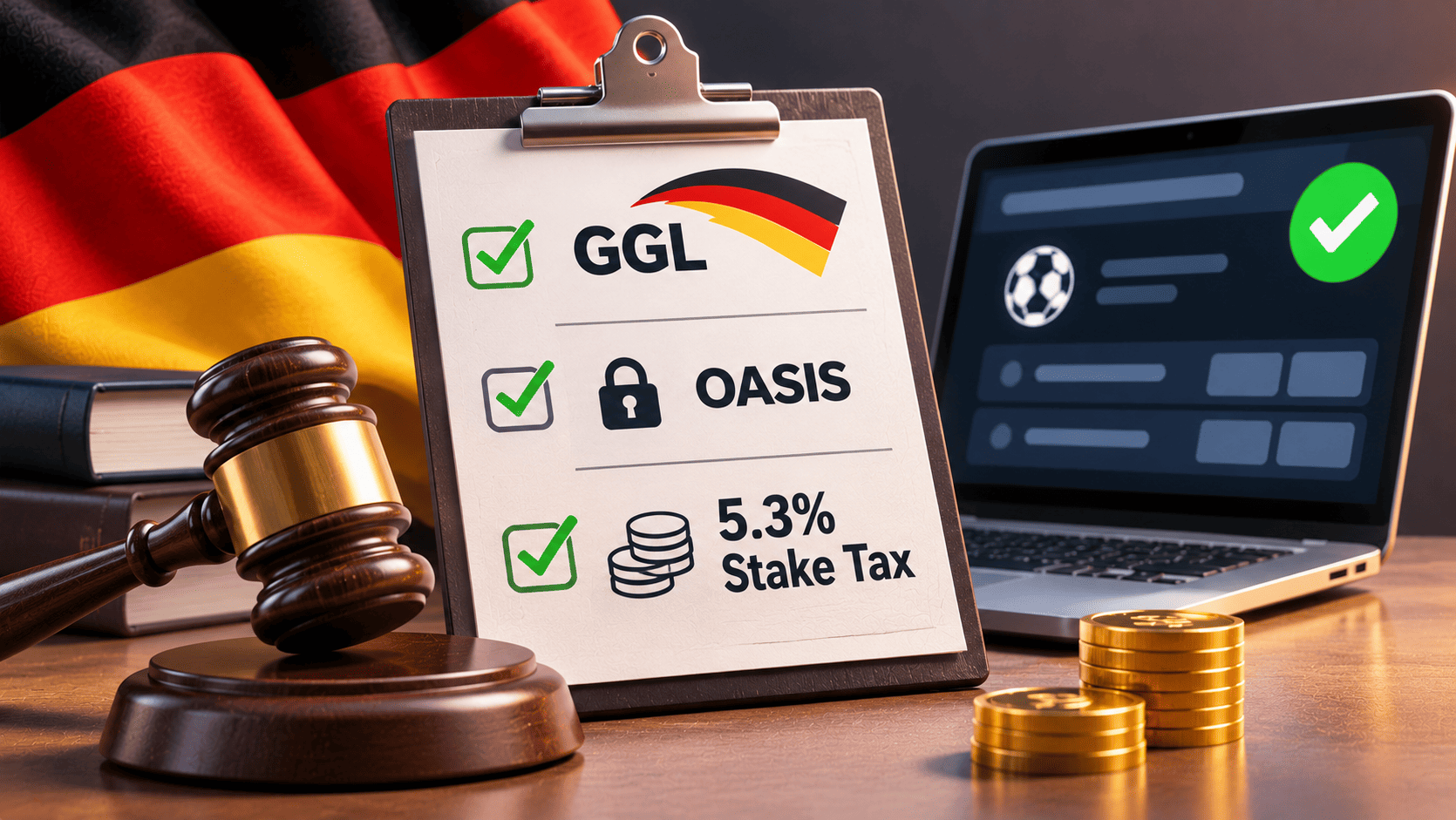
German sports betting rests on three pillars that shape every licensed bet. One regulator keeps a public list of approved operators, a national register blocks self-excluded players, and a federal tax takes a slice of every stake.
Together they explain why German betting slips look the way they do, from lower payouts to identity checks before the first bet.
Here is how the GGL whitelist, the OASIS register and the 5.3% stake tax work, and what German fans living abroad should keep in mind.
Pillars at a Glance
Owners and purposes differ, and the table sums them up.
|
Pillar |
Owner |
What it does |
|
Whitelist |
Gemeinsame Glücksspielbehörde der Länder (GGL) |
Lists every operator licensed for online gambling in Germany |
|
OASIS |
Regierungspräsidium Darmstadt |
Blocks self-excluded and externally excluded players across all licensed operators |
|
Stake tax |
Federal tax law |
Charges 5.3% on each sports bet stake |
Last verified: November 2026
German law sets the sports betting tax at 5.3 percent of the tax base, which is the stake actually paid minus the tax itself.
The GGL Whitelist
The GGL licenses operators and publishes their names, so players can check a site before depositing. Whitelisted sports betting sites must apply the stake limits, deposit caps and identity checks set by the 2021 State Treaty on Gambling.
Public registers exist in other jurisdictions too, and a list of public registers shows where to verify licences elsewhere.
OASIS Register Explained
Licensed operators must query OASIS before every session. The register held about 367,000 active exclusions in early 2026, and operators sent more than 5.2 billion queries during 2025.
How Self-Exclusion Works
Players can request an exclusion themselves, and family members or operators can trigger one in some cases. Licensed sites must refuse play for anyone on the list.
How the Stake Tax Shows Up
Operators handle the tax in two main ways. Some deduct 5.3% from each stake, while others absorb it and reflect the cost in their odds.
Bettors comparing German prices with offshore lines should keep that difference in mind, since the tax reduces returns on every licensed slip.
German Fans Abroad
Germans who have moved away follow the rules of their new country, since the whitelist, OASIS and stake tax cover betting from inside Germany. Self-exclusion offshore depends on each platform, and published cooling-off settings vary widely.
Dexsport and German Rules
Dexsport operates outside the German system, with an Anjouan licence through Dexapp LTD, no GGL licence and no OASIS link. People living in Germany should choose a whitelisted book.
For German fans abroad where local law allows offshore betting, Dexsport names bundesliga.de among its settlement sources. Anjouan-licensed books follow their own licence requirements, and Dexsport accepts self-exclusion requests sent to its support address.
Conclusion
Germany's betting rules rest on the GGL whitelist of licensed operators, the OASIS exclusion register and a 5.3% tax on each sports bet stake. Together they shape how licensed slips look, who may play and what each bet costs.
OASIS held about 367,000 active exclusions in early 2026, and licensed operators either deduct the tax or build it into prices. Offshore books such as Dexsport fall outside all three pillars.
People in Germany should stick to the whitelist. Supporters abroad should review local law, stake only once of legal age and allow for the fact that KYC or AML checks may apply.
Disclaimer: The information here is provided for general purposes only and is not legal, tax, investment, or financial advice. German gambling law, tax rules, the GGL whitelist and platform licences change over time and vary by country. Residents of Germany should use GGL-licensed operators. Betting involves risk, so check the law where you live. Please bet responsibly, within your means, and only if you are of legal age.