


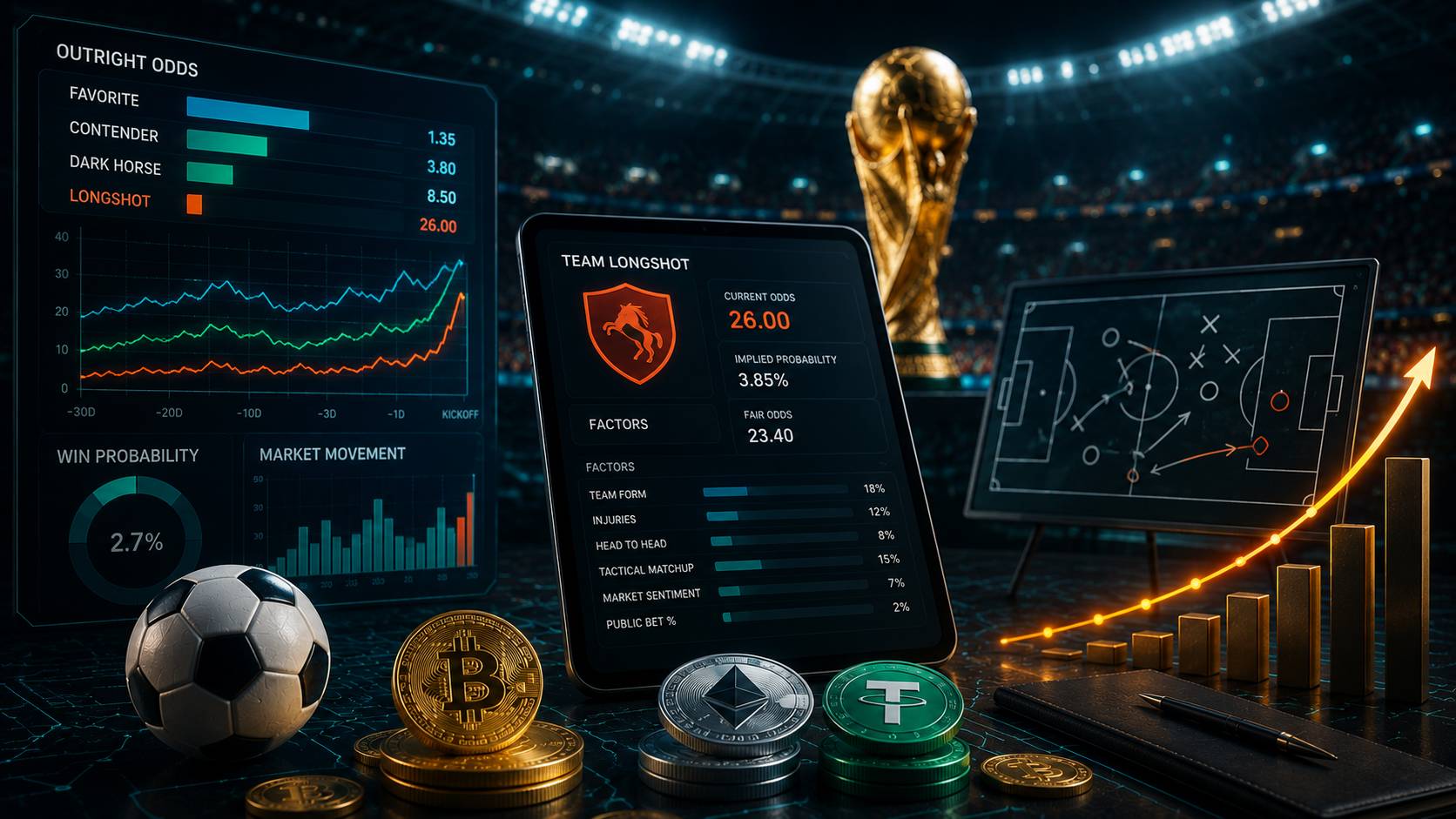
A longshot price looks like the book's honest opinion of an upset. It is not. It is that opinion with a deliberate cushion added, and the cushion is thickest exactly where the payout looks most tempting.
Understanding that distance is not a route to beating the market. It is a way of reading a Final's underdog price for what it actually is: a commercial number shaped by how a book manages its own uncertainty, not a forecast of how likely the upset is.
Every Price Starts as a Probability, Then Gets Padded
Odds convert to probability by simple arithmetic. Divide one by the decimal price and you get the implied probability, the chance that price represents. Do that for every outcome in a market and the total should be 100%.
It never is. The sum always exceeds 100%, and the excess is the bookmaker's margin, known as the overround, the vig, or the juice. A market where the implied probabilities add to 105% carries a 5% margin, which is the book's built-in edge regardless of who wins.
For a football match-result market, a margin under 3% is unusually sharp, 3% to 5% is competitive, and 5% to 7% is typical of a traditional book. That excess is the price of playing, and it applies to favourites and underdogs alike.
The Padding Is Not Spread Evenly
Here is the part that shapes a long shot. Books do not apply their margin uniformly across a market. They load a smaller share onto favourites and a disproportionately larger share onto outsiders.
The reasoning is commercial and openly documented. Bettors who focus on favourites are price-sensitive and will simply not bet a poor number, which forces books to keep those prices competitive.
Bettors drawn to a big underdog are far less price-sensitive, because the appeal is the size of the potential payout, not the precision of the odds. A book can shade a long shot and still take the bet.
|
Outcome type |
Margin loaded |
Why |
|
Short-priced favourite |
Smaller share |
Price-sensitive money forces competitive numbers |
|
Mid-range price |
Moderate share |
Mixed demand, moderate liability |
|
Long-priced outsider |
Larger share |
Payout appeal outweighs price scrutiny |
Books Shorten Longshots to Protect Their Own Modelling
There is a second reason, and it is more interesting than commercial cynicism. Rare events are genuinely hard to price. The difference between a true 1% chance and a true 1.5% chance is enormous in payout terms and nearly invisible in the modelling.
A book that misprices a favourite by a fraction is out a little. A book that misprices a longshot is exposed to a payout many multiples of the stake it took. So books quote longshots shorter than a neutral model would, building a buffer against their own uncertainty. The cushion is insurance, not malice.
This pattern has a name and a long paper trail. The favourite-longshot bias has been documented in betting markets since 1949, and it holds across football, tennis, and horse racing with enough consistency that researchers treat it as a structural feature of fixed-odds pricing.
Published Margin Understates the Longshot Cost
One finding is worth stating plainly, because it cuts against the standard advice. Bettors are often told to calculate the overround to work out their expected loss. That calculation is a floor, not an estimate.
Because margin sits unevenly, actual loss rates on football markets run roughly a fifth higher than the overround formula implies across large datasets.
The published margin describes the market; it understates what the longshot end of that market actually costs. Anyone reading a big Final price as "the book thinks this is a 6% shot" is reading a number that has already been trimmed.
None of This Is a Strategy
The mechanics above describe pricing. They are not a strategy, and treating them as one is where bettors get into trouble.
-
It does not mean favourites are profitable: the margin still applies to them, just less of it. Backing favourites blindly loses too, only more slowly.
-
It does not identify a mispriced longshot: knowing the padding exists says nothing about which outsider is underpriced on a given night.
-
It is a pattern, not a law: reverse cases are documented in some markets, so the bias is a tendency across large samples, not a rule about any single Final.
-
It does not change variance: an upset either happens or does not, and no amount of pricing theory shifts the football.
-
It does not survive contact with a hunch: the bias is strongest precisely where the story is most compelling, which is where a Final longshot lives.
Spain's opponent on Sunday will be priced by these mechanics, and so will Spain. Neither price is a prediction, and the reason two books can show different numbers on the same match is that each is managing its own margin and liability, not converging on a truth.
Where Dexsport Fits the Pricing Question
Dexsport carries more than 100 markets per match, which is the practical relevance here: a longshot is one option among many on a Final, and market depth is what lets a bettor see the full spread of prices instead of just the eye-catching one. Cash Out is available on eligible bets.
Its structural difference is in what happens after the price is struck. Dexsport is non-custodial, so funds settle to a wallet the bettor holds, and bets post to a public on-chain desk where the price taken and the outcome are both recorded.
CertiK and Pessimistic have both audited the underlying smart-contract code.
One boundary matters especially on this topic. Dexsport is a hybrid: settlement is recorded on-chain, but odds are set off-chain, exactly as described above. On-chain betting makes the record verifiable; it does not remove the margin from the price or make an underdog's number more honest than anyone else's.
Reading an Underdog Price Without Romance
A Final longshot is the most emotionally appealing number on the board and the most heavily loaded. That is not a coincidence; it is the design. Books price outsiders defensively because rare events are hard to model and because the people betting them rarely argue about the price.
None of this tells anyone what to back. It explains why the tempting number is tempting, which is a more useful thing to know than a tip.
Confirm what is legal where you live, keep stakes within a set budget, and play only if you are of legal age, since KYC or AML checks may apply. Responsible gambling matters most on exactly the bets that feel like a story worth telling.
Disclaimer: The information here is provided for general purposes only and is not legal, tax, investment, or financial advice. This article explains how odds are constructed and is not betting guidance or a prediction. Odds and margins vary by book and move constantly, so confirm current markets before betting. Betting carries risk, and rules vary by country, so check the law where you live. Please gamble responsibly, within your means, and only if you are of legal age.