

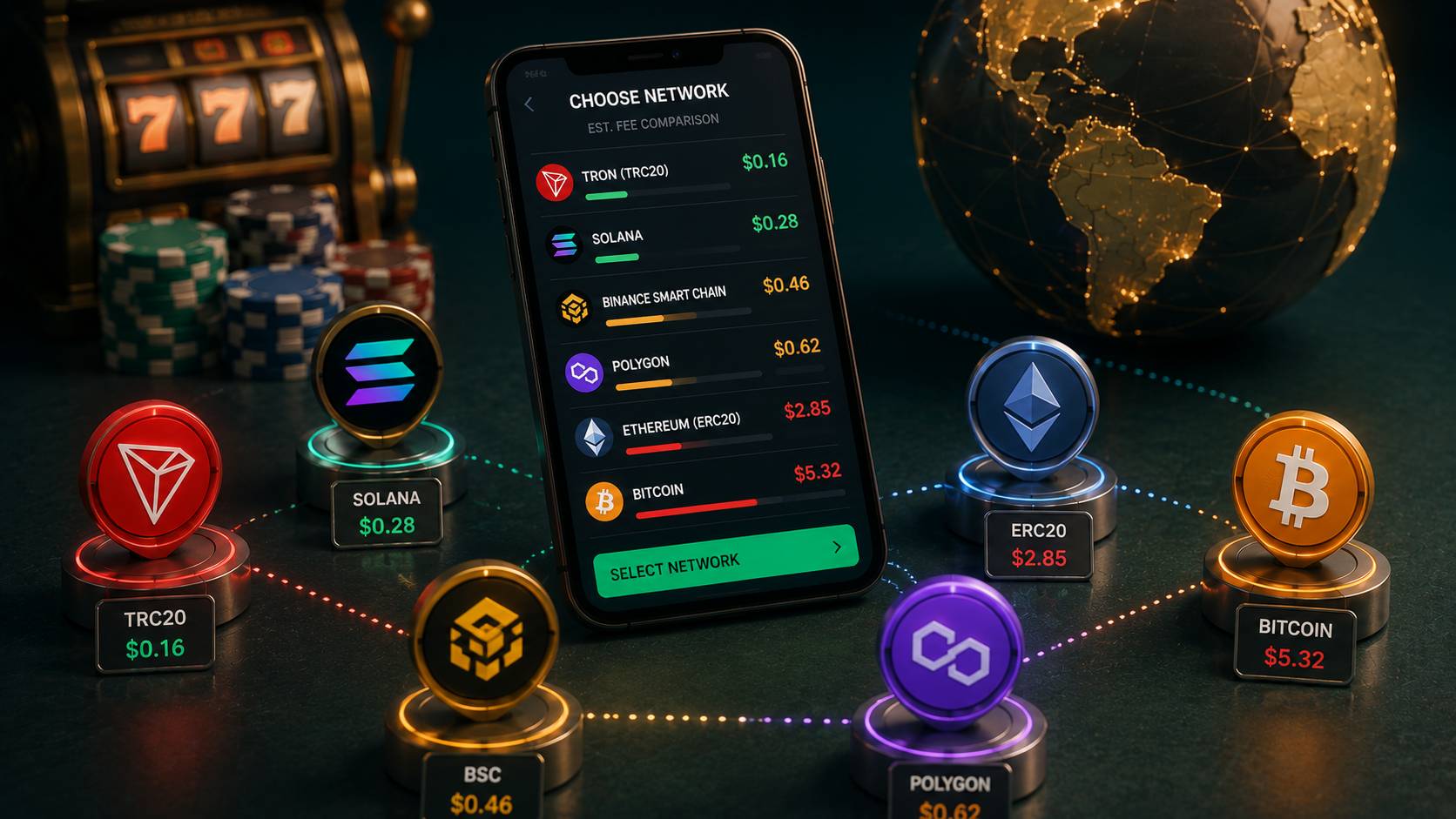
Funding a crypto casino balance with $50 can cost a fraction of a cent or several dollars, and the only thing that changes is the network the coin travels on.
That spread is the whole point of choosing a chain deliberately: the same deposit, the same casino, and the same coin can carry wildly different network fees depending on the blockchain it moves across.
For a player making frequent, smaller deposits, that difference adds up fast, which is why the network is worth a moment's thought before every transfer.
Network Fee and Casino Minimum Are Two Different Costs
A deposit carries two separate costs, and confusing them leads to the wrong fix. The network fee goes to the blockchain that processes the transfer, and the casino does not set it or receive it. The casino may set a minimum deposit, which is a different thing entirely.
That split matters because the network fee is the one a player controls by choosing a chain, while the minimum is fixed per coin in the cashier.
Lowering the cost of funding a balance is almost always about the network, not the casino, and a player who wants to keep more of a deposit on the table starts there.
The Same Deposit Costs Wildly Different Amounts by Chain
Network fees vary by orders of magnitude, and the spread is widest between the oldest chains and the newer high-throughput ones. The table sets typical costs for a standard transfer under normal conditions, the kind of figure that funds a casino balance.
|
Network |
Typical transfer fee |
Note |
|
Solana |
Under $0.01, often a fraction of a cent |
Among the lowest available |
|
Polygon |
Roughly $0.001 to $0.10 |
Ethereum-compatible, low cost |
|
Tron (TRC-20) |
Around $0.20 to $1.40 |
Cheaper with rented energy; wide USDT support |
|
Bitcoin |
Roughly $1 to $20, auction-based |
Rises with network demand |
|
Ethereum (ERC-20) |
Roughly $2 to $10, higher when busy |
The costliest for small transfers |
These are typical ranges, not fixed prices, and any congestion-sensitive chain like Bitcoin or Ethereum can spike well above them during busy periods. Treating them as a starting point and checking current conditions before a transfer is the honest way to read the table.
Small Deposits Feel the Fixed Fee Most
A network fee is usually a flat cost per transaction, not a percentage, and that changes the maths depending on how much a player is moving. A fee of a dollar is trivial on a $500 deposit and painful on a $10 one, where it swallows a tenth of the transfer before play even starts.
The practical read follows from that. A player who funds a balance in small, frequent amounts has the most to gain from a low-fee chain, since the fixed cost lands on every single transfer.
Someone making one larger deposit feels it far less, which is why the size and rhythm of a player's deposits matter as much as the chain itself.
A Low-Fee Chain Only Helps If the Casino Supports It
A low fee is worthless if the transfer cannot land. The network a player picks has to be one the casino actually accepts for that coin, and it has to match the address the cashier provides, since a coin exists as a separate token on each chain it runs on.
Two checks keep the saving real instead of costly:
-
Confirm the casino supports the network: the lowest-fee chain is only an option if it appears in the cashier for the coin being sent.
-
Match the coin and network on every send: a stablecoin sent over the wrong network, such as a Tron-based token to an Ethereum address, is usually lost with no recovery.
Fee-chasing that ignores those checks costs far more than it saves, since a lost transfer is a total loss, not a high fee. The network match matters more than the fee every time.
Dexsport and the Network-Fee Question
Dexsport spans more than 50 cryptocurrencies across 23 networks, so a player can usually fund a balance on a low-fee chain like Solana or a Tron-based stablecoin instead of a costlier one, choosing the network to suit the deposit.
Its cashier is fee-free at the operator level, so the platform adds no charge above the network fee, and because it is non-custodial, a withdrawal settles back to a wallet the player holds on whichever supported chain they pick.
The breadth of networks is the practical point for cost: more low-fee routes to choose from on the way in and the way out.
Read fee-free precisely, though. It describes the operator's charge, not the blockchain's, which still bills the per-chain fee on every transfer regardless of the platform.
Choosing a Chain Without Overthinking It
Picking a low-fee chain to fund a balance comes down to a short sequence: see which networks the casino supports for the coin held, favour a low-cost one for frequent small deposits, and match the network exactly on every send.
A stablecoin on Solana, Polygon, or Tron usually keeps the cost near zero for the amounts a casual player moves.
None of this changes the odds or the house edge, which sit apart from the cost of funding a balance.
Confirm what is legal where you live, keep stakes within a set budget, and play only if you are of legal age, since KYC or AML checks may apply. Responsible gambling matters more than shaving a few cents off a transfer.
Disclaimer: The information here is provided for general purposes only and is not legal, tax, investment, or financial advice. Network fees and platform terms vary and change over time, so confirm current details before depositing. Betting carries risk, and rules vary by country, so check the law where you live. Please gamble responsibly, within your means, and only if you are of legal age.