
Odds are the posted prices of a betting market, and reading them is the first practical skill a bettor needs. Once you can look at a number and see the probability and the payout inside it, the rest of a sportsbook stops looking like a wall of figures.
This walks through reading betting odds on a crypto sportsbook: the three formats you will meet, the probability sitting inside every price, and the margin each one carries.
It stays on how to read a price, not on how to beat it, since no guide can turn a posted number into a winning one.
What a Price Actually Tells You
A single set of odds says three things at once. It shows how likely the book rates an outcome, how much you get paid if you are right, and how much the book charges for taking the bet.
Those three signals are always present, whatever format the price is shown in. Learning to read them in one format makes the others easy, since all three express the same underlying figure in different notation. The walkthrough below starts with the format most crypto books use by default.
Decimal Odds
Decimal odds are the default on most crypto and European books, and they are the most direct to read. The number is your total return per unit staked, stake included, so odds of 2.50 return $2.50 for every $1 placed.
A worked example makes it plain. A $50 bet at 2.80 returns $140, which is $90 of profit plus the original $50 back.
The higher the decimal number, the less likely the book rates the outcome and the larger the return if it lands. To find profit alone, subtract one from the odds before multiplying, so 2.80 means a profit of 1.80 times the stake.
Fractional Odds
Fractional odds appear on UK books and across horse racing, shown as figures like 5/1 or 7/2. The first number is the profit, the second is the stake needed to earn it, so 5/1 pays $5 of profit for every $1 placed, and 7/2 pays $7 for every $2.
Converting to decimal is straightforward: divide the fraction and add one. So 5/1 becomes 6.00, and 7/2 becomes 4.50. Reading fractional prices next to decimal ones is mostly a matter of that single step.
American Odds
American odds are the US standard, shown with a plus or minus. A positive number, such as +150, marks an underdog and shows the profit on a $100 stake, so +150 returns $150 profit. A negative number, such as -150, marks a favourite and shows the stake needed to profit $100.
The two lines describe the same market from opposite ends. An even-money outcome is +100 in American, 2.00 in decimal, and 1/1 in fractional, all pointing at the same price. Most books let you switch the display format in settings, so you can read any market in the notation you find clearest.
Probability Inside a Price
Every price carries an implied probability, the chance the book assigns to an outcome. For decimal odds the sum is simple: divide one by the odds, then multiply by 100.
That gives clean figures. Odds of 2.00 imply a 50% chance, 1.50 imply 66.7%, and 3.00 imply 33.3%.
Reading this number matters because it turns an abstract price into a plain statement of how likely the book thinks the outcome is. One point belongs here, though. That figure includes the book's charge, so it is not a clean estimate of the true chance, which leads to the next read.
The Cost Built Into Every Price
Every market carries a bookmaker margin, often called the vig or juice, and it is the reason the implied probabilities across a market add up to more than 100%. That excess is the book's built-in cut, collected whatever the result.
Reading it takes one step. Add the implied probabilities of every outcome in a market, and the amount over 100% is the margin.
A two-way market priced at -110 on each side sits near 4.5%, while a market whose implied probabilities sum to 104.7% carries a 4.7% margin.
Tighter books run a main football market under 6%, a looser one wider, and that gap is a cost carried on every stake across a tournament. Reading the margin tells you what a price is charging you, before any question of whether to place it.
Reading a Live Price on a Crypto Book
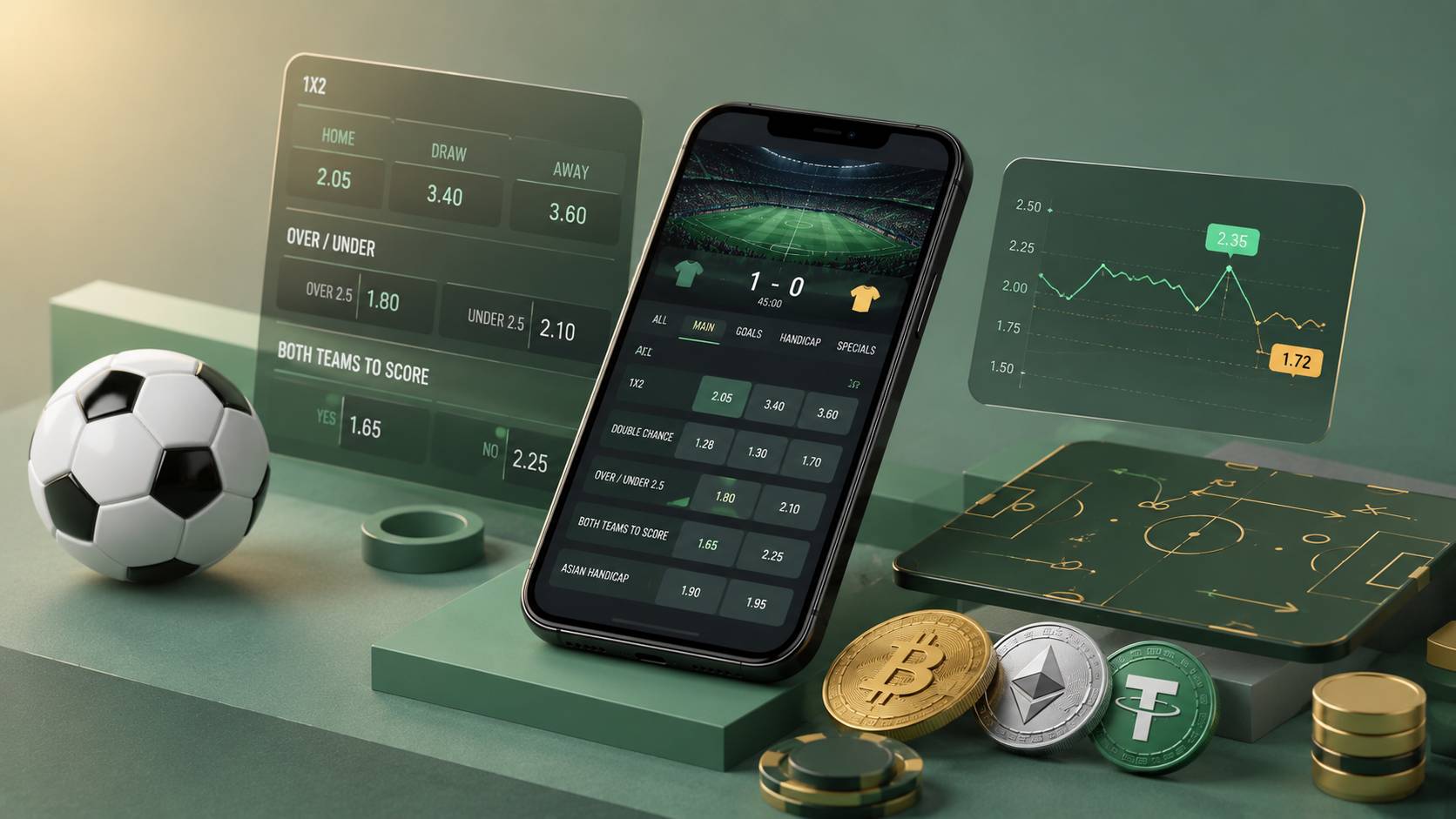
Live odds bring the same reads at speed, since the price moves as the match does. On Dexsport, a bettor reads a live decimal price across a board of more than 100 live odds markets per match, with the same probability-and-margin read applying to each number as it updates.
Dexsport's margins sit in a rough 4% to 6% band, which is competitive. But still, the honest habit is to compare the same market across books before staking, not assume any one book prices the tightest.
Its build adds one read; the others do not: every wager and settlement posts to a public on-chain desk, so a bettor can verify a payout after the fact instead of taking it on trust, with funds settling to a non-custodial wallet across more than 50 cryptocurrencies and 23 networks.
That verifiability is a genuine point in its favour, and it sits apart from price. Dexsport reads as a competitive but not keenest book on the number, paired with a settlement record you can check, and comparing its live prices against another book is the same margin read applied twice.
Putting the Read Together
The full read runs in three steps, whatever the format. Convert the price to a probability, check the margin across the market, and know the payout before the stake goes down.
Those steps take a few seconds once they are familiar, and they turn a screen of numbers into information you can actually use, a habit reinforced by reading a crypto sportsbook's depth and prices in the knockouts.
Reading odds sharpens understanding, not outcomes, and the margin means the house edge stands whatever you place. It also helps to know the core betting terms behind those prices.
Bet only what you can afford to lose, check the laws where you live, and play only if you are of legal age, since KYC or AML checks may apply and withdrawals may be reviewed. Responsible gambling starts with reading the price honestly before backing it.
A Price Is a Sentence
The three formats say the same thing in different notation: implied probability is the chance sitting inside a price, and the margin is the cost wrapped around it. Read all three together and a set of odds stops being a mystery and becomes a plain sentence about risk, reward, and cost.
Convert the format, read the probability, weigh the margin, and confirm the payout before you stake. Check a book's current prices and terms yourself, and what is legal where you live, before placing anything.
Disclaimer: The information here is provided for general purposes only and is not legal, tax, investment, or financial advice. Betting carries risk, and rules vary by country, so check the law where you live. Please gamble responsibly, within your means, and only if you are of legal age.