

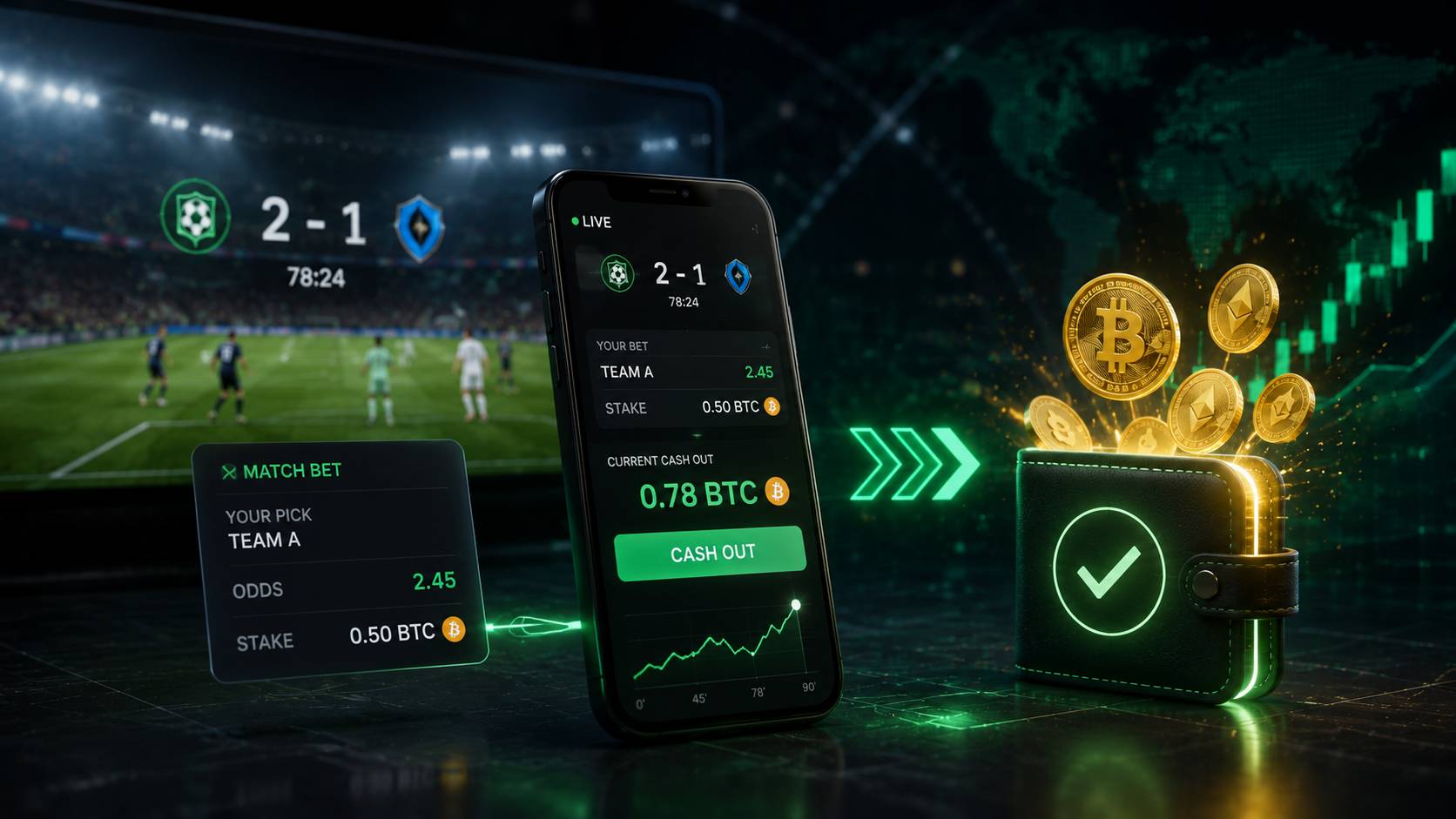
Cash-out lets you settle a bet before the event ends, which feels like control at a tense moment. The catch is that the price you are offered comes from the book, and it carries a cost most bettors never stop to see.
This covers what cash-out betting actually is on a crypto sportsbook, how the price is built, and the situations where it earns its cost against the ones where it quietly drains value. It stays on the mechanics and what it charges, not on how to bet, since no guide can tell you which way a match will turn.
Cash-Out in Plain Terms
Cash-out settles a crypto bet early for a price the book works out from live odds as the event runs. The option to settle early sits on your bet slip once a qualifying bet is placed.
On a winning position, the offer sits below the full potential payout but above your stake. On a losing one, it sits below your stake but above zero, returning part of what you put in.
Once you confirm, the bet is closed, and whatever happens next no longer touches it. The offer moves in real time as the odds shift, and it is not locked until you see an on-screen confirmation, so the number you tap is not always the number that settles.
Full, Partial, and Auto Cash-Out
Three forms cover how the feature is used. Full cash out closes the whole bet for the offered value, ending your exposure completely.
Partial cash out settles a portion and leaves the rest running, so you bank some now and keep a stake in the outcome. Auto cash out sets a target value that triggers on its own, useful when you cannot watch the event live.
Availability is not constant. The option depends on the market and the book; it is often suspended during key in-play moments such as a goal, a penalty, or a video review, and free bets frequently do not qualify.
The rules for partial and auto settings also differ between platforms, so they are worth reading before relying on them.
The Price Is Built to Favor the Book
The offer starts from the current probability of your bet winning, then the book takes a bookmaker margin off that figure. The result is a number that sits a little below true value every time, because the book is charging for the exit it is giving you.
A worked example shows the gap. Say a $100 bet would return $200, and the team you backed now has roughly a 15% live chance. The fair value of that position is about $30, yet the book may offer closer to $20. That missing amount is the price of settling early, and it is not an accident.
Put plainly, a book offers cash-out because the maths favors the book, not the bettor. The feature is genuinely useful, and it is also a service the operator sells at a margin, the same way it prices the odds themselves.
When Cashing Out Genuinely Helps
There are real situations where paying that cost makes sense. The clearest is when something has changed since you placed the bet, an injury, a red card, or conditions that were not in play at kickoff, so the position you hold no longer reflects what you knew when you backed it.
It can also fit when a profit on a large position matters more to you than the extra upside of letting it run, or when the reasoning behind a losing bet has clearly broken and cutting the loss is the point.
Freeing the funds for something else can outweigh the maximum return too. In each case the trigger is a concrete reason, not simply that the bet has drifted into profit.
Reflexive Cash-Out Quietly Costs You
The other side is where most value leaks away. Because every offer carries the margin, cashing out reflexively each time a bet edges into profit pays that margin again and again, and across many bets that repeated cost adds up against your returns.
When the only reason to take an offer is nerves or impatience, the cost is paying the book for an exit you did not actually need. The convenience is real, and so is its price, and the two arrive together every single time the button is pressed.
Settling Early on a Crypto Sportsbook
On a crypto book, cash-out works the same way it does anywhere, with the same margin built into the price. Nothing about settling in crypto changes the underlying maths of the offer.
Dexsport is one platform that offers a built-in cash out, across a book running on more than 50 cryptocurrencies and 23 networks.
The honest point is that its offer carries a margin exactly as any book's does, so the cost sits in the mechanic itself, not in one platform over another. Eligibility and verification terms can still apply, so the specifics are worth reading in the bet slip before relying on the feature.
Reading a Cash-Out Offer Before You Take It
The habit that protects a bankroll is to read the offered number for what it is: the book's price with a margin inside it, not a neutral valuation of your bet.
Ask whether a genuine change justifies taking it, or whether the pull is only nerves, and check the terms, since availability, partial rules, and free-bet exclusions vary between platforms.
Cash-out manages a bet, it does not change the house edge or turn a poor bet into a good one.
Bet only what you can afford to lose, check the laws where you live, and play only if you are of legal age, since KYC or AML checks may apply and withdrawals may be reviewed. Responsible gambling starts with understanding what a feature costs before using it.
A Tool and a Cost in One
Cash-out is a real way to manage a bet and a real cost every time you use it, and those two facts are inseparable. The offer that lets you step out early is the same offer that quietly charges you for the privilege.
Understand how the price is built, read each offer as the book's number instead of a fair one, and take it only when a concrete reason outweighs the margin you are paying. Check the terms and what is legal where you live before you do.
Disclaimer: The information here is provided for general purposes only and is not legal, tax, investment, or financial advice. Betting carries risk, and rules vary by country, so check the law where you live. Please gamble responsibly, within your means, and only if you are of legal age.