

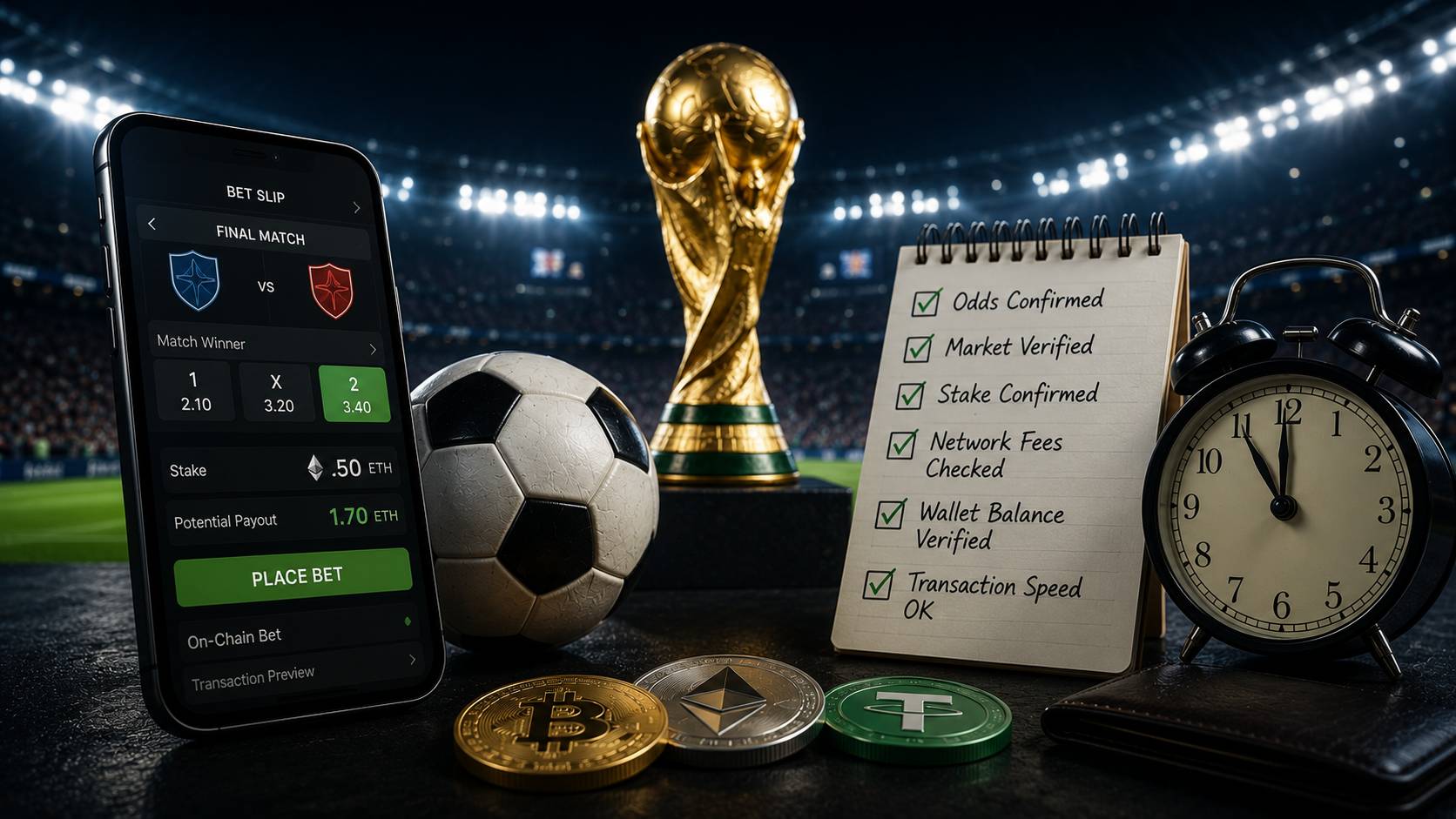
Forty minutes before a World Cup Final, a bettor with an unfunded balance and a Bitcoin wallet has already missed the bet. The transfer will eventually be confirmed, but eventually is after kickoff, and a market that closes does not wait for a blockchain.
This is the part of crypto betting that only bites under time pressure. Across a group stage, nobody notices, because there is another fixture tomorrow. On a Final, the closing window is the whole game, and the deciding factor is not the sportsbook. It is the chain the money is travelling on.
Block Time, Finality, and Credit Are Three Different Clocks
Most confusion here comes from collapsing three separate things into one number. A wallet showing "sent" is not the same as the network treating a transfer as irreversible, and neither is the same as a platform crediting a usable balance.
Block time is how often the network produces a block. Finality is the point at which a transaction cannot be reversed by a reorganisation. The required confirmation count is the platform's own rule about how many blocks it waits before your funds appear, and that rule is not negotiable by the person sending.
The third clock is the one that decides whether a Final bet lands, and it is the one bettors check least.
The Closing Window, Network by Network
The table sets typical figures under normal conditions. Every number stretches when a chain is congested, which a major sporting event makes more likely, not less.
|
Network |
Block time |
Typical credit to balance |
Last safe send before kickoff |
|
Solana |
~400ms slots |
15 to 30 seconds |
Minutes |
|
Tron (TRC-20) |
~3 seconds |
1 to 3 minutes |
Around 10 minutes |
|
Polygon |
~2.5 seconds |
Often ~5 minutes at checkpoint |
Around 15 minutes |
|
Ethereum (ERC-20) |
~12 seconds |
Minutes; 30+ when congested |
An hour, comfortably |
|
Bitcoin |
~10 minutes |
30 to 60 minutes, 3 to 6 confirmations |
Well over an hour |
The Bitcoin row is the one that ruins Final nights. A ten-minute block target sounds manageable until a platform waits for several confirmations, and a low fee attached to a transfer can leave it sitting in the mempool for hours while the match plays out without you.
An Underfunded Balance Is the Only Real Emergency
Everything else in a last-minute check is quick. The funding is not, which is why the sequence matters more than the checklist.
-
Fund first, decide later: a balance that is already sitting on the platform turns a last-minute bet into a two-tap decision.
-
Match the network before sending: a coin sent over the wrong network is usually gone, and time pressure is exactly when people misread a cashier.
-
Do not start a Bitcoin deposit inside the hour: if that is the only funded wallet, accept the bet may not happen instead of sending and hoping.
-
Check the market rule, not just the price: a match-result bet settles on the 90-minute score, so extra time and penalties do not count toward it, while a to-lift-the-trophy market covers the full result.
That last one is a Final-specific trap. In a match likely to go the distance, backing the same team in those two markets is backing two different outcomes.
Platform Traffic Peaks at the Same Moment
Timing is not only a chain problem. A Final concentrates a month of platform traffic into a few hours, and the cashier queues alongside everything else. A deposit that clears in a minute on a quiet Tuesday can take longer when every bettor on the platform is doing the same thing at the same time.
This is a reason to treat the published confirmation figures as a floor, not a promise. Build in margin, because the busiest hour of the year is not the moment to discover a chain's congestion behaviour.
Some Steps Sit Outside the Window Entirely
Some things are simply outside the window, and knowing which saves a frantic scramble.
A first withdrawal cannot be rushed, and a verification review triggered by activity or amount will run at its own pace, so a bettor who plans to deposit, bet, win, and withdraw inside the evening is planning around a step they do not control.
Meanwhile a wrong-network send cannot be recalled at all, and a market that has closed does not reopen because a transfer landed a minute late.
None of that is a platform failing. It is what a public blockchain and a regulated-adjacent cashier are, and the workable response is to move the funding earlier instead of expecting the last ten minutes to behave differently.
Where Dexsport Fits the Closing Window
Dexsport spans more than 50 cryptocurrencies across 23 networks, which is the practical lever here: a bettor holding a stablecoin can fund on a quick-settling chain like Solana or Tron instead of waiting on a Bitcoin transfer, and its cashier is fee-free at the operator level.
It carries more than 100 markets per match with Cash Out on eligible bets, and it is wallet-first and non-custodial, so a connected wallet is the account and funds settle back to a wallet the bettor holds.
Bets post to a public on-chain desk, so a wager struck in a rushed final minute is recorded somewhere a bettor can check independently of a busy dashboard.
The network clock still applies. Broad chain support widens the options for beating a closing window; it does not override how long a given blockchain takes to confirm, which belongs to the chain and not the book.
Betting a Final Without Racing the Chain
Last-minute Final bets fail on funding, not on judgement. The bettor who wins the closing window is the one who moved money hours earlier and spent the last ten minutes choosing a market instead of refreshing a block explorer.
Confirm what is legal where you live, keep stakes within a set budget, and play only if you are of legal age, since KYC or AML checks may apply.
A Final is exactly the fixture where a rushed decision costs the most, so responsible gambling matters more in that closing hour than at any other point in a tournament.
Disclaimer: The information here is provided for general purposes only and is not legal, tax, investment, or financial advice. Network confirmation times, platform rules, and fees vary and change with congestion, so confirm current details before depositing. Betting carries risk, and rules vary by country, so check the law where you live. Please gamble responsibly, within your means, and only if you are of legal age.