


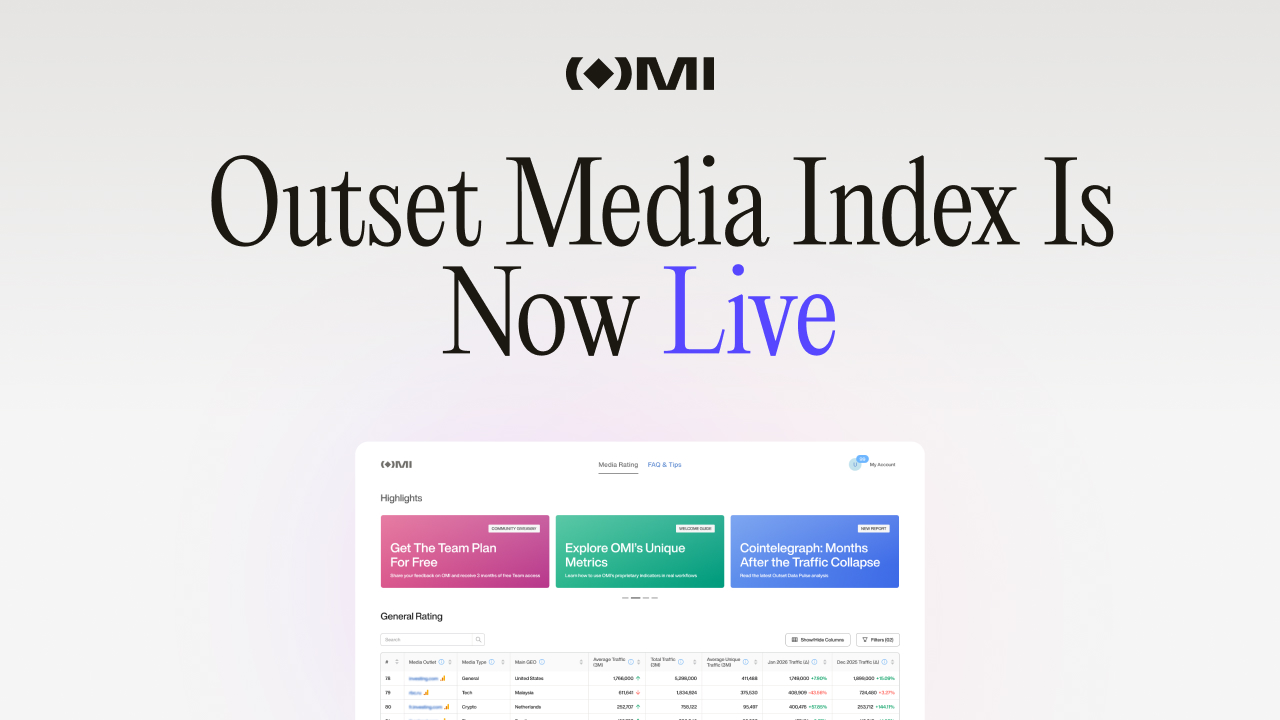
Outset Media Index, a structured media benchmarking platform built for advertisers, publishers and communications teams, announced its soft launch on March 12, 2026. The system currently tracks more than 340 crypto-covering publications and examines how they perform online across sectors such as blockchain, fintech, technology and general news.
Working out which news outlets actually carry influence has become less straightforward than it once was. A publication may show large traffic numbers for a headline and then lose readers quickly, while another reaches a smaller audience but keeps its stories circulating through search engines, aggregators and newsletters long after publication.
Outset Media Index, or OMI, was built to make that process far less time-consuming. Instead of piecing together information from multiple sources, it gives users a more convenient way to review and compare publications from a single interface – a change that can save hours of analysis for teams working with media every day.
The point becomes clearer when major media assets change hands. Earlier this year Axel Springer agreed to acquire the Daily Telegraph in a deal reportedly valued at about $770 million. The transaction highlights the continued importance of established news brands even as the economics of digital publishing become harder to interpret.
At the same time, acquisitions of that scale inevitably raise a broader question: what exactly defines the strength of a news organization today?
Part of the answer still lies in familiar indicators such as audience reach, reputation and subscription revenue, but those numbers rarely settle the question on their own. That makes judging the real weight of a publication harder than it used to be.
This is the kind of problem OMI is trying to solve and cut through the uncertainty. Early users are now testing the system and helping refine how the platform works in practice. If approaches like this take hold, they could start to determine how media strength is judged in the years ahead.
More About Outset Media Index
OMI uses a uniform methodology to analyze media outlets beyond standard traffic figures. The dataset combines information from external providers like Similarweb and Moz and internal research signals. Deeper insights come from several OMI-specific metrics that cover aspects such as where audience quality is higher, whether readership is growing or cooling down over time, how original coverage travels through the broader media space, how hard it is to submit an article to an outlet’s editorial team and more.
For advertisers, marketing teams and PR professionals, those signals help answer practical questions and build focused, KPI-aligned media lists for effective campaign planning and execution. Publishers themselves can examine the broader media landscape to understand their competitive positioning and shape growth strategies. Investors can make informed buying and selling decisions based on the actual value of a given media asset.
Overall, 37 parameters form OMI’s methodology and feed into its two summary scores. The General Score captures the overall picture of a publication: how large its audience is and how actively readers interact with the site. The Convenience Score looks at the experience of working with that outlet like editorial responsiveness, turnaround times and pricing relative to reach.
“We introduced the two scores because the dataset is quite large,” said Sofia Belotskaia, product lead at Outset Media Index. “General Score, for example, serves as an entry point into the index and helps users quickly grasp how publications differ.”
Before rankings are calculated, the system standardizes the data so outlets can be compared using the same criteria. OMI’s methodology is intentionally transparent and publicly documented. All indexed publications are ranked based on what real data shows and cannot be influenced financially.
In practice, users can benchmark outlets through a table interface where media brands appear side by side. Filters allow teams to compare publications by sector, audience size or other impact-driven parameters. Each publication can also be opened on a separate profile page that shows more detailed information about the site and its metrics.
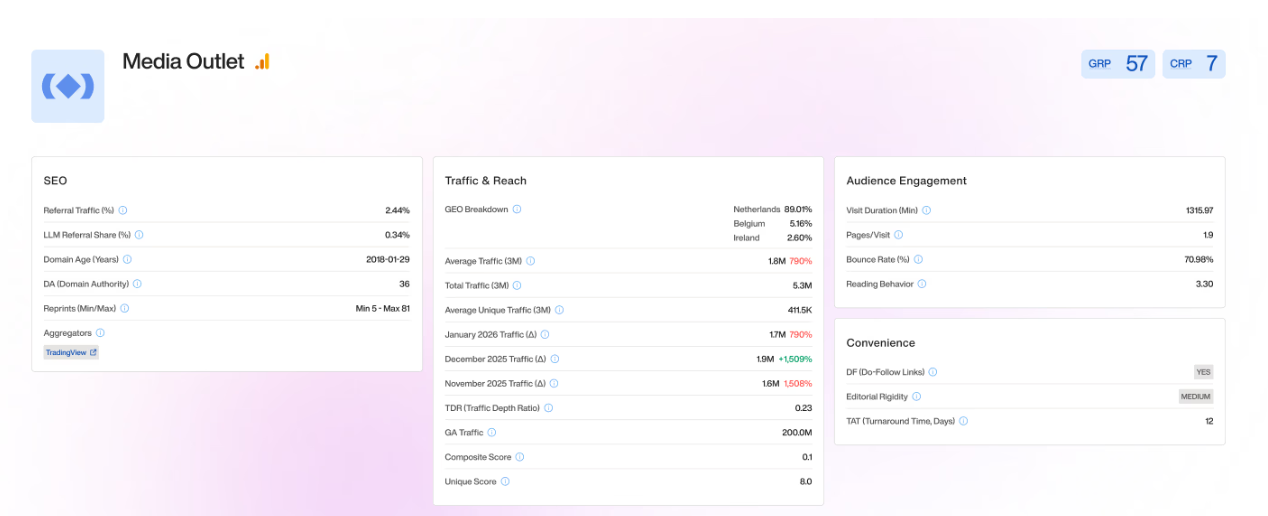
Source: omindex.io
Outset Media Index is part of the Outset PR data-led infrastructure. Within that system, it functions as a standalone analytics framework designed to make media analysis fair, repeatable and reliable at scale. The dataset is also supported by Outset Data Pulse, a series of reports that translate the index’s signals into a professional interpretation of media trends and actionable insights for teams launching campaigns globally.
While OMI focuses on individual outlets, ODP looks at the industry from a wider angle. Using the same dataset, it studies broader movements in traffic, engagement and distribution across the media market.
“The idea was not just to collect data, but to build a structure around it,” said Mike Ermolaev, founder of Outset Media Index and Outset PR. “Once you have a consistent dataset, you can start asking bigger questions about how the industry works.”
Large media acquisitions often force teams to confront those questions directly. Together, OMI and ODP break down what’s happening in the complex media market and explain what its numbers actually mean.