



The latest U.S. edition of Outset Data Pulse by Outset PR surfaces a single number that explains more about the structure of American crypto media than any ranking or headline could on its own. The Gini coefficient of 0.62 reveals how unevenly reader attention is distributed across U.S. crypto-native publishers in Q4 2025.
For comparison, U.S. household income inequality sits closer to 0.48, meaning visibility in crypto media is more concentrated than income in the American economy, pointing to a structural condition rather than a temporary imbalance.
A score of zero would indicate a balanced ecosystem where publishers capture similar readership, while a score approaching one would signal extreme concentration. At 0.62, the American crypto press sits firmly in the latter category, showing that attention does not circulate freely but accumulates and once accumulated, compounds.
What makes this concentration especially notable is that it persists even as broader market interest cools. Loyal readers now define visibility in this market. Instead of chasing headlines or relying purely on algorithms, U.S. audiences are returning to the same trusted crypto outlets week after week. Direct visits accounted for roughly 44% of all traffic in Q4, which shows that habitual readership, not discovery spikes, is what actually stabilized U.S. crypto publishers as broader interest cooled.
During the same period, mainstream financial media traffic fell 14%, yet crypto-focused publishers largely held their footing. This resilience contrasts with other regions: Asia’s crypto media ecosystem remains dominated by exchange-anchored information flows, while in Latin America only 28% of crypto outlets recorded growth.
An Oligopoly Formed by Scale, Not Editorial Merit
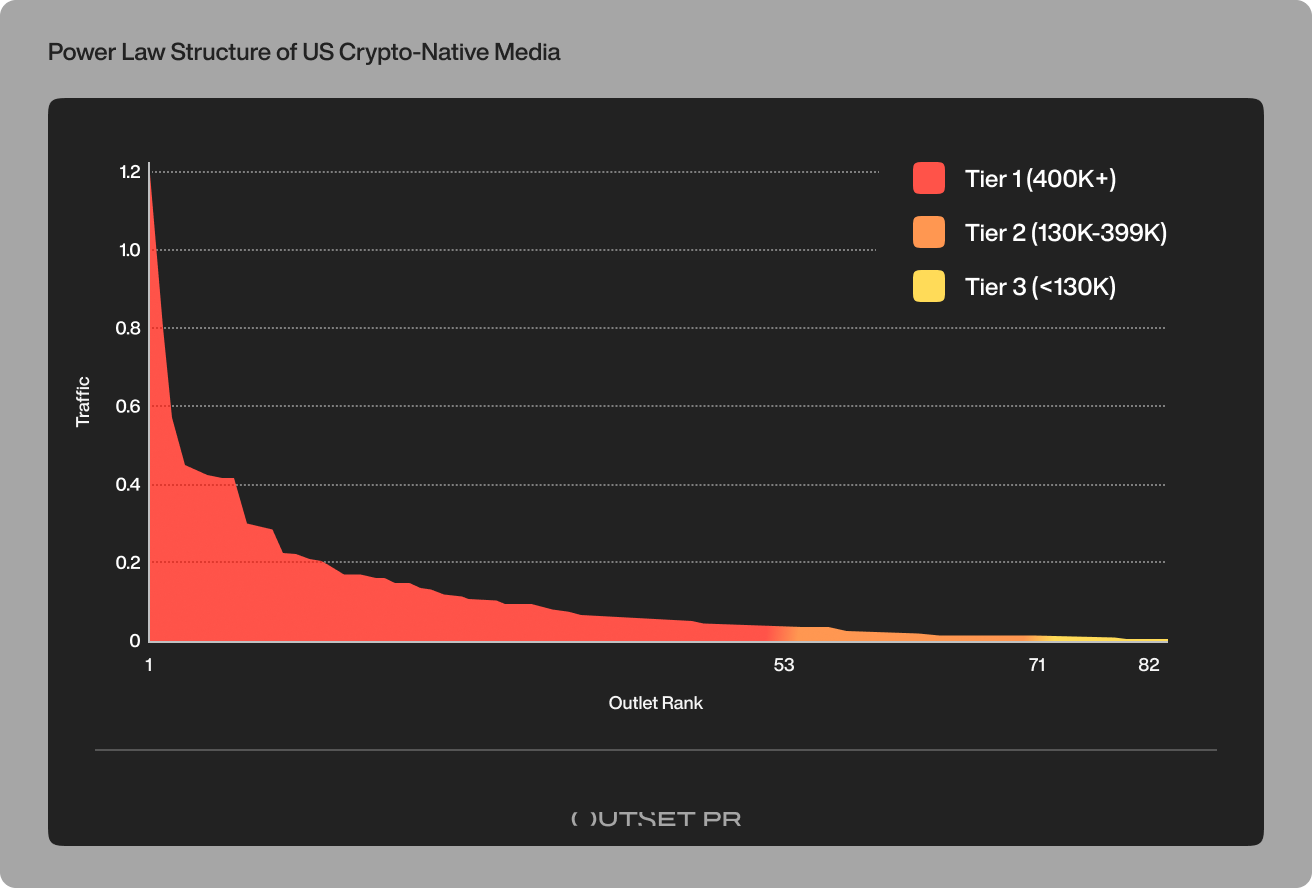
Outset PR’s tier analysis makes this inequality concrete. Of 82 U.S. crypto-native outlets, just 53 tier-1 publishers, each generating more than 400,000 monthly visits, account for 95% of total traffic, representing over 101 million Q4 visits combined.
Mainstream financial outlets were analyzed separately and are not included in this tiering, as their traffic is driven by broader news ecosystems rather than crypto-specific discovery.
The remaining 29 outlets share less than 5% of demand, with 18 tier-2 publishers controlling only 3.8% of traffic and 11 tier-3 outlets accounting for just above 1%.
Source: Outset Data Pulse
“This distribution follows a strict power-law, or Zipfian, curve, quantified by the same Gini coefficient, making the sector more unequal than the U.S. income distribution itself,” explains Maximilian Fondé, senior media analyst at Outset PR. “The driver is not editorial quality, but the compounding nature of algorithmic authority, where search engines reward historical volume, social platforms amplify accounts that already generate engagement, and referral networks route traffic toward entrenched domains.”
Social distribution reinforced the same pattern. In Q4, more than 70% of all social traffic to U.S. crypto-native outlets flowed through X, leaving most publishers exposed to a single platform’s engagement cycles. In this environment, competition exists almost exclusively within the top tier; below it, attention rarely redistributes.
For publishers outside tier 1, this structure creates a familiar paradox. High-quality reporting can still attract readers, but discovery increasingly happens downstream, where stories are summarized, cited, or absorbed by larger platforms that capture the majority of traffic. Much like high-inequality economies, outcomes depend heavily on starting position, with early scale mattering more than incremental improvement and momentum increasingly outweighing merit.
AI Discovery Is Reinforcing the Same Pattern
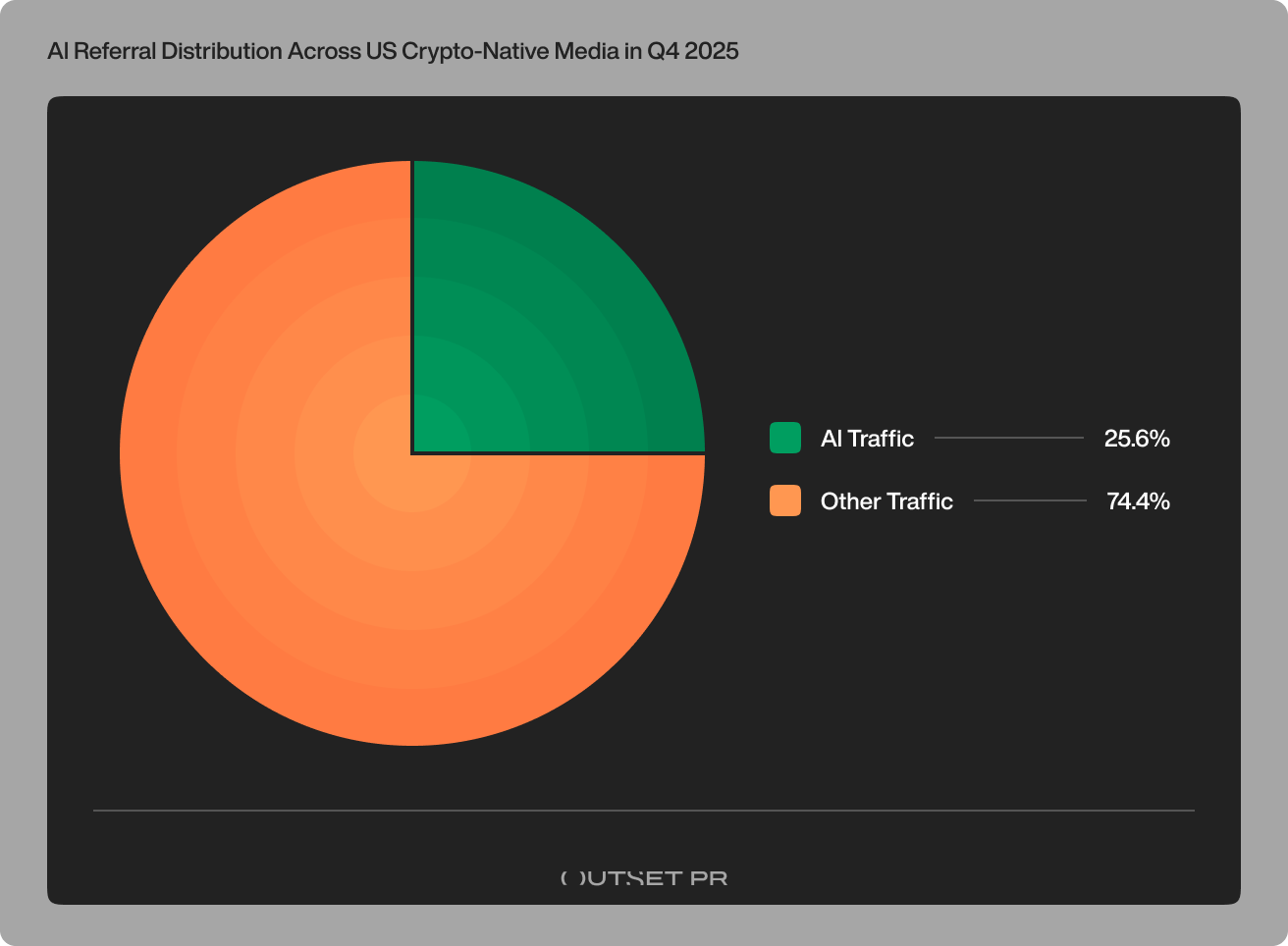
In Q4 2025, AI referrals constituted for slightly over 25% of referral traffic, which is still a small share of total visits, but one of the few discovery channels that continued functioning as search and social softened.
Source: Outset Data Pulse
The effects are visible in the Composite Score (CS) rankings inside Outset Data Pulse, which combine growth, absolute traffic gain, and engagement quality.
AI systems privilege structured data, clear entity definition, and historical authority, meaning the effect is not redistribution but refinement: friction is reduced for users, while the range of publishers that consistently capture attention narrows further.
Being picked up by AI tools isn’t a gradual process. Outlets tended to fall into two clusters: those capturing a meaningful share of AI-driven referrals, and those receiving almost none. Once an outlet failed to surface consistently in AI responses, organic recovery paths narrowed sharply.
Interpreting the Structure of Attention
A 0.62 Gini coefficient should be read as a structural indicator of how attention now behaves in U.S. crypto media. It shows that discovery systems spanning search, social distribution, and AI-mediated citation consistently reinforce existing scale, making visibility itself a compounding advantage. In practical terms, the same publishers are repeatedly surfaced across search results, feeds, and AI responses, not because alternatives are absent, but because discovery mechanisms privilege established reach.
As a result, concentration persists even during periods of market cooling, barriers to visibility rise for smaller outlets, and shifts in audience attention occur slowly despite ongoing editorial activity across the ecosystem.