

Europe’s crypto media industry showed what appeared to be healthy traffic trends during the third quarter of 2025. Crypto-focused news sites across the continent pulled in around 67.5 million visits, marking a slight gain from 65 million in the prior quarter.
However, Outset PR’s deep-dive just published research tells a more nuanced story. The majority of individual outlets actually saw their traffic stagnate or decline. In fact, just 39% of the 200 crypto-native publishers we track recorded any growth in Q3. The remaining 61% saw traffic either flatline or fall.
In other words, a small number of large players propped up the industry’s overall numbers, even as most crypto sites felt a squeeze.
TL;DR – What This Article Answers
Why did Europe’s crypto media totals rise while most outlets declined?
Because traffic concentrated at the top. Just 44 publishers captured around 90% of all crypto-native visits, while growth failed to materialize for most of the remaining outlets.
Where did the real slowdown happen?
Most of the quarter’s strength came from July, when visits were close to 24 million. By the time September rolled around, traffic had slipped to under 21 million, leaving a 13% gap that the quarter as a whole barely hints at.
What changed structurally in Q3?
Discovery tightened. With nearly 90% of traffic still coming from search and direct visits, outlets without scale or diversified entry points felt declines first, while large publishers absorbed the shock.
How July’s High Base Made Q3 Look Healthier Than It Was
What made Q3 misleading wasn’t volatility but timing. The quarter opened strong, and that early momentum did most of the work in keeping headline totals afloat. As the summer went on, traffic cooled steadily, but not sharply enough in any single month to trigger alarm.
Because the drop happened gradually, it was easy to miss unless you looked at the flow month by month. Large publishers, especially those with strong search and direct audiences, held on long enough to smooth out the decline. Smaller outlets didn’t have that buffer.
Regionally, the same pattern applied. Eastern Europe’s rebound from a weak second quarter helped offset the slowdown, while Western Europe carried most of the cooling without dragging the total down outright. In other words, Q3 redistributed where traffic sat.
How 44 Outlets Take 90% of Europe’s Crypto Media Traffic
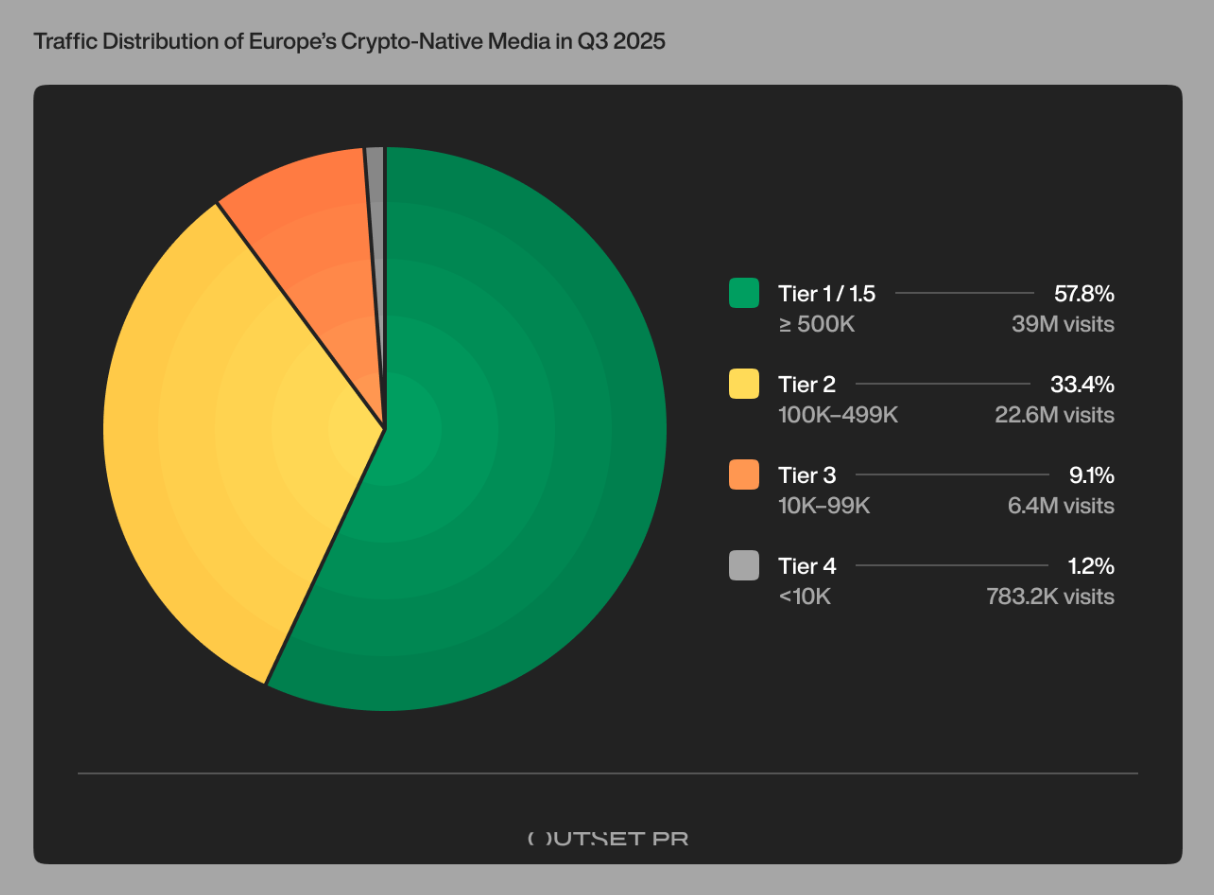
A relatively small group of large crypto news outlets accounted for the majority of reader traffic. This kept total visit numbers elevated even as most outlets saw little or no growth. Out of the 200 crypto-native publishers across Europe, the top 12 sites accounted for roughly 58% of all crypto media visits during the quarter.
Source: Outset PR
We refer to this group of 12 as the top tier, representing well-established brands and market leaders. These outlets benefit from strong name recognition, strong search visibility, and loyal audiences.
The next tier consists of 32 mid-sized outlets, and together these top 44 publishers drew roughly 90% of all crypto-specific traffic in Europe. The remaining roughly 150 smaller sites competed for roughly 10% of the total audience.
This top-heavy distribution means aggregate traffic can rise even when most outlets decline.
Search and Direct Visits Dominate Crypto News Discovery
A major factor behind the pressure on most crypto outlets is how readers discover crypto news in the first place. Europe’s crypto audience still relies heavily on search engines and direct visits.
In Q3, around 46% of all traffic to crypto-native sites came through organic search, such as Google. Another 42% came from direct navigation, typically loyal readers visiting sites directly. That leaves just 12% of traffic coming from all other sources combined, including referrals, social media, newsletters, aggregators, and similar channels.
What shows up instead is a kind of discovery squeeze that built through the quarter. The steady month-to-month decline suggests fewer new readers were finding crypto news as the quarter went on. This may reflect declining hype as the market selloff reduced search interest in crypto topics.
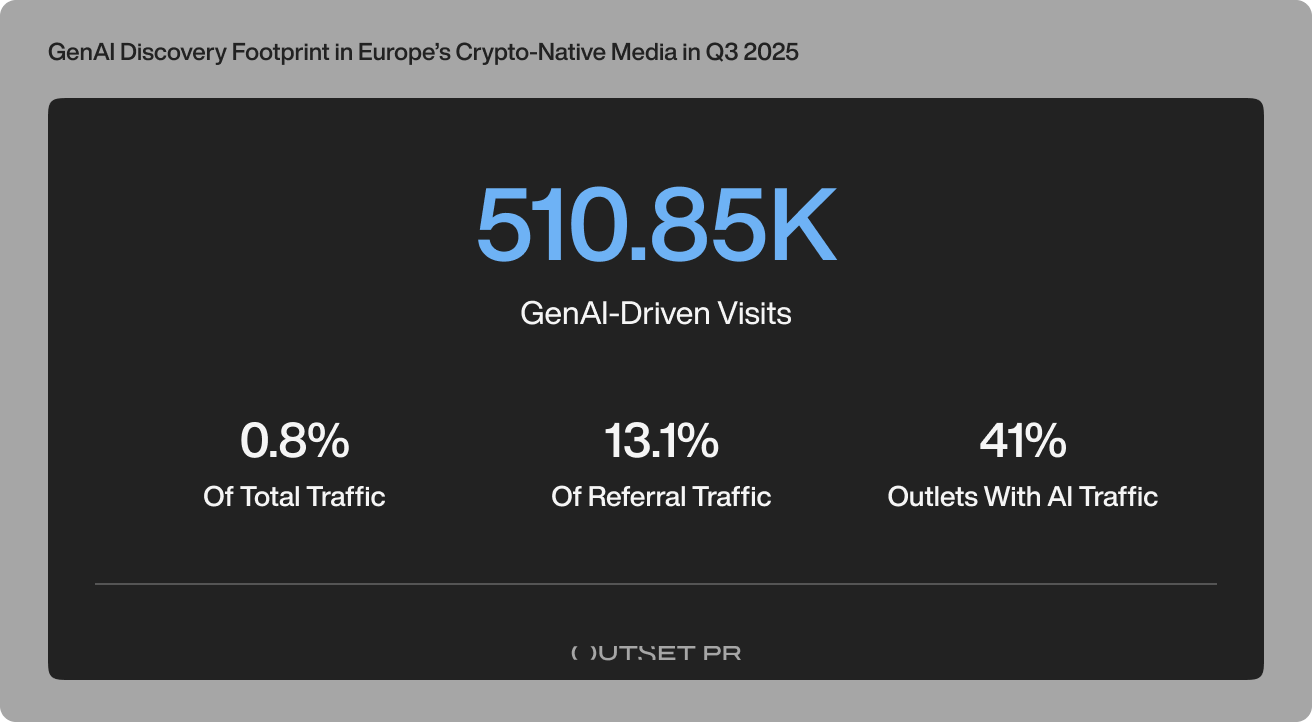
Because many outlets lack diversified referral channels, a drop in search traffic is difficult to offset elsewhere. AI-driven tools and chatbots represent new discovery paths, but they remain marginal. Outset PR’s data shows that slightly under 0.8% of total crypto site visits came from generative AI tools such as ChatGPT, plugins, and AI-powered search assistants.
Source: Outset PR
How Diversified Discovery Can Cushion the Next Traffic Shock
The third-quarter story was neither one of across-the-board collapse nor broad-based recovery. Instead, a handful of outlets and regions managed to grow or stabilize, while many others experienced decline. Outset PR sees these trends as signs of a structural reset in how information is distributed and consumed.
The key takeaway from Q3 is that aggregate totals do not tell the full story. Total traffic for Europe’s crypto news industry can remain flat or even rise slightly while many individual publishers struggle simultaneously.
Rather than concluding that crypto media is dying, which it clearly is not, these results are seen as a call to adapt and diversify. European crypto outlets will need to explore new ways to reach readers, particularly by experimenting with emerging channels such as AI-driven content discovery.