



If you’ve worked in PR or communications long enough, you’ve probably used at least one media intelligence platform.
Cision, Meltwater, Muck Rack—these tools have become the backbone of modern media operations. They help you monitor coverage, track mentions, manage outreach, and report on campaign performance. In many ways, they’ve solved a major problem: making sense of what happens after your story is out in the world.
But here’s the thing most teams were running into: None of these tools really help you decide where to go in the first place.
The gap at the decision-making stage
Before any campaign starts, there’s a messy phase: choosing media outlets.
And despite all the sophisticated tooling there is, this process still feels surprisingly manual.
You check traffic in Similarweb.
You look at domain authority in Ahrefs.
You try to recall past experiences.
You maybe ask a colleague.
And then, eventually, you make a call. It’s not that there’s no data—it’s that the data is fragmented, inconsistent, and hard to compare. Even worse, most metrics only capture one dimension of performance. Traffic doesn’t tell you influence. Domain authority doesn’t tell you engagement. Volume doesn’t tell you impact.
Many teams default to a “spray and pray” approach—distribute widely and hope something sticks. That’s the missing layer in media intelligence.
What Outset Media Index is trying to fix
Outset Media Index (OMI) is the first media intelligence platform that adds a decision system for media planning.
Instead of focusing on monitoring or outreach, it focuses on something earlier and arguably more important:
Which media outlets to publish in and why?
OMI offers a unified way to look at media performance
The core idea behind OMI is simple: Bring all relevant media signals into a single, standardized framework.
Rather than jumping between tools and trying to reconcile conflicting data, OMI aggregates and normalizes metrics into one system, making outlets directly comparable.
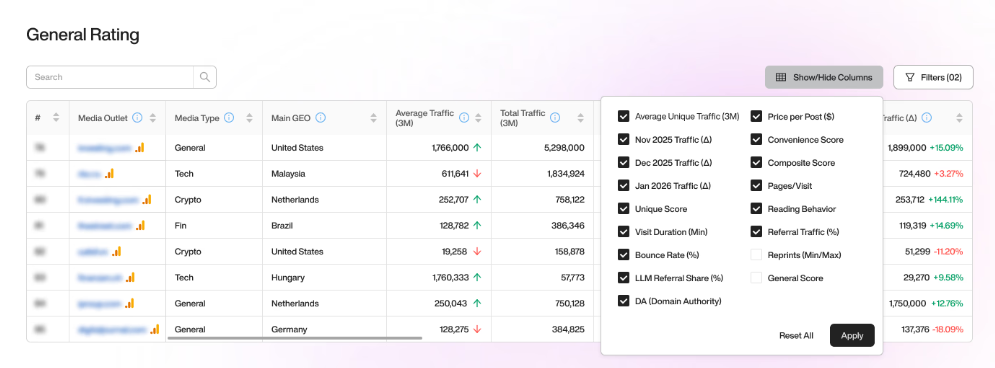
What’s interesting is the breadth of what it measures. We’re not just talking about traffic or SEO scores. The platform analyzes outlets across more than 37 metrics, including:
-
audience reach
-
engagement quality
-
editorial flexibility
-
syndication patterns
-
visibility in LLMs and AI-driven environments
That last one is particularly forward-looking. Most tools still operate in a pre-AI paradigm, while OMI is already factoring in how media content propagates through AI systems.
From scattered metrics to actual decisions
OMI is built around three principles: unified, independent, and decision-ready. That last part—decision-ready—is where the platform really differentiates.
Most tools give you dashboards. OMI gives you something closer to answers.
Instead of asking:
-
“Which outlet has higher traffic?”
You can start asking:
-
“Which outlets are most likely to contribute to my campaign goal?”
-
“Where should I allocate budget for maximum impact?”
-
“Which publications can get a deeper syndication?”
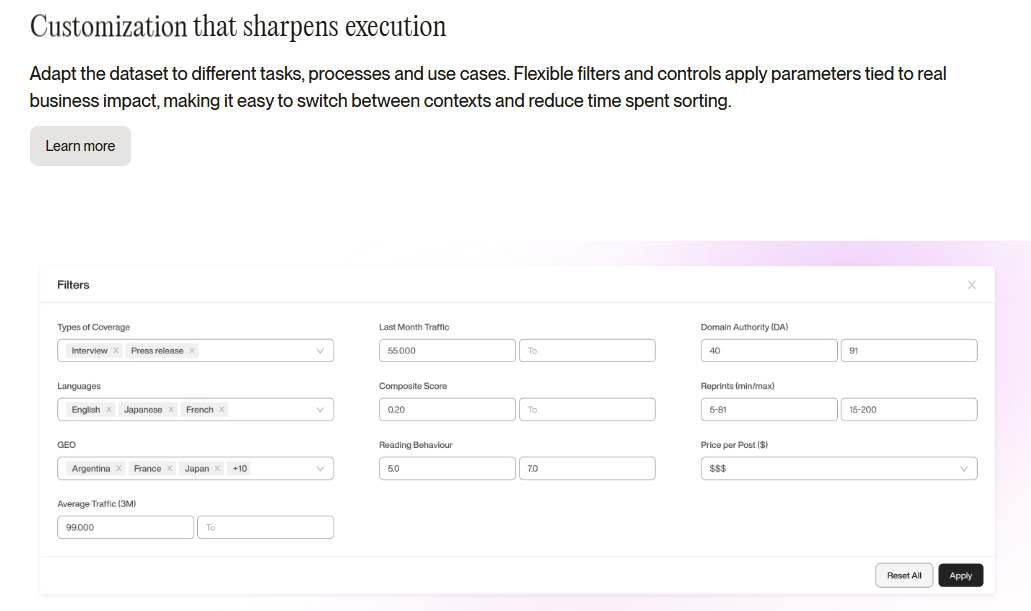
Another thing OMI does well is reflect the fact that media impact isn’t one-dimensional. Some outlets drive traffic, others get picked up and syndicated, others perform well in search or AI outputs. Traditional tools don’t really capture this nuance.
OMI, on the other hand, treats media performance as a system of interacting factors, not a single KPI.
This makes it much easier to align media selection with specific objectives instead of relying on generic indicators.
Objectivity (finally)
One subtle but important point: benchmarking in PR has always been messy. Rankings are often opaque, and methodologies are often unclear.
OMI takes a more structured approach:
-
normalized data
-
consistent methodology
-
no paid ranking bias
It’s a small shift in theory, but in practice it makes comparisons far more reliable.
What new does OMI deliver?
While most media intelligence platforms help you understand what already happened, OMI helps you decide what to do before anything happens. It turns a PR workflow from reactive measurement the proactive planning based on structured data
Platforms like Cision or Muck Rack are still essential for outreach, relationship management, and monitoring. Outset Media Index introduces a decision layer into media intelligence. And in doing so, it replaces guesswork and the inevitable “spray and pray” with a more structured, data-backed media selection.
Disclaimer: This article is provided for informational purposes only. It is not offered or intended to be used as legal, tax, investment, financial, or other advice.