



Crypto is no longer vying for attention. That may sound strange for an industry built so heavily on speculation, but it may not be a bad thing.
After all, attention rarely lasts on its own. The Starbucks Teddy Bear cup is a small example: a limited-edition drop that drew queues, collector hype, and then faded.
Crypto often worked the same way in previous cycles, when visibility and excitement were treated as proof of strength. This time, the market seems a little less dependent on being in the spotlight all the time.
The change becomes more interesting when you look at the data. Outset Data Pulse (ODP) tested that idea by analyzing 63,926 CoinDesk headlines published between January 1, 2014, and December 30, 2025, and then matched them against daily Bitcoin closing prices from the TradingView composite index, covering a total of 4,381 days.
ODP’s findings may run against what many traders feel they’ve seen in real time, but the data points in a different direction: news does not predict Bitcoin’s price.
More precisely, the correlation between daily news and next-day Bitcoin price movements was 0.019 (negligible). Even the headline tone proved weak as a signal: CoinDesk coverage was 58% neutral, 21% positive, and 21% negative, while sentiment explained only about 0.5% of price movement.
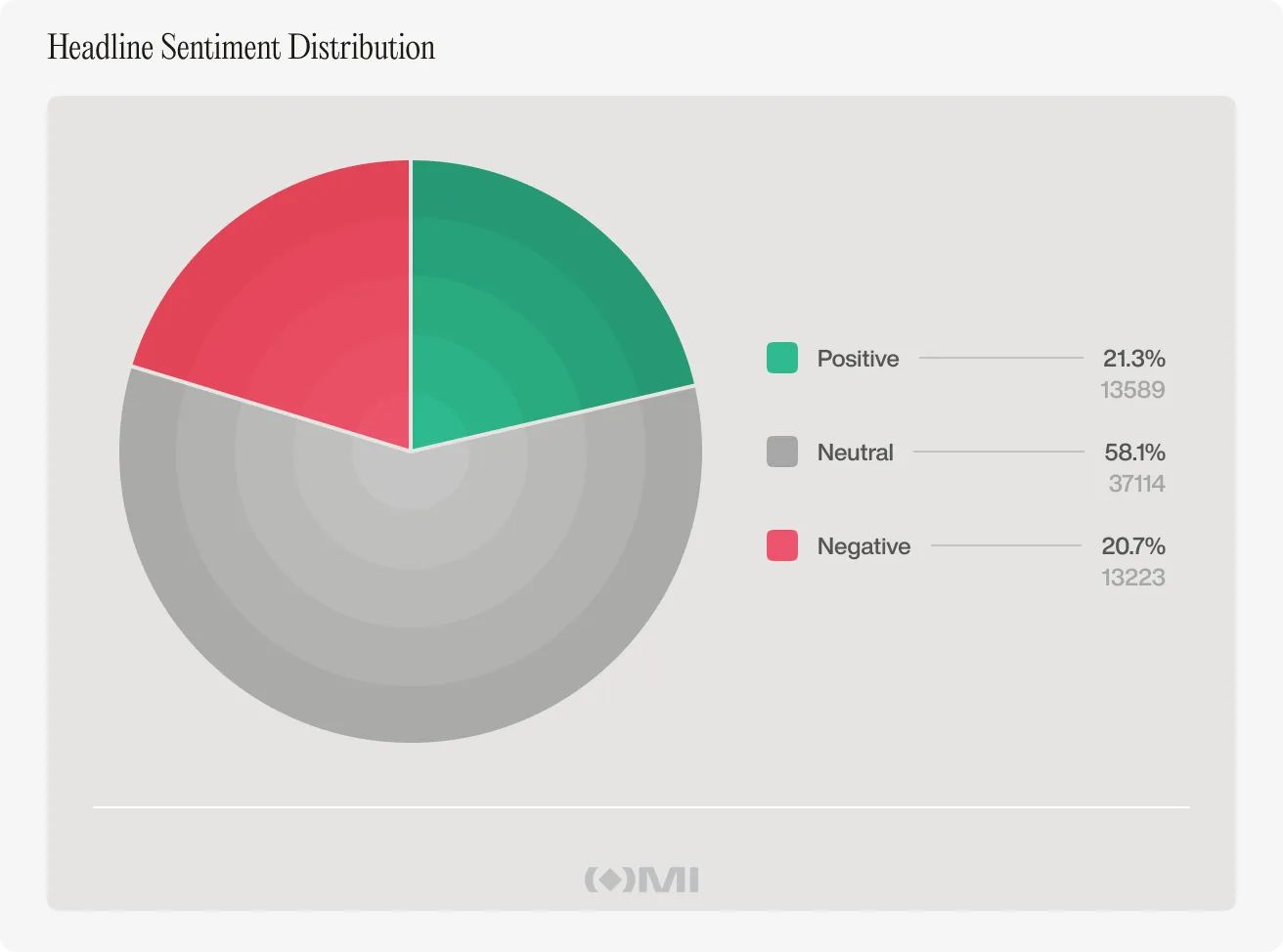
Image source: Outset Data Pulse
That held true across halving cycles, bull and bear markets, the COVID crash, and the FTX collapse, and no meaningful effect showed up in the data. ODP examined its findings across five different time lags, in both directions, and still found no meaningful predictive effect.
If anything, the opposite might be true. Bitcoin prices appeared to move before coverage, rising by roughly 1% before news spikes and then falling by around 0.8% after coverage. The market reacts first, presumably through insider networks or social media, while the headlines catch up later. In ODP’s framing, the headline is often just the last mile of an information relay: by the time it appears, faster channels have usually done the real work.
The relationship looks loose even at the yearly level. More articles did not consistently mean more volatility, which only adds to the case that attention is not the same thing as signal.
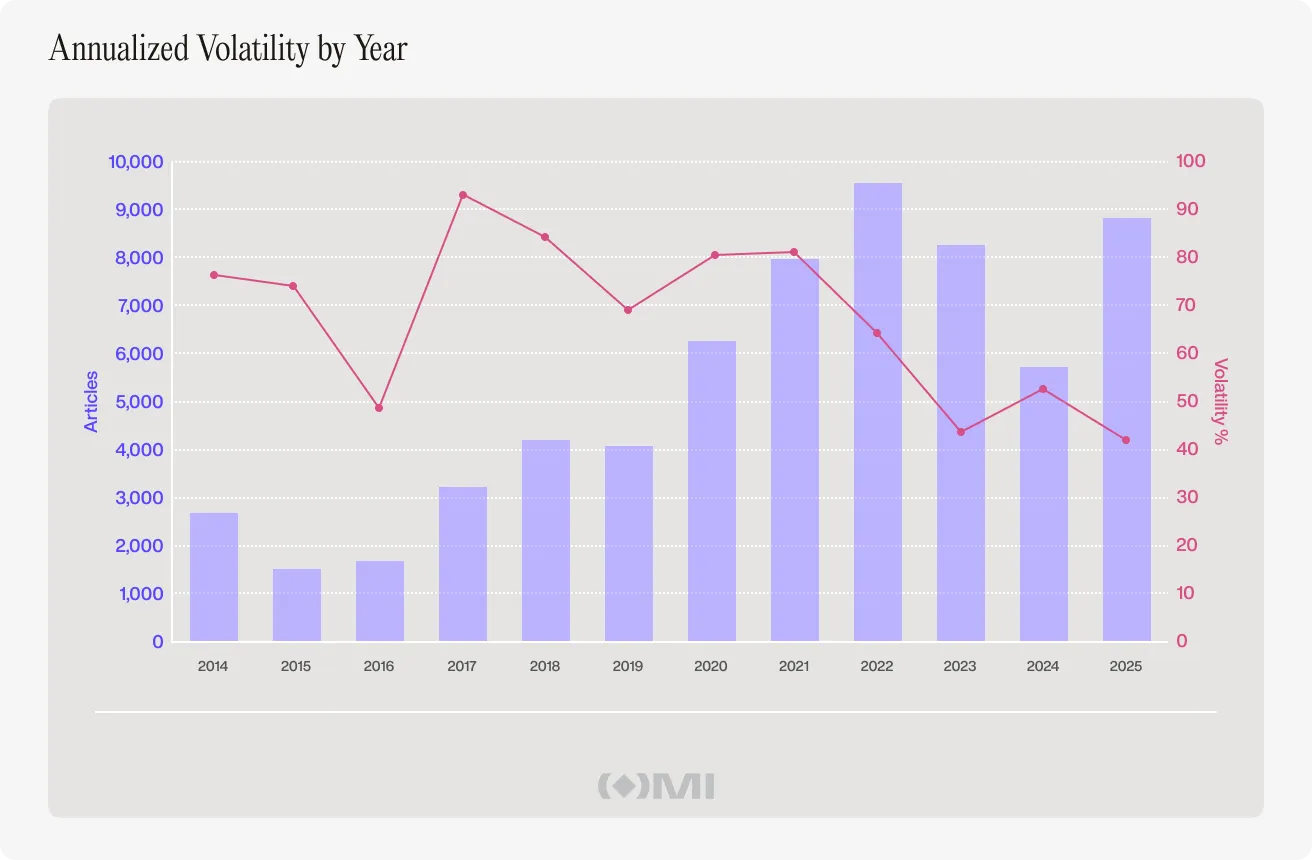
Image source: Outset Data Pulse
ODP supports its claims with individual events as well. One good example is that of the Bitcoin ETF approval. In January 2024, the U.S. SEC approved the spot Bitcoin ETF, and CoinDesk published 51 articles that day. Despite this being the biggest news of the year, Bitcoin dropped 7.67% the next day.
At first glance, that seems backwards. How could BTC’s price fall after a major regulatory win? The report answers this question with data from before the actual event. A month prior to the ETF approval, on December 4, 2023, CoinDesk published 81 articles on the topic as ETF speculation reached a fever pitch. Bitcoin rose 5% on December 4. “The market had already priced in the approval weeks before it happened,” analysts behind ODP state.
The report is based on a defined dataset and should be read in that context. Even so, it highlights an interesting phenomenon: crypto may be learning to function without constant visibility.
What the report does suggest is that crypto may be relying less on headlines as proof of relevance. If markets are moving before the coverage arrives, then attention is no longer the clearest signal of where the real action is.
In essence, crypto may no longer need constant headlines to show that it still matters. By moving away from an attention-driven phase to a usage-driven one, crypto doesn’t become weaker, as some traders would assume. Instead, it makes it potentially more durable underneath.
That said, it doesn’t mean attention has disappeared from the equation. This is the attention economy, so to say that it doesn’t matter entirely is, at the very least, disingenuous. However, when hype becomes a temporary spike rather than the engine itself, the market starts to look less attention-driven.