

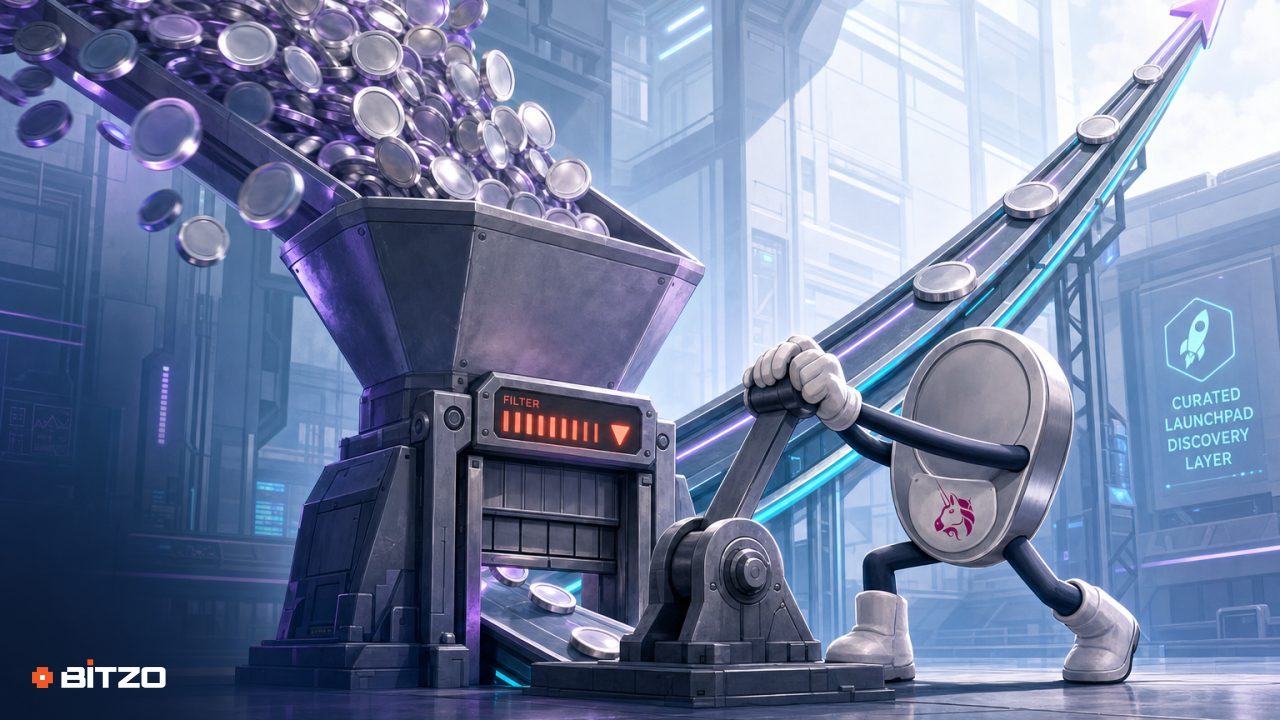
The token factory meta has been running red hot. If you’ve watched your feed lately, it feels like hundreds of thousands of new tickers are appearing each month. Whether the exact count is 340,000 or not, the direction is obvious. Creation is cheap. Discovery is the hard part.
Uniswap is leaning into that reality by wiring token launch discovery directly into its app. The goal is simple: make it easier to find real launches, bid, and claim in one place without handing your funds to a third party.
This piece breaks down what Uniswap’s new layer actually is, why it’s happening now, how the Auctions and LiquidityLauncher flows work, where it’s live, how it compares to other launch options, and the very real risks to keep in view.
Uniswap is rolling out a launch discovery layer inside the main app that surfaces onchain token sales and liquidity bootstraps, so users can discover auctions, place bids, and claim in one interface. The push comes as token creation explodes and Uniswap’s own infra matures with v4 hooks and cross-chain deployments. The key pieces are Uniswap Auctions using Continuous Clearing Auctions and LiquidityLauncher with LBP-style strategies.
- CCA discovery is live in the Uniswap web app front end, per the public landing page Uniswap.
- Core contracts like LiquidityLauncher, CCA Factory, and LBPStrategy are deployed across major chains, listed on the developer site Uniswap Developers (Deployments).
- Uniswap’s v4 ecosystem is shipping fast with tens of thousands of hooks initialized, signaling a growing surface for new launch mechanics Uniswap Labs (Substack).
- Heavy stablecoin routing and new chain activity, including on Robinhood Chain, make onchain launch rails more practical at scale Uniswap Labs (Substack).
What is Uniswap’s launch discovery layer in plain English?
Think of it as a native shelf inside Uniswap where new token sales and liquidity bootstraps show up. Instead of jumping between a dozen sketchy sites to find a live presale, you can see onchain auctions, bid with your wallet, and later claim, without leaving the Uniswap front end. The discovery is the feature. The custody stays with you.
Uniswap’s Continuous Clearing Auctions, the mechanism behind Uniswap Auctions, already have a dedicated page that states you can discover auctions, place bids, and claim tokens directly in the Uniswap web app Uniswap. That’s the core of the discovery layer.
It’s not just auctions either. Uniswap has a LiquidityLauncher and an LBPStrategy contract that let teams seed liquidity with a predictable curve instead of dumping a pool on day one. Those pieces show up on the deployments list across multiple chains, which is how this discovery shelf goes cross-chain Uniswap Developers (Deployments).
How do Uniswap Auctions and LiquidityLauncher actually work?
Uniswap Auctions run on a Continuous Clearing Auction design. In normal words, it batches incoming bids and matches them in slices so price discovery isn’t just a gas war at block one. Bidders commit funds onchain and the mechanism clears against available tokens over time. The experience is handled through the main Uniswap app, so you don’t have to use an offsite widget Uniswap.
LiquidityLauncher is the follow-on step. Instead of market making by hand or hoping a bot shows up, projects can spin up initial liquidity with guardrails. The LBPStrategy is part of that kit. It lets you start with a higher price and programmatically adjust weights downward so the market walks into a fair point. It’s not new to crypto as an idea, but Uniswap shipping a standardized version across chains is.
Both flows keep custody in your wallet. You approve, you bid, and if an auction clears, you claim. If you seed liquidity, you can do it with parameters that your contract enforces, not a handshake with a third party.
Why now? What changed in the token factory meta?
Two words: throughput and noise. Launching a token is trivial now. Anyone with a template can click a few buttons and push a mint. When that many tokens show up in a month, finding the credible ones becomes the whole game. A native discovery shelf gives Uniswap a way to surface onchain-first launches without pretending to be a gatekeeper.
There’s also a very practical plumbing story. Uniswap reports that more than 65,000 v4 hooks have been initialized, with 1,000 in a single week. That pace shows there’s developer energy for custom liquidity behaviors that pair naturally with launches Uniswap Labs (Substack).
Then you’ve got stablecoin liquidity. In mid July, Uniswap said it handled 58% of all EVM stable to stable volume in the prior 30 days. If most money routes through Uniswap for stables, that’s a ready base for auction bids, treasury raises, and liquidity bootstraps settled in USDC, USDT, or similar Uniswap Labs (Substack).
Finally, the chain map widened. Uniswap highlighted that trading on Robinhood Chain topped $6 billion that week with its first $1 billion day, and that CCA is live on that chain. New flow plus new rails is generally when product teams wire up a cleaner user path Uniswap Labs (Substack).
Where is this live and how does cross-chain discovery fit?
Uniswap lists deployments for LiquidityLauncher, ContinuousClearingAuctionFactory, and LBPStrategy across a wide set of networks. Examples on the page at the time of writing include Ethereum, Base, Unichain, Arbitrum, Robinhood Chain, Avalanche, X Layer, and Sepolia for testing. LBPStrategy v3.1.0 addresses are posted for several of those chains too Uniswap Developers (Deployments).
That breadth matters. Teams don’t all launch on the same network anymore. A discovery shelf inside Uniswap that can surface auctions and bootstraps from multiple chains in one place reduces the hopping and the spoof risk. You still execute on the origin chain. The front end simply gives you a cleaner route to find and interact.
For now, the public CCA page makes it clear that the entire flow sits in the main app shell. No account, no custody handoff, just your wallet and an onchain mechanism Uniswap.
Pro tip: before you bid or seed liquidity, cross check the auction or launcher contract address against the official deployments list and your chain’s explorer. If the address isn’t on the Uniswap page, pause and verify.

How does Uniswap’s approach compare to existing launchpads?
Projects have a few common paths to market: centralized exchange launchpads, DIY presales, bonding or LBP-style pools, and now Uniswap’s native Auctions and LiquidityLauncher. They differ on custody, price discovery, access rules, and composability.
Here’s a high-level snapshot to keep the tradeoffs straight:
| Path | Price discovery | Custody | Access | Where it lives | Notes |
|---|---|---|---|---|---|
| Uniswap CCA Auctions | Batch-style clearing over time | User self-custody | Open by default, project can set params | Onchain, Uniswap front end | Integrated discovery, claim in-app; subject to gas and MEV dynamics |
| Uniswap LiquidityLauncher + LBPStrategy | Programmed weight shifts shape price | User self-custody | Open trading once pool seeds | Onchain, Uniswap front end | Predictable liquidity curve without CEX market making |
| Centralized exchange launchpad | Set or auctioned off-platform | Exchange custody during sale | Often KYC, geo limits, allocations | Off-chain platform | Distribution reach but permissioned access and listing rules |
| DIY presale or OTC | Ad hoc, high variance | Varies, often custodied by organizer | Whitelists or invite-only | Websites, forms, multisigs | Flexible but high counterparty and spoof risk |
Uniswap’s angle is composability. Auctions feed straight into onchain liquidity. No export to a private venue. No hidden order types. If you live onchain already, keeping price discovery and pool seeding there too is cleaner.
What are the risks for creators and buyers?
Risk didn’t disappear just because the rails moved into a familiar app. Smart contracts can have bugs. Projects can still go dark after the sale. MEV can impact effective pricing if a rush of bids hits the same block window. And if you seed liquidity with parameters that are too aggressive, you can create a hard dump the moment pools unlock.
There are market structure risks too. If a token team directs a huge chunk of the treasury into a thin LBP curve, a few whales can dominate the path. On the buyer side, you’re still exposed to immediate post-claim volatility. The first hours after claims are usually whippy. Slippage controls and patience help.
Regulatory posture varies by region. Participating in token sales may carry tax reporting or securities questions depending on your jurisdiction. None of this is financial or legal advice. Read the docs and, if it’s meaningful size for you, get counsel.
How do I evaluate a new Uniswap auction in 10 minutes?
Here’s a tight checklist you can run before you click bid or seed:
- Address sanity: match the auction or launcher contract to the official deployments list and a reputable explorer tag.
- Team wallets: scan the token contract for owner, mint, and pause rights. If upgradeable, who controls the proxy?
- Supply math: total supply, initial circulating, team and investor allocations, and any cliffs or vesting.
- Liquidity plan: is there a lock, timelock, or clear policy for LP tokens after the sale?
- Hook usage: if a v4 hook is involved, read what it does. Fees, limits, or custom behaviors can affect fills.
- Chain choice: gas, bridge risk for claims, and venue liquidity on that network today.
- Stablecoin route: which stable is accepted and how it will be used post sale, given Uniswap’s stable routing depth Uniswap Labs (Substack).
- Docs and commits: a minimal README, a threat model, and recent commits go a long way. If it’s silent, assume the worst.
- Post-claim plan: what’s the first week look like? Listings, incentives, or a quiet build. Hype without a plan tends to fade fast.
Common Mistakes
- Blind bidding into a spoofed auction page. Fix: only interact from the official Uniswap app and verify contracts against the deployments list Uniswap Developers (Deployments).
- Ignoring permissions on the token contract. Fix: check owner roles and upgradeability before bidding or adding liquidity.
- Overpaying gas in the first minute. Fix: wait a few blocks. CCA designs are meant to reduce gas wars, not reward them Uniswap.
- Assuming Uniswap discovery means endorsement. Fix: treat it as plumbing, not a rating. Do your own diligence.
- Forgetting claim windows or LP unlock times. Fix: set reminders. Missed claims and surprise unlocks are avoidable errors.
Frequently Asked Questions
Does the discovery shelf mean Uniswap vets or endorses these launches?
No. It’s an interface for onchain mechanisms, not a ratings agency. Treat every auction or liquidity bootstrap like a raw protocol interaction and verify addresses before signing.
Can bots or MEV distort Uniswap’s Continuous Clearing Auctions?
They can influence effective prices around clearing moments, especially if many bids cluster. The batch style helps reduce pure gas wars, but it’s not a shield against MEV. Use price limits where available and avoid chasing the first minute.
What chains can I use today?
Uniswap lists deployments for the auction and launcher components on networks including Ethereum, Base, Unichain, Arbitrum, Robinhood Chain, Avalanche, and X Layer, with testing on Sepolia. Check the live list before you act because coverage can change by version Uniswap Developers (Deployments).
Are funds ever custodied by Uniswap during an auction?
No. You interact with onchain contracts from your wallet. Approvals and bids sit in the auction contract logic. You claim from the same flow. Always revoke approvals you no longer need.
How do stablecoins fit into this?
Most bids and bootstraps are denominated in stablecoins. Uniswap reported handling a majority share of EVM stable to stable volume in a recent 30 day window, which makes routing and settlement straightforward for many users Uniswap Labs (Substack).
What if a project disappears after a successful auction?
You still own the tokens you claimed, but there’s no guarantee of delivery on roadmaps or liquidity support. That’s the core project risk. Diversify, size positions realistically, and prefer teams with transparent contracts and timelocks.
Can I use a hardware wallet and multiple chains in one session?
Yes, as long as your wallet supports those networks. Expect separate approvals and gas on each chain. If you bridge funds, account for bridge time and risks before an auction clears.