



If you run treasury, payments, or operations, Ripple Mint just gave you a cleaner lane to handle RLUSD at scale. This piece walks through how institutions mint, redeem, bridge, and account for Ripple’s dollar stablecoin without duct taping five tools together.
We’ll map the full flow. Where the APIs fit. What the flexible redemption window changes in day-to-day operations. And the risks to model before you flip it on in production.
The timing matters. RLUSD has real usage and also some cooling in transfer volume, so tooling that reduces friction could decide whether this stablecoin sits in your stack or not.
Ripple Mint is Ripple’s institutional portal and API suite for RLUSD that lets approved entities mint against fiat, redeem to bank rails, and bridge RLUSD between the XRP Ledger and Ethereum using one interface and consistent reference IDs. It adds programmatic calls, webhook status alerts, and a flexible redemption flow that can hold inbound RLUSD for up to three hours while you decide to redeem to fiat or bridge across chains. It is live for existing RLUSD customers as of July 23, 2026.
- Unified UI plus APIs for mint, redeem, bridge, and account views Ripple
- Programmatic lifecycle tracking, webhooks, and end-to-end reconciliation IDs Ripple
- Flexible redemption window up to 3 hours to choose fiat redemption or cross-chain bridge Ripple Documentation
- RLUSD supply around $1.5B split across XRPL and Ethereum, with a recent volume dip CoinDesk
What is Ripple Mint and why does it exist?
Ripple Mint is a single platform for institutions to interact with RLUSD. Instead of juggling a bank portal for wires, a help desk for redemption tickets, and on-chain tools for tracking balances, Mint centralizes it. You can mint RLUSD after funding, redeem back to fiat, bridge between the XRP Ledger and Ethereum, and track every step with consistent reference IDs.
Ripple formally announced the product on July 23, 2026, positioning it as a unified path to access, mint, redeem, bridge, and manage RLUSD across chains Ripple. That timing lines up with RLUSD’s growth into a multi-chain footprint and the need for cleaner ops around it.
The crux here is operational clarity. Teams want strong programmatic tooling and a UI their finance staff can use without pinging engineers every time a status update is needed. Ripple Mint tries to cover both, with APIs and webhooks for automation and a screen for humans who just need to reconcile a batch by 5 pm.
How does institutional minting and redemption actually work?
The mint side looks familiar if you’ve worked with other fiat-backed stablecoins. You onboard, complete compliance, fund a designated bank account, and initiate a mint request. The difference is you can kick this off via UI or programmatically and then watch every lifecycle hop through webhooks and status queries. Each instruction carries a reference ID you can pass through your ERP so reconciliation later is simple Ripple.
Redemption is where Ripple Mint adds a useful twist. When flexible redemption is enabled, inbound RLUSD sits in a Pending state for up to 3 hours. During that window, you choose to redeem to fiat or bridge to the other chain. If you do nothing, the system auto processes based on your default preference Ripple Documentation.
Operationally, this helps busy teams that receive RLUSD from clients on-chain, then have to decide whether to settle vendors in fiat or rotate liquidity to the other network. You can basically hold the coin at the loading dock, then wheel it to the right door based on late-breaking needs.
Settlement timing still depends on bank rails and chain conditions. Plan for normal wire or ACH windows on the fiat side and block times plus gas on the crypto side. The notifications matter here. If your systems are listening, they can book entries and message counterparties automatically the moment a state changes.
Where does RLUSD live today and what does that mean for operations?
As of late July 2026, RLUSD’s market value was roughly $1.5 billion, with supply split around $877 million on the XRP Ledger and about $643 million on Ethereum, according to reporting at the time. Monthly transfer volume had cooled by about 25 percent from roughly $14.6 billion to around $11 billion CoinDesk.
Two chains means two operational realities. XRPL gives you low fees and native payments tooling. Ethereum offers mature DeFi integrations but requires gas planning and smart contract interactions. Ripple Mint lets you bridge between them from one screen, which is handy if your liquidity or counterparties skew one way but you need the other.
Here is a quick side by side to center your planning:
| Aspect | XRPL | Ethereum |
|---|---|---|
| Typical fees | Low, predictable | Variable gas, can spike |
| Settlement feel | Fast finality for payments | Robust but gas dependent |
| Ecosystem fit | Payments and remittance flows | DeFi, custody platforms, on-chain funds |
| Operational overhead | Simpler addressing and fee planning | More monitoring for gas, nonce, MEV-aware routing |
| Bridging via Mint | Yes, to Ethereum | Yes, to XRPL |
If you already run multi-chain operations, this is nothing new. The useful bit is the three hour decision window for inbound funds so you can flip them to the chain that best fits your immediate need Ripple Documentation.

How do the APIs, webhooks, and reconciliation IDs help a finance team?
Programmatic tools are the difference between a pilot and something your auditors will accept. Ripple Mint exposes APIs to initiate actions, query status at each lifecycle step, and fetch balances by account. Webhooks ping your systems when a state flips so you don’t need to poll constantly. The reference ID model lets you tie an on-chain event to a bank instruction and a journal entry without bespoke glue code every time Ripple.
This matters for scale. Imagine a partner sends you RLUSD on XRPL at 4:55 pm. Your rules engine gets a webhook, checks open payables, and decides to bridge to Ethereum for an exchange deposit. The bridge starts, your ERP books a transfer in transit, and your ops chat gets a bot note saying the funds are now on chain B. No swivel chair.
Reconciliation pain is where stablecoin programs usually bog down. With consistent reference IDs and lifecycle queries, you can match mints, redemptions, and bridges without spreadsheet archaeology. That lowers the operational risk that shows up during audits and lets fewer people run more volume.
What are the costs, risks, and controls to think through before go live?
Even with better tooling, you still face the classic categories. There are network fees, bank fees, and potential slippage if you swap RLUSD on venues. There is smart contract and bridge risk on the Ethereum side. There are operational risks like fat-fingered addresses and webhook timeouts.
Controls help. Segregate duties between initiators and approvers. Rate limit API keys. Require per-transfer approvals above thresholds. Keep chain fee buffers topped up so you never stall a redemption because nobody bought gas. Document default behavior for the flexible redemption window so no one is surprised if an auto process triggers after three hours Ripple Documentation.
On the treasury side, define when RLUSD is a cash equivalent on your books and when it is an inventory item you plan to convert. Your accounting policy should match your operational intent so you do not whipsaw your statements month to month.
- Access control: unique API keys per system, least privilege, rotation schedule
- Approval matrix: dual approval for mint and redemption above set limits
- Fee policy: minimum gas buffers per chain and daily top up routine
- Settlement playbook: default action for the 3 hour pending window
- Monitoring: webhook health checks and status polling fallback
- Counterparty registry: whitelisted addresses and bank accounts
Pro tip: test end-to-end with tiny amounts on both chains at your actual closing time. You will uncover the real bottleneck only when everyone is trying to go home.
How does Ripple Mint compare to doing it the old way?
The old way is a patchwork. You log into an issuer portal for fiat wires, email a support rep for statuses, bridge through a third party when you need the other chain, and cross your fingers that all three systems line up with your ERP labels. It works until it does not, usually during quarter end or a market wobble.
Ripple Mint tries to streamline that. One interface, one set of reference IDs, and programmatic status updates. You still manage bank timing and chain fees, but fewer tabs and tickets usually means fewer mistakes.
| Workflow | Ripple Mint | Legacy mix |
|---|---|---|
| Initiation | UI or API in one place | Multiple portals and forms |
| Status visibility | Lifecycle queries and webhooks | Email threads, manual polling |
| Bridging | Built in, same reference flow | Third party bridge, separate IDs |
| Reconciliation | Consistent IDs end to end | Spreadsheet stitching |
| Decision window | 3 hour pending to choose action | No native hold and decide step |
If you are already heavily automated with your own middleware, you may only care about the APIs and IDs. If you are newer to on-chain treasury, the UI plus playbooks will likely save you from a few bruises.
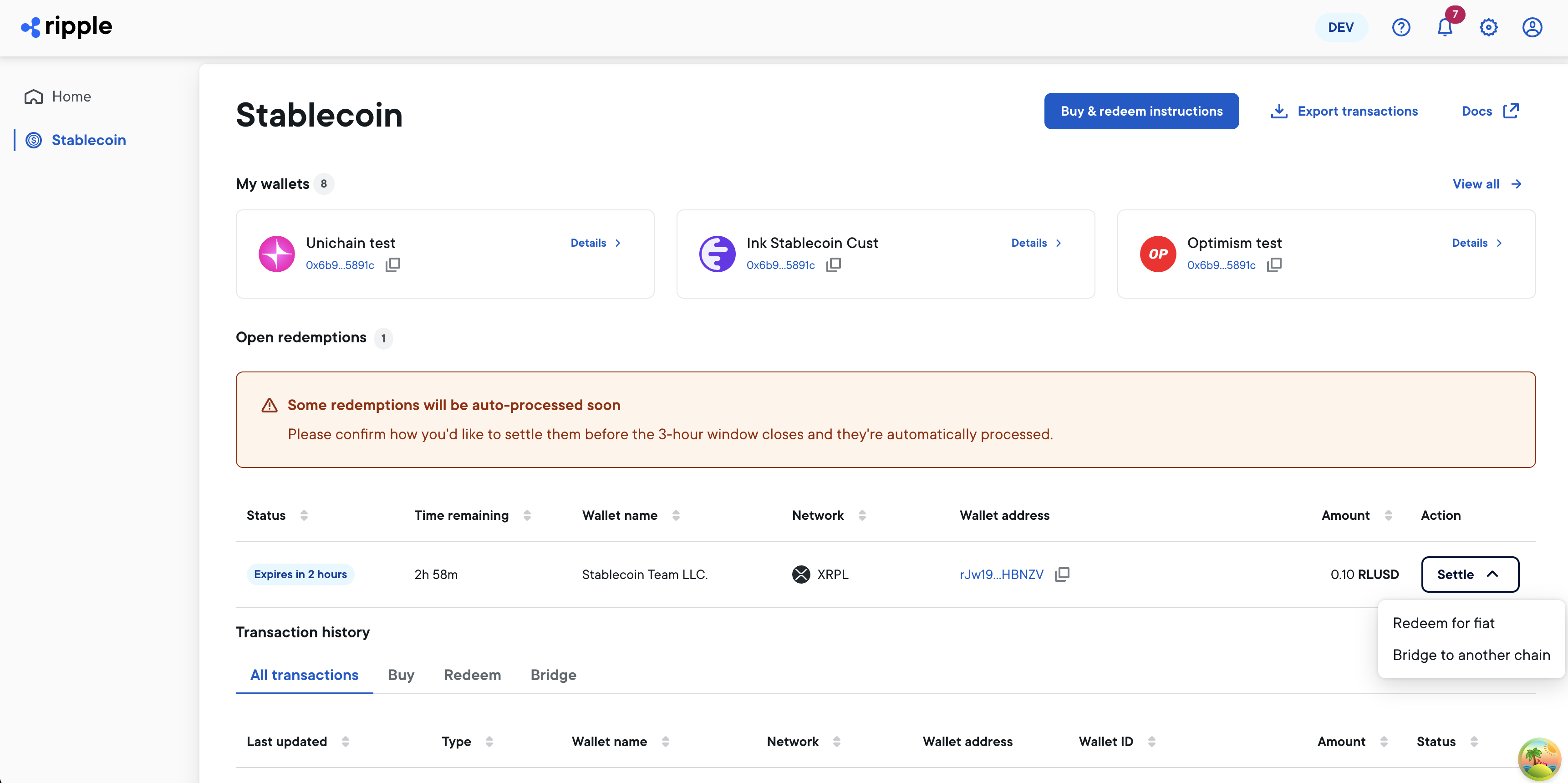
Screenshot of the Ripple Mint Stablecoin dashboard showing an open redemption in 'Pending' with a 3-hour countdown and a 'Settle' menu (Redeem for fiat / Bridge to another chain) — illustrates the flexible redemption workflow institutions use to decide fiat payout versus on-chain bridging. — Source: Ripple Documentation (Redeem RLUSD tutorial)
Is Ripple Mint worth it for institutions in 2026?
The answer depends on your use case and volume. RLUSD has real footprint across XRPL and Ethereum and sits around the billion plus scale, though monthly transfer volume recently dipped roughly a quarter from earlier levels CoinDesk. If you care about operational certainty more than chasing every basis point in DeFi yield, a unified portal with good reconciliation may be exactly what your auditors and team want.
For payment-centric flows, XRPL’s low fee environment is attractive and RLUSD fits naturally. For exchange and DeFi access, Ethereum is still the busiest venue list, and bridging through Mint gives you a neat path to move between both. The 3 hour pending choice is a small but practical feature for real life.
If your volumes are tiny or your team already runs a custom hub that normalizes multiple stablecoins, Ripple Mint might be incremental rather than transformative. But if RLUSD is becoming a core settlement asset for you, this brings most moving parts under one roof, which tends to reduce errors during stress.
As always, weigh custody arrangements, regulatory posture in your jurisdiction, and counterparty risk. None of these tools erase volatility or operational risk. They just make it easier to see and manage.
Common Mistakes
- Skipping webhook monitoring. If your listener dies, you miss status flips and reconcile late. Add health checks and fallback polling.
- Letting gas buffers hit zero. A redemption can stall on Ethereum if you cannot pay fees. Automate top ups and alert on thresholds.
- Unclear default for the 3 hour pending window. Document who decides and what the default action is so auto processing does not surprise anyone Ripple Documentation.
- One API key for everything. Use per-system keys with least privilege and rotate. That way one compromise does not take down the shop.
- Reconciling only at month end. Daily small matches beat monthly archaeology. Use the reference IDs Ripple Mint provides Ripple.
Frequently Asked Questions
Can we mint RLUSD on one chain and receive it on the other?
Mint and bridge are separate steps, but Ripple Mint lets you initiate both in one workflow. Practically, you fund, mint, then bridge to the target chain inside the same interface so the handoff is smooth and tracked with one reference trail.
What happens if we do nothing during the 3 hour pending window?
If flexible redemption is enabled and you do not act, the transfer auto processes according to your configured default after up to three hours. Set that default intentionally so the system does what you expect when no one clicks in time Ripple Documentation.
Can smaller institutions use Ripple Mint or is it only for large counterparties?
Ripple Mint is positioned for institutional customers. Access is subject to onboarding and eligibility. If you are smaller, you may still interact with RLUSD on-chain through custodians or platforms that aggregate access.
How are fees handled on redemption and bridging?
You should plan for bank fees on fiat legs and network fees on-chain. On Ethereum, gas costs vary, so set buffers. The UI and APIs make these steps explicit, but cost control is ultimately an operational policy decision on your side.
What if a webhook fails or our system is offline?
Design for failure. Webhooks are great, but polling endpoints for status as a backup keeps you in sync. Keep idempotent booking logic so a retry does not duplicate entries.
Does Ripple Mint let us restrict who can approve a redemption?
The product supports operational UI features and programmatic controls. In practice you should enforce segregation of duties in your own IAM, and map approver roles to Ripple Mint permissions when you set it up.
Is RLUSD liquidity deep enough for day to day settlements?
RLUSD sits around the billion plus scale with activity across XRPL and Ethereum, though monthly transfer volume recently dipped. For day to day settlements, many institutions pair on-chain movements with fiat rails to manage liquidity needs CoinDesk.