



OpenZeppelin said on October 20 that it embedded Chainlink’s Cross-Chain Interoperability Protocol, or CCIP, and Automated Compliance Engine, known as ACE, into its developer tooling, while establishing a migration path from OpenZeppelin Defender to Chainlink’s Runtime Environment, or CRE.
According to OpenZeppelin’s announcement, the integration is available in OpenZeppelin Wizards, its AI tooling, Skills and documentation; UI Builder support is planned for a future release. The move gives teams using OpenZeppelin’s contract-generation workflow selectable options for cross-chain token functionality and transaction-policy controls, particularly for stablecoin or real-world-asset token systems that need rules for transfers and issuance without designing those connections from scratch.
CCIP and ACE in OpenZeppelin tools
With CCIP and ACE options, OpenZeppelin’s Contracts Wizard can generate ERC-20, stablecoin and RWA tokens, according to the company’s documentation. CCIP handles cross-chain token-pool integration; ACE routes transfer and mint-or-burn operations through a configurable Policy Engine.
The product placement matters because Wizards is intended to turn contract choices into deployable code. Rather than requiring developers to separately incorporate Chainlink’s components after producing a base token contract, the announced options place those choices in the contract-development flow.
Chainlink described CCIP 2.0, announced on September 28, as offering built-in compliance functionality for KYC, anti-money-laundering checks, transaction limits and other controls defined by an issuer on cross-chain transactions. The OpenZeppelin integration is an implementation channel for those underlying capabilities; the scope of controls still depends on how an issuer configures and operates its policies.
Configurable compliance policies
The new options cover token standards including ERC-20 and ERC-3643, OpenZeppelin said. The available controls include sanctions screening, KYC checks, volume limits and Secure Mint.
ACE’s Policy Engine is central to the design. Transfers and mint-and-burn activity can be routed through that layer, separating policy handling from the core token contract. OpenZeppelin says compliance policies can then be updated without redeploying the core token contract.
That separation can reduce the need to alter a token’s foundational contract when operational requirements change. It does not itself determine which jurisdictions, counterparties or policy providers an issuer must use; the announcement describes technical controls rather than a standardized compliance program.
For cross-chain activity, CCIP provides the token-pool integration, while ACE supplies the policy-routing mechanism within the generated-token workflow. The arrangement is intended to make those controls available when developers select token features, rather than leave compliance logic solely to downstream customization.
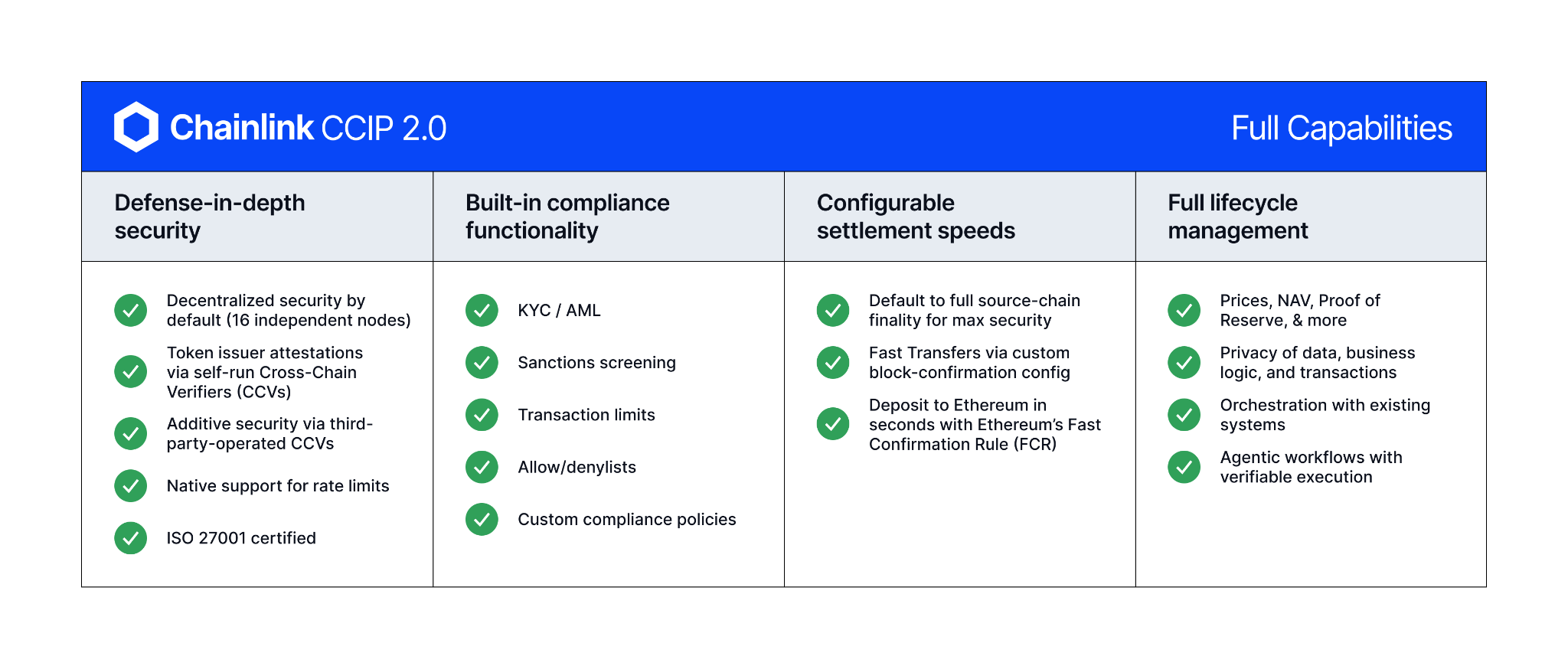
Capabilities of Chainlink CCIP 2.0, including additive security, configurable settlement speeds, and built-in compliance. — Source: Chainlink
Defender migration and reference solutions
OpenZeppelin said the partners are establishing a migration path from Defender to Chainlink Runtime Environment (CRE).
OpenZeppelin and Chainlink plan to deliver three institutional reference solutions combining OpenZeppelin smart contracts with CRE workflows. According to OpenZeppelin, the planned solutions are to include deployable code, architecture documentation, threat models, security considerations and internal quality reviews.
CCIP and ACE integration is live across OpenZeppelin Wizards, AI tooling, Skills and documentation, while UI Builder support remains planned for a future release.