



Tokenized nickel, in the ALKN structure offered through Bitfinex Securities, is a regulated digital security linked to a financing arrangement supported by physical nickel inventory. It is not a token that gives its holder a claim to a particular length of nickel wire or puts metal itself on a blockchain.
Bitfinex Securities announced a planned $50 million tokenized capital raise for Luxembourg-based Alkemya Metacore on August 27, 2026. The offering token, ALKN, represents limited-partnership interests connected to an estimated $1.6 billion stockpile of high-purity nickel wire held in Switzerland, according to CoinDesk. Understanding the legal interest, the custody of the metal and the rules for transferring the token matters more than the fact that a blockchain is involved.
ALKN is a limited-partnership interest, not nickel wire
ALKN represents a digital limited-partnership interest. Its holder therefore has a legal and economic interest in an investment structure, not direct title to individual pieces of the supporting nickel inventory.
Physical nickel supports the arrangement, and the capital raised is intended to fund a business producing engineered nickel products. The token’s rights—including its economic claims and any applicable redemption terms—are set by the offering’s governing documentation.
Those terms matter because buying ALKN does not necessarily entitle the holder to delivery of a specified amount of nickel, and the token’s value is not necessarily identical to nickel’s spot price. ALKN is best understood as a regulated financing instrument with off-chain asset support, rather than digitized warehouse receipts for retail metal collection.
In the tokenized-commodity model, Bitfinex says blockchain can record and transfer a legal claim or exposure linked to an off-chain commodity. The underlying nickel does not thereby become native to the network.
Swiss nickel inventory supports the structure
The reported underlying inventory consists of 7,026,905 linear metres of NP1-grade nickel wire, with stated purity of 99.99% and a diameter of 0.025 millimetres. Bitfinex describes the material as ring-fenced and unencumbered, held by Helvetic Securgest in a Swiss vault.
The reported approximately $1.6 billion value of that inventory is relevant because it provides the stated asset base behind a much smaller planned $50 million raise. But the presence of a substantial inventory does not itself define every right of an ALKN holder. Investors still need the legal terms to establish how the inventory relates to their limited-partnership interest and what happens if custody, valuation or the issuer’s operations are challenged.
Physical assets require a chain of evidence that a distributed ledger cannot replace. Bitfinex says the nickel inventory is subject to physical inspections, valuation review and financial auditing by independent firms. Those processes address questions that exist outside the blockchain: whether the metal exists in the stated form and location, whether it remains free of competing claims, and how its value is assessed.
A useful comparison is a digitized record connected to a secured financing arrangement. The token may make the record easier to issue and transfer among eligible investors, while vaulting, inspection and audit remain the means by which the physical foundation is maintained and checked.
Proceeds target engineered-nickel operations
Bitfinex’s ALKN materials describe proceeds for working capital, research and development, and manufacturing and distribution through Green Transitional Metals. The stated focus is engineered nickel products for electromagnetic shielding, aerospace and defense, semiconductors, power systems, green hydrogen and metals recovery.
Nickel’s established industrial uses include stainless steel, nickel-based superalloys for jet engines and rechargeable batteries, according to the U.S. Geological Survey.
In this structure, that industrial demand provides a commercial rationale for using nickel inventory as financing support or for financing businesses that process and apply nickel-based materials. It does not, by itself, define the investment exposure: investors are also tied to execution in the businesses and markets the proceeds are intended to fund. Manufacturing costs, research outcomes, customer demand, distribution and other operating factors can matter alongside changes in the value attributed to the inventory, so a nickel-linked security is not necessarily a straightforward commodity bet.

How investors enter and trade ALKN
ALKN is issued on the Liquid Network using Blockstream AMP. Unlike an unrestricted cryptoasset that can generally be sent to any compatible wallet, the security-token structure uses account whitelisting.
Only investors who complete required know-your-customer and anti-money-laundering checks can hold or transfer the token, according to Bitfinex. Investor eligibility and registration with the issuer are also part of the process. These controls are intended to keep transfers within the set of permitted holders rather than treating the token as freely transferable to any on-chain address.
The sequence can be understood in practical terms:
- An investor establishes eligibility and completes the required KYC/AML process.
- The investor registers with the issuer and, where approved, receives access to the capital raise.
- Funds are pledged during the primary offering and tokens are allocated under the raise’s applicable allocation rules.
- Following the offering, tokens may be available for secondary-market trading among eligible participants.
Bitfinex Securities says its capital-raise model can tokenize representations of shares or debt in a primary offering. Pledged funds are held during the raise, while allocations can use first-in-first-out or pro-rata rules; tokens may then trade on a secondary market. Availability, allocation and secondary trading remain subject to the terms and conditions of the specific offering.
This is why “on-chain” should not be confused with “permissionless.” The blockchain provides the infrastructure for issuance and transfer, but regulated eligibility rules can remain embedded in how holders and transfers are administered.
What blockchain changes—and what stays off-chain
Tokenization can make a financial interest divisible into smaller digital units and potentially streamline how eligible investors hold, transfer or settle that interest. Bitfinex identifies fractional ownership, faster settlement, continuous market access and potential use as collateral among the possible attractions of tokenized commodity exposure.
These are properties of the digital representation and the market infrastructure around it. They do not remove the institutions and contracts supporting the asset. A vault operator still holds the wire. Independent firms still need to inspect, value and audit it. An issuer and the relevant legal framework still determine investor rights, while compliance processes govern who can receive the token.
Consider a hypothetical transfer between two eligible ALKN holders. The on-chain transfer could update the token’s recorded holder under the whitelisting rules. It would not require the nickel wire to leave the Swiss vault or be physically divided. Nor would that transfer, by itself, answer whether a buyer can redeem metal; that depends on the contractual terms attached to the security.
For investors, the practical question is therefore not whether the token can move digitally. It is what exactly moves with it: the legal interest, the economic rights, the transfer restrictions and any claim connected to the underlying arrangement.
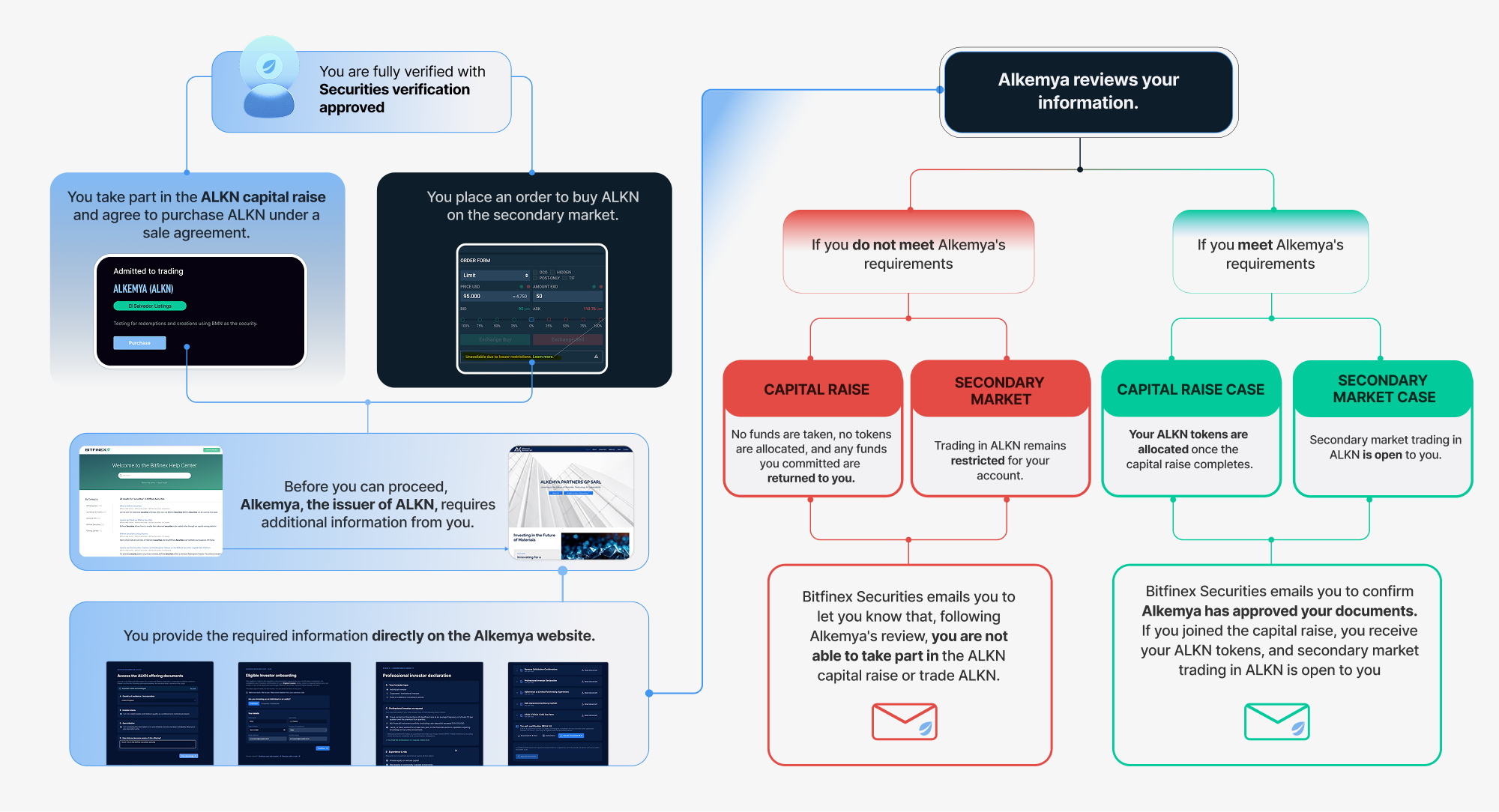
Official workflow diagram showing eligibility, issuer review and access to the ALKN capital raise and secondary market. — Source: Bitfinex Support
Custody, enforceability and liquidity are the constraints
Tokenization does not eliminate traditional financial and operational risks. The physical inventory remains dependent on custody arrangements, inspections, valuation review and audit. If any of those elements fails, a blockchain record alone cannot restore missing, impaired or incorrectly valued collateral.
Legal enforceability is equally important. A security token can accurately record a transfer, yet an investor’s ultimate protection rests on the legal documents, jurisdiction, issuer obligations and priority of claims. Prospective holders should distinguish between the existence of an on-chain token and the enforceable rights that token is intended to represent.
Valuation presents another issue. A token linked to inventory and an operating business may not trade in line with a simple quoted nickel benchmark. The assessed value of the specific wire, the terms of the structure and demand in the secondary market can all affect the price at which a holder can buy or sell.
The Bank for International Settlements’ Financial Stability Institute, summarizing work by the Financial Stability Board and BIS, has identified liquidity mismatches, valuation and oracle risks, operational and cyber vulnerabilities, legal uncertainty, third-party custody dependence and fragmented secondary-market liquidity as risks in tokenized arrangements. A compliant secondary venue may offer a route to trade, but it does not guarantee deep liquidity or an immediate exit at a desired price.
ALKN illustrates the essential trade-off. Blockchain infrastructure may modernize issuance and controlled transfer, but it concentrates attention on the things a token cannot independently verify: the asset’s custody, the quality of the legal claim, the accuracy of valuation and the availability of real buyers and sellers.
Frequently Asked Questions
Does ALKN give investors direct ownership of nickel wire?
No. ALKN represents a digital limited-partnership interest, rather than direct ownership of particular pieces or lengths of the Swiss-held nickel wire.
What physical asset is linked to the ALKN structure?
The stated inventory is 7,026,905 linear metres of 99.99%-pure, 0.025-millimetre NP1-grade nickel wire. Bitfinex says it is held in a Swiss vault by Helvetic Securgest.
What is the planned $50 million intended to fund?
Alkemya Metacore says the capital is intended for working capital, R&D, manufacturing and distribution of engineered nickel products through Green Transitional Metals.
Can anyone buy or transfer ALKN?
No. The structure uses whitelisted accounts, and holders must complete applicable KYC/AML requirements and investor-registration steps with the issuer.
Does a tokenized nickel security remove custody or liquidity risk?
It does not. The arrangement still depends on physical custody, verification, enforceable legal terms, valuation processes and a functioning secondary market among eligible investors.