


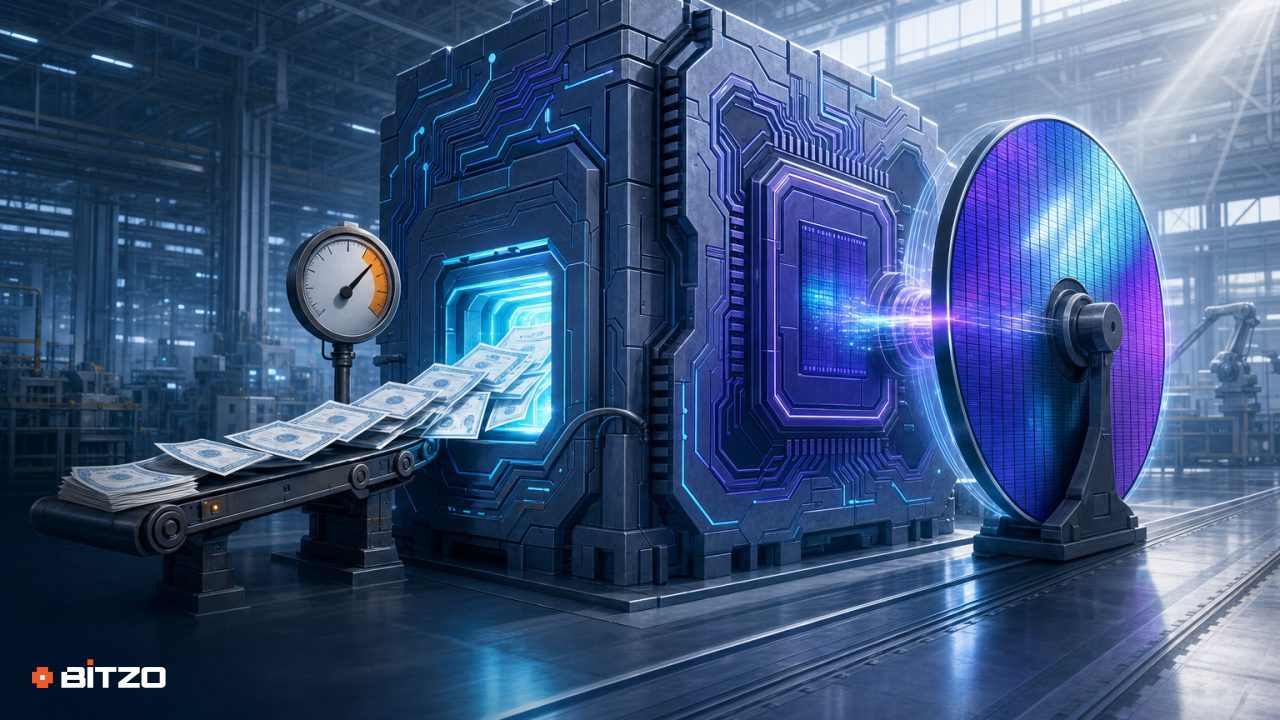
Intel is leaning into the hard way. If you want to build a global foundry business, you need capital. A lot of it. So rather than tiptoeing around leverage, the company is choosing the more honest path in markets: dilution.
Here’s the premise investors are chewing on right now: a massive new equity raise, framed here as a 5 billion-share sale, used to speed up Intel’s foundry buildout. Whether the final sizing lands exactly there or not, the direction of travel is obvious. Foundry scale takes cash, and cash comes at a price.
This isn’t just a semiconductor story. Crypto folks watch semis because chips shape everything from AI inference at the edge to mining economics and data center capacity. When capex and competition shift at the top of the stack, it trickles into hardware availability, pricing, and the way risk-on trades breathe.
| Point | Details |
|---|---|
| The raise | Intel is pursuing a large equity issuance, framed here as a 5 billion-share sale, to accelerate its foundry roadmap. Size, structure, and timing matter for dilution and price discovery. |
| Recent performance | Q2 2026 revenue reached $16.13B as the company leaned into AI demand (Investing.com). |
| Foundry snapshot | Intel Foundry Services booked $5.77B in Q2 2026 revenue; external foundry revenue was $293M, highlighting early-stage customer penetration (MarketBeat). |
| Capex path | Management lifted 2026 capex to 20B-plus and said 2027 will be “up meaningfully,” aligning with the need for equity fuel (Investing.com). |
| Street sentiment | UBS raised its price target to $121 in mid-July 2026, reflecting a more constructive view into the print (Benzinga). |
Why dilution now, not just more debt
Chipmaking is a capex blood sport. Fabs cost tens of billions. Ramps take years. Yields eat patience for breakfast. If you’re rebuilding a foundry business in the midst of an AI hardware arms race, you don’t nickel-and-dime your balance sheet. You raise real equity.
Why not lean harder on debt? Because ratings matter. Because the cycle can turn. Because each new fab or node ramp compounds execution risk. And because a foundry, by design, asks customers to trust you with their roadmaps for a decade. They like the look of a fortress balance sheet.
There’s also something cleaner about equity here. It puts a hard number on shared risk between management and shareholders. You accept dilution today to shunt cash into capacity that, if executed, pushes Intel into a structurally larger market.
Pro tip: When the prospectus hits, read the mechanics. Watch the offer type (fully marketed vs accelerated), the discount to the last close, any greenshoe, potential convertibles, and whether there’s an ATM program layered on top. Those details decide the trading tape over the first 10 sessions.
What the numbers already say about the foundry climb
Strip out the narrative and look at the scoreboard Intel just posted. Revenue for Q2 2026 landed at $16.13 billion, boosted by AI demand at various layers of the stack. That sets a baseline for what the core business can support while the foundry plan scales (Investing.com).
Inside that, Intel Foundry Services reported $5.77 billion in Q2 sales. The important tell is external foundry revenue: $293 million. That’s small in absolute terms, but it’s the right metric to watch because it measures how much non-Intel product is trusting Intel’s lines. The ramp there is the credibility curve (MarketBeat).
Capital is the lever. Management hiked 2026 capex above $20 billion and flagged 2027 spend will step up meaningfully as customer demand lines up against capacity plans. That posture all but requires fresh equity to keep balance sheet flexibility intact during the heaviest lift phase (Investing.com).
Wall Street’s not blind to the pivot either. UBS took its target to $121 ahead of the earnings call, suggesting incremental confidence that the plan can pass the sniff test if execution holds (Benzinga).
How a 5 billion-share sale could hit the math
Let’s keep this straight. The offering size used here is a scenario to explore mechanics. Your job is to plug in the actual terms once filed. The dilution math is simple but merciless.
At the headline level, more shares stretch earnings across a wider base. Even if net income rises as foundry revenue scales, near-term EPS generally steps down. Multiple compression can follow if the market doubts the return path. If investors believe the capex converts to durable, high-utilization revenue, the multiple can hold or expand.
Here’s the basic frame you’ll use when the term sheet drops:
New EPS = Net Income / (Existing Shares + New Shares)
Then pressure test the other inputs:
- What discount did the deal price clear at? A 3 to 8 percent range is common for accelerated offerings in liquid megacaps, but structure drives this.
- Is there a greenshoe? If yes, that’s extra capacity for stabilizing trades post-pricing.
- Any convertible component? That changes the dilution curve over time and often carries a higher premium, lower coupon profile.
- Are there lockups or parallel insider sales? Those change supply dynamics months out.
Pro tip: Build two models. One that assumes proceeds go straight to capex and pull forward revenue ramps by 2 to 4 quarters. Another that assumes delays and flat utilization for 12 months. Use both to bracket fair value while the noise is loud.
Debt vs equity vs converts: which signal are you getting
Funding a fab program isn’t binary. The instrument a company chooses telegraphs how it sees risk and timing.
| Instrument | Pros | Cons | Signal |
|---|---|---|---|
| Straight equity | Strengthens balance sheet; no interest burden; big upfront cash | Dilution; EPS drag near term | Management prioritizes flexibility and runway over short-term optics |
| Debt | Non-dilutive; tax shield | Leverage risk into a cyclical downshift; ratings pressure | Confidence in cash flows and timing; or limited equity appetite |
| Convertibles | Lower coupon; delayed dilution | Complex; future overhang at conversion | Bridging tool when management expects upside to crystallize later |
Given Intel’s capex guide and the multi-year nature of customer qualifications, straight equity to anchor the plan makes sense. It hurts today. It buys time tomorrow.
Timelines that move the stock more than the headline
The temptation is to anchor on the share count. Resist that. Watch the ramps.
- Customer qualification cycles. For new nodes and packaging, outside customers typically need 12 to 24 months to qualify, depending on complexity. Any slippage there is more damaging than a few extra points of dilution.
- Yield learning curves. Early wafers are expensive lessons. Yield moving from, say, 60 percent to the 90s changes the unit economics more than modest ASP shifts. Equity gives room to learn without panicking.
- Utilization. Foundries live on utilization. Idle cleanrooms are a tax. The faster external revenue moves from hundreds of millions toward the billions, the firmer the investment case.
Don’t anchor on quarter-to-quarter noise. Track three lines: external foundry revenue, capex cadence versus guide, and any disclosed mega-customer wins. Those three lines will tell you how the dilution ages.
What it means for crypto and AI-exposed segments
Why should crypto market participants care? Because hardware capacity isn’t just a tech stock story. It feeds into everything from GPU leasing rates to the availability of cutting-edge packaging used in AI inference, and yes, into the economics of specialized mining hardware at the margin.
- AI infra spillovers. If Intel successfully adds competitive capacity for advanced packaging and compute, tightness in the AI supply chain could ease sooner at the edge and in smaller data centers. That can shift demand for tokenized AI services and the economics of decentralized inference networks.
- Mining and hardware cycles. Miners tend to chase efficiency gains. Foundry competition, even if not focused on mining ASICs, can influence lead times and pricing power across adjacent suppliers. Small changes in delivery windows can swing hashrate expansion plans.
- Risk-on correlation. Semis are bellwethers. When investors price in smoother supply for AI buildouts, risk appetite often broadens. We’ve seen crypto beta wake up during periods when hardware bottlenecks show signs of easing.
A reality check though: external foundry revenue was just $293 million in Q2 2026, so we’re early in the third-party adoption curve (MarketBeat). Manage expectations. The crypto-adjacent impacts are second-order and slow moving.
How to think about the offering overhang
Equity raises in megacaps develop playbooks. You don’t need to overcomplicate it.
- Wait for terms. The real price is the offer price, not yesterday’s close.
- Watch the book coverage. Multiple times covered at a modest discount means fast digestion. Soft books and extended marketing mean wider discounts or structure tweaks.
- Track the greenshoe. If exercised in full, it can smooth the first two weeks of trading.
- Respect lockups and blackout windows. Secondary supply has a way of arriving on the first legal day it can.
- Rerun your models at T+1 and T+10. The market will. Update for any incremental disclosures about customer wins or capex phasing.
And keep the macro picture in the corner of your eye. Intel printed $16.13B in Q2 revenue and lifted capex above $20B for the year. Those facts contextualize the raise and give you a sanity check on what a sustainable balance sheet might need to look like (Investing.com).
Common mistakes and myths to avoid
- Myth: Equity raises always crush stocks. Reality: If the proceeds fund high-return projects and remove uncertainty, the stock can base and grind higher. Execution decides.
- Mistake: Ignoring the use of proceeds. A dollar to capex that accelerates a node ramp is not the same as a dollar to plug a cash hole.
- Myth: Foundry turns profitable overnight. External foundry revenue at $293M in Q2 2026 says we’re still in proof mode for third-party volume (MarketBeat).
- Mistake: Modeling linear ramps. Yields and customer qualifications are lumpy. Assume delays and build buffers.
- Myth: Analysts raising targets guarantees a floor. UBS at $121 is a datapoint, not a parachute (Benzinga).
What to watch next
- The prospectus. Offer size, type, pricing, greenshoe, and any convertible terms.
- Capex cadence. Management guided 2026 capex above $20B with more in 2027; watch quarter-by-quarter spend versus plan (Investing.com).
- External foundry revenue. The jump from hundreds of millions to billions is the tell for third-party momentum (MarketBeat).
- Pacing of AI hardware supply. Any signs of easing backlogs for accelerators and packaging are relevant for broader risk appetite.
- Policy and subsidies. Milestones or adjustments around domestic manufacturing incentives can shift the capital stack calculus.
Frequently Asked Questions
Is a 5 billion-share sale confirmed?
The piece analyzes a large equity raise framed as a 5 billion-share sale to explain mechanics and implications. Treat that as scenario sizing until official terms are filed. The logic holds either way: bigger foundry ambitions require more equity.
Why would Intel pick dilution over debt?
Fabs are capital hungry and cyclical. Equity preserves balance sheet flexibility, buffers execution risk during multi-year ramps, and signals to customers that Intel can fund commitments without tripping ratings or covenants.
How much will EPS be diluted?
It depends on the final share count and pricing. The quick math is Net Income divided by total post-deal shares. Update your model once the prospectus sets the exact sizing and discount.
What’s the key metric for the foundry pivot?
External foundry revenue. It was $293M in Q2 2026, which shows early customer traction but a long runway ahead. Sustained growth there, alongside utilization and yield gains, is what refuels the equity story.
Does higher capex change the risk?
Yes. Management raised 2026 capex above $20B and said 2027 will step up. Bigger checks magnify execution risk but also accelerate timelines. Equity funding helps manage the downside if ramps slip.
How could this affect crypto markets?
Indirectly. If AI hardware bottlenecks ease and data center capacity scales, risk appetite can broaden. Hardware pricing and availability also ripple into GPU rental markets and, at the margin, mining hardware cycles.
What near-term catalysts matter most?
The offering’s final terms, any major third-party foundry wins, and quarterly updates on capex pacing and external foundry revenue. Analyst estimate revisions will follow those breadcrumbs.