


By mid-morning the tape lit up: Kingspan was up 17.8%, and suddenly a boring corner of building materials looked like an AI trade. Not chips. Not cloud stocks. Insulation and panels.
What changed? A simple story, really. Data centers are no longer a niche real estate category. They are a construction super-cycle, and the supply chain that wraps them is starting to re-rate.
If you make the envelope that keeps 30 megawatts of compute cool and dry, the market is finally noticing you.
For months, hyperscalers have been sprinting to add capacity, shifting from a few hundred megawatts per campus to multi-gigawatt masterplans. That creates a predictable pull on certain materials: airtight walls, high R-value roofs, fire-safe panels, and interior systems that manage airflow with surgical precision. Kingspan sits right in that lane.
AI is turning the data center shell into performance equipment. The envelope is now part of the thermal system, not just weather protection.
The capex is staggering and increasingly public. Meta’s expansion headlines alone tell you where this is going. On July 13, 2026 the company said it will expand its Hyperion campus in Louisiana to 5 gigawatts of IT capacity and expects the site will require more than 50 billion dollars of investment, a number that pushes the project into utility-scale territory (Data Center Knowledge).
Two weeks later Meta and BlackRock announced a joint venture to build a 1 gigawatt campus in El Paso, Texas, a roughly 14 billion dollar project with a large chunk of financing arranged as 12.5 billion dollars of debt (Meta investor press release / PRNewswire).
And zooming out, FactSet tallied hyperscaler aggregate capex that could exceed 690 billion dollars in FY26, with about 490 billion dollars spent in the 12 months to May 2026. That is not a normal cycle for construction inputs. That is a gravitational field (FactSet Insight).
Why data centers are a materials story now
When you turn power into heat at unprecedented densities, the building has to help you, not fight you. The envelope matters. That has three immediate consequences for materials suppliers.
Envelopes as performance gear
Insulated metal panels and high-spec insulation reduce thermal loads on HVAC and liquid-cooling systems. Airtightness, thermal bridging control, and fire performance are now line items in project economics. If an envelope can shave megawatts off cooling or keep humidity within tight tolerances, it gets premium treatment.
Speed equals premium
Hyperscalers operate on compressed timelines. Panelized systems that show up finished, click into steel, and pass tests fast will win orders. Downtime during fit-out is ruinously expensive. Materials that shorten critical paths command share.
Standardization creeps in
Campuses roll out in modules. Once a spec is locked for a first building, suppliers often ride the copy-paste to subsequent phases. That creates stickiness and amplifies the initial win into multi-year production.
Where the demand is coming from
The headlines are big, but the nuance is bigger. The demand spike is not just one social network building a server farm. It is an industry-wide tilt toward purpose-built AI campuses that tie into the grid like small cities.
| Initiative | Stated capacity | Capital scale | Read-through for materials | Source |
|---|---|---|---|---|
| Meta Hyperion, Richland Parish, LA | 5 GW IT capacity | > $50B project | Multi-phase panelized shells, large roof/insulation scope, long-run standardization potential | Data Center Knowledge |
| Meta x BlackRock, El Paso, TX | 1 GW campus | ~ $14B, $12.5B debt | Programmatic build with financing visibility, likely fast-turn envelope packages | Meta PR |
| Hyperscaler capex (FY26) | Sector aggregate | > $690B est. | Breadth of demand beyond one client, multi-vendor pull through across regions | FactSet |
The financing angle
External capital is stepping in because AI build schedules outrun internal cash flows. That matters for suppliers. Debt-backed programs tend to move on rails once paperwork clears, reducing stop-start risk on purchase orders. It does not make demand risk disappear, but it does add a layer of schedule discipline.
What Kingspan actually sells into AI campuses
It helps to get specific about product-market fit. Kingspan’s data center relevance is not vague.
Insulated metal panels and high-R roofs
These are the obvious ones. Factory-finished panels deliver consistent thermal performance, speed installation, and bring tested fire ratings. On a 200,000 to 400,000 square foot shell, the scope is large and repeatable.
Airflow-guiding interiors
Inside the white space, raised access floors and airflow management systems do two jobs at once. They route power and networking cleanly and help direct cold air where it is needed. As chips get hotter and liquid cooling spreads, the floor and plenum strategy still matters for containment and serviceability.
Envelope-integrated details
Doors, penetrations, cable trays, parapets, roof upstands. The unglamorous bits decide whether a building stays airtight and dry after a year of wind loading and thermal cycling. Turning these into standard kits reduces field risk. That is the kind of detail hyperscalers will pay up for.
Cooling, water, and the site constraint nobody can wish away
Here is the other side of the coin. Siting is getting harder, and that shapes product choices. A Virginia Department of Environmental Quality study released July 30, 2026 concluded that under current permitting standards no location east of I-95 can support a hypothetical large groundwater withdrawal of 3 million gallons per day. Sustainable withdrawal estimates were as low as less than 30,000 gallons per day in some counties, and roughly 360,000 gallons per day in Northumberland County (Data Center Knowledge summarizing the DEQ report).
Why does that matter to an insulation maker? Because water constraints push cooling strategies away from evaporative-heavy designs and toward air-cooled chillers, closed-loop liquid systems, and heat rejection that needs tighter envelopes and better thermal isolation. If you cannot spend water, you have to spend materials and power.
Hotter chips, tighter buildings
The thermal gradient between indoors and outdoors grows as densities climb. That puts pressure on joints, gaskets, and panel continuity. Materials that keep their stated performance across temperature swings and humidity cycles become more valuable.
How this translates to orders, revenue, and timelines
Investors often ask when construction demand actually shows up in the P&L. The rough sequence for a greenfield campus looks like this.
- Site control and power agreements. The client needs grid access or a plan for on-site generation.
- Permitting and environmental. Water and air permits can change the cooling and envelope spec.
- Design-freeze and procurement. This is where panel systems, roofs, and interior airflow components get locked and long-lead items are booked.
- Shell and core. Envelope installation drives visible progress and cash collection milestones.
- White space fit-out. Raised floors, containment, and finishes go in as mechanical and electrical systems land.
- Commissioning and repeat. If the first module hits targets, the spec tends to roll into the next building with fewer surprises.
For a supplier like Kingspan, revenue typically starts in the shell-and-core phase and extends into interior systems through fit-out. Because many AI campuses build in repeating blocks, the first win can morph into a multi-year run-rate as long as the spec holds.
Margin nuance
Margins can improve on repeat work. Crews get faster, site logistics settle, and waste falls. But the flip side is pricing pressure once a spec becomes familiar. Hyperscalers negotiate hard. The long game is to keep adding performance features that justify premium positioning.
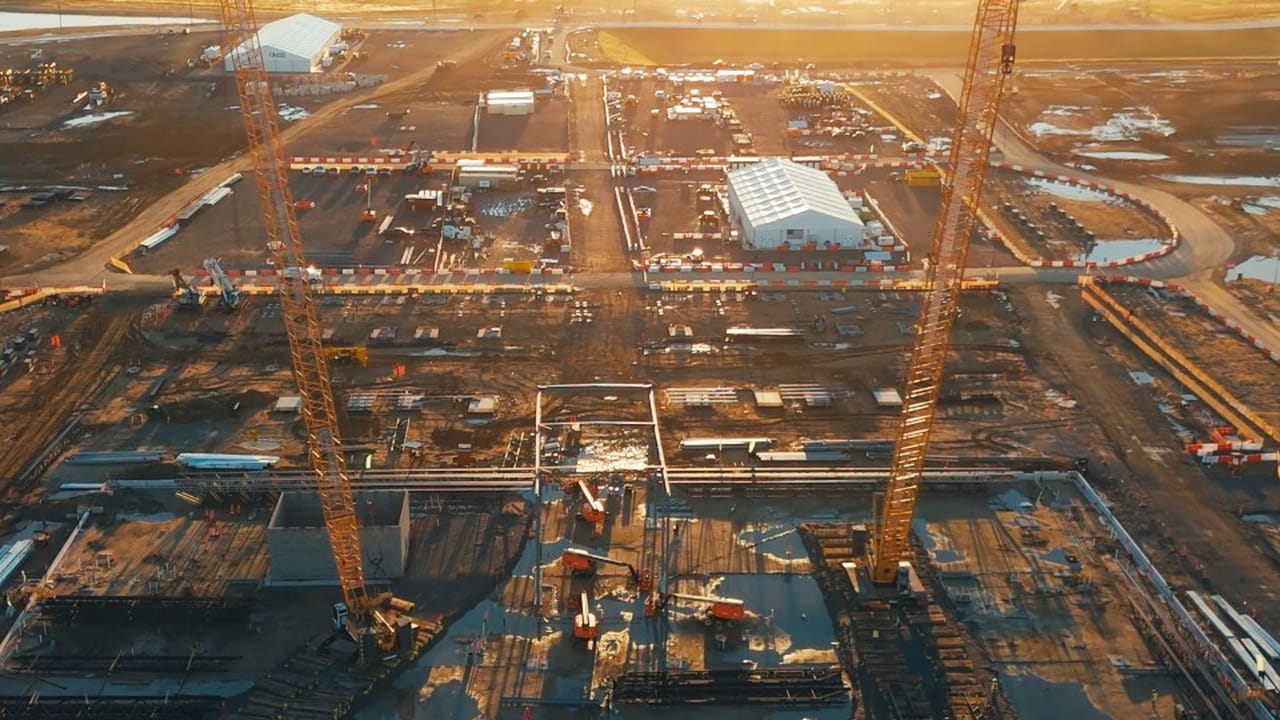
Aerial photo of Meta’s Hyperion construction (July 13, 2026) — illustrates the scale of hyperscale data‑center building activity that drives demand for insulation, panels and other building‑materials suppliers. — Source: Data Center Knowledge
Who else is riding the wave, and how Kingspan fits
Data center builds have a big cast. Mechanical heavyweights handle chillers and air handlers. Power specialists deal with switchgear and UPS. Electrical contractors fight for racks and busways. Building envelope and interiors are a distinct lane in that orchestra.
Adjacent beneficiaries
Power and thermal vendors have been early winners as AI loads skyrocketed. But as sites scale to gigawatts and move into hotter, drier regions, the building itself is getting re-specified. That is where envelope players step forward. The field includes insulated panel makers, roofing specialists, and data center interiors firms with airflow chops. Kingspan’s angle is the combination of exterior performance and interior airflow that plugs into standard campus templates.
Regional spread
With Meta’s El Paso project financed in part through a 12.5 billion dollar debt package and the Louisiana Hyperion site framed as a 5 gigawatt destination, the U.S. South and Southwest are clearly in focus. Europe and parts of APAC will follow their own regulatory paths. Water stress and grid access will push designs toward closed-loop cooling and tighter building skins in multiple regions, not just Virginia.
Risks and what could go wrong
- Permitting friction. Water, noise, and land-use fights can slow projects or push them to different specs, shifting product mixes or timelines.
- Grid constraints. Delays in substation buildouts or transmission upgrades can defer shell starts, dragging on materials orders.
- Spec volatility. A late design pivot from evaporative to fully air-cooled systems can change envelope needs, hurting near-term visibility.
- Price pressure. Once a standard is set, hyperscalers may rebid to drive down unit costs across follow-on phases.
- Cycle whispers. If AI demand expectations cool or financing tightens, campuses can stretch builds over longer windows.
- Execution bandwidth. Labor and logistics can bottleneck if too many mega-campuses ramp at once, pinching margins.
Big-ticket capex is great until one chokepoint slows the parade. Power, permits, or specs can each play spoiler.
Frequently Asked Questions
Why did Kingspan jump 17.8%?
The move lines up with growing conviction that AI data centers are a multi-year build program, not a one-off spike. As hyperscaler capex swells and mega-campuses stack up, investors are re-rating suppliers that sit on the critical path, including building envelope and interior airflow systems.
Which Kingspan products are most relevant to data centers?
Insulated metal wall and roof panels, high R-value insulation, and interior systems that manage airflow and containment. The value proposition is thermal performance, speed of install, and predictable fire and weather ratings across large footprints.
How do hyperscaler announcements translate into orders?
After site and power are locked, clients freeze designs and start procurement. That is the window when panel packages and interior kits get booked. Once a campus template is proven on the first building, follow-on phases often repeat the spec with minor tweaks.
Is water scarcity really shaping building choices?
Yes. A July 2026 Virginia DEQ-linked analysis found no location east of I-95 could support a hypothetical 3 million gallon per day groundwater withdrawal under current rules, with some counties under 30,000 gallons per day sustainable levels. That pushes projects toward water-light cooling and tighter envelopes to cut thermal loads.
What does the Meta and BlackRock JV signal?
Scale and financing structure. A 1 gigawatt El Paso campus funded in part with a 12.5 billion dollar debt facility suggests more programmatic builds with external capital, which can improve schedule certainty for suppliers once contracts are in place.
How big is the AI capex wave overall?
FactSet estimated hyperscaler capex could exceed 690 billion dollars in FY26, with about 490 billion dollars spent in the 12 months to May 2026. That breadth implies demand is not dependent on a single buyer or campus.
Is this investment advice?
No. This is context to help you frame the drivers and risks. Shares can be volatile, specs can change, and big projects can slip. Do your own research and consider risk tolerance carefully.