


The broader decentralized finance landscape is facing a profound macroeconomic reality check. With traditional finance yields remaining elevated—such as U.S. Treasury bills actively cannibalizing crypto liquidity—the overall stablecoin market cap has stalled at a stubborn $301 billion plateau. Capital allocators are prioritizing preservation over the speculative yield farming that defined previous cycles.
Within this tightened liquidity environment, the "Rollup + Synthetic Dollar" stack is being stress-tested. Arbitrum (ARB), the premier Ethereum Layer-2 rollup, and Ethena (ENA), the protocol behind the synthetic dollar USDe, are critical infrastructure for on-chain stable yield. Yet, despite their fundamental utility, both assets are trapped in well-established technical downtrends, trading dangerously close to their 30-day structural floors. The question for traders is whether these current valuations represent a deep value accumulation zone for a resilient DeFi stack, or simply the deflation of another points-driven campaign.
Arbitrum (ARB): Rollup Beta Sitting On The Floor
Source: tradingview
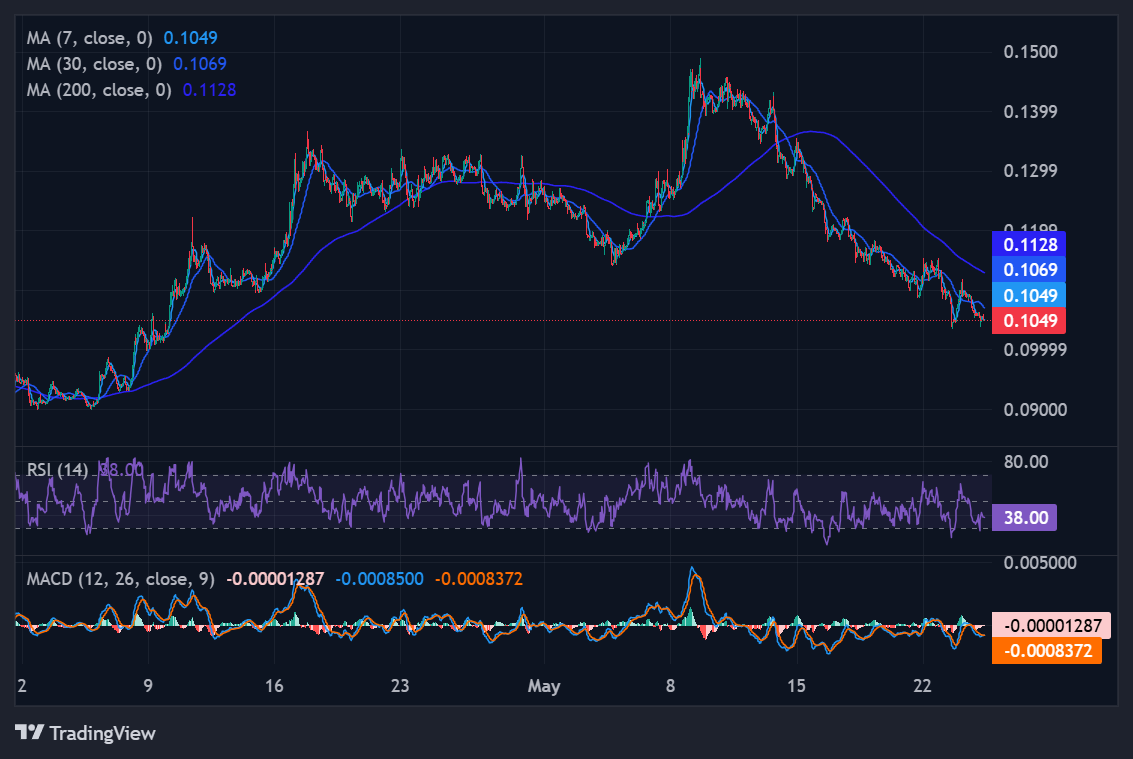
Arbitrum remains the dominant Layer-2 by Total Value Locked (TVL), yet its native token is trading like highly speculative beta. With the SMA-7 ($0.111), SMA-30 ($0.124), and SMA-200 ($0.153) all stacked above the current price, ARB is in a textbook, persistent downtrend.
The Fibonacci Map ($0.1035 to $0.1489):
-
78.6% Retracement: ~$0.113
-
61.8% Retracement: ~$0.120
-
50.0% Retracement: ~$0.126
-
38.2% Retracement: ~$0.131
Immediate Support:
-
$0.103 to $0.105: ARB is currently sitting right on its 30-day swing low ($0.1035). This is the absolute critical local floor. Because it has fallen so far, there is no other meaningful support inside the 30-day window. A daily close below $0.103 confirms a new structural leg down, potentially exposing ARB to severe multi-month lows.
Immediate Resistance:
-
$0.113 to $0.121: The 78.6% and 61.8% Fibonacci levels. This is the first "bounce band." Reclaiming and holding this zone would be the first indication that short-sellers are backing off.
-
$0.126 to $0.132: The 50% and 38.2% levels, converging near the 30-day SMA ($0.124). Turning this band into support is how ARB would signal a legitimate trend repair rather than a dead-cat bounce.
The Read: ARB is cheap for a reason: it is deeply oversold within a persistent downtrend. It is hugging its structural floor. Unless it can rapidly reclaim the $0.113 bounce band, it is highly vulnerable to further downside exploration.
Ethena (ENA): Synthetic Dollar Beta Grinding Lower
Source: tradingview
Ethena’s USDe has achieved a staggering $14.8 billion market cap, capturing roughly 5% of the total stablecoin market. However, with perpetual futures funding rates heavily compressed in Q2 2026, the synthetic yield engine has stalled. Consequently, the ENA token is grinding lower alongside it.
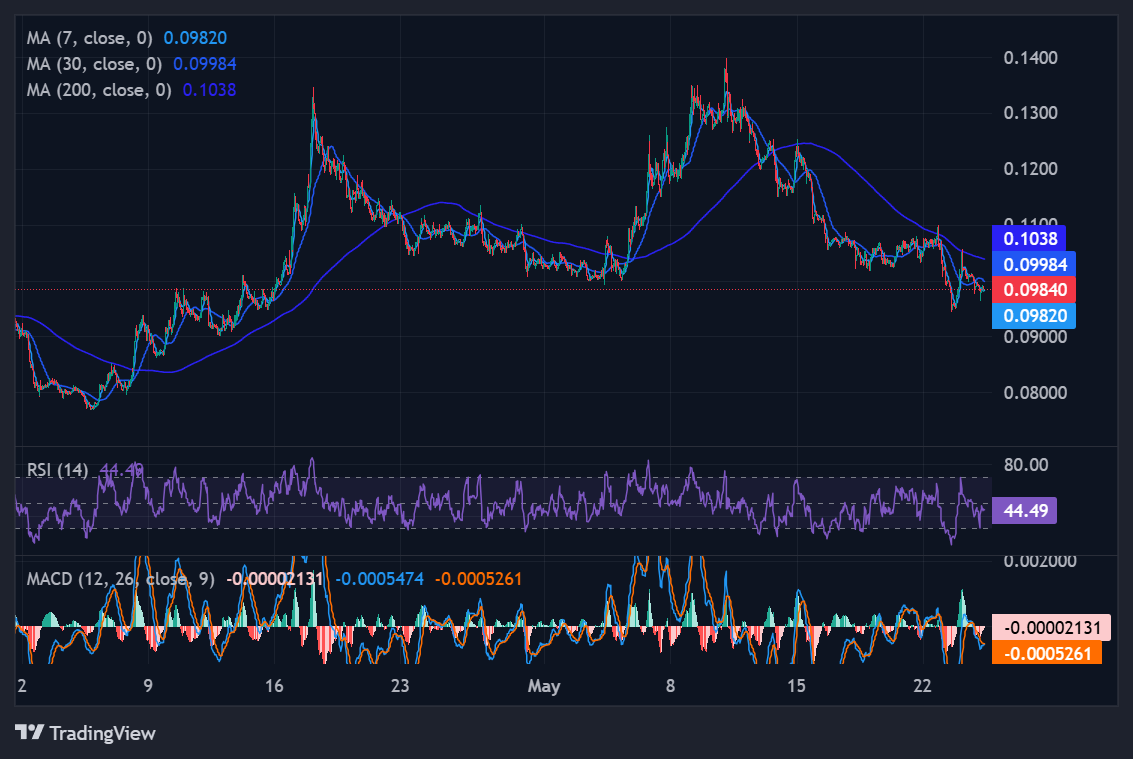
The Fibonacci Map ($0.0944 to $0.1397):
-
78.6% Retracement: ~$0.104
-
61.8% Retracement: ~$0.111
-
50.0% Retracement: ~$0.117
-
38.2% Retracement: ~$0.122
Immediate Support:
-
$0.094 to $0.099: ENA is hovering precariously above its 30-day swing low ($0.0944). Like ARB, this is the final line of defense within the current structure. A daily close below $0.094 confirms a deeper, prolonged down leg.
Immediate Resistance:
-
$0.104 to $0.112: The 78.6% and 61.8% retracements. The short-term SMA-7 ($0.103) sits at the very bottom of this band. This is ENA’s initial resistance ceiling; reclaiming it would suggest the synthetic-dollar narrative still commands residual buying power.
-
$0.117 to $0.122: The 50% and 38.2% levels. ENA must reach this territory to even begin testing its 30-day moving average (~$0.110), proving it has the strength to revert to the mean.
The Read: ENA is exhibiting steady weakness. All moving averages are stacked above the price, indicating a clear downtrend. It must furiously defend the $0.094 floor to prevent a slide into deep, historical base levels.
Conclusion: Core DeFi Stack Or Points-Driven Pair?
Both assets are exhibiting the classic hallmarks of tokens that have exhausted their initial hype cycles and are now searching for a fundamental price floor in a risk-off environment.
They Anchor the “Rollup + Synthetic Dollar” Stack If:
-
ARB holds the $0.103 support floor and grinds back into the $0.113–$0.132 resistance block, converting it into support as on-chain TVL stabilizes.
-
ENA defends the $0.094 floor, reclaims the $0.104–$0.112 zone, and begins trading higher as synthetic yield strategies maintain demand despite compressed funding rates.
-
Macroeconomic friction eases, and institutional capital rotates back from U.S. Treasuries into decentralized, stable yield opportunities.
They Remain "Just Another Points-Driven Pair" If:
-
ARB loses the $0.103 floor and ENA loses the $0.094 floor, triggering cascading liquidations into deeper ranges.
-
Relief rallies repeatedly stall at the very first Fibonacci resistance bands ($0.113 for ARB; $0.104 for ENA) and fade quickly on weak volume.
-
The market effectively declares that capital only entered these ecosystems to farm airdrop points, and without double-digit yields, the liquidity is exiting permanently.
Final Verdict: The charts confirm a harsh reality: both ARB and ENA are fundamentally cheap relative to their recent highs, but they are fighting a massive uphill battle against a rotation-heavy, yield-starved environment. They are deeply oversold and leaning on their final support floors. Until they can break overhead resistance, they remain high-risk, high-beta plays.
Disclaimer: This article is provided for informational purposes only. It is not offered or intended to be used as legal, tax, investment, financial, or other advice.