



PR teams often reference traffic numbers, domain authority, and visibility metrics when selecting media outlets. On the surface, this creates the impression of a structured, analytical process.
In reality, most PR decisions are still based on partial data and interpretation.
Checking traffic and SEO scores is not the same as understanding media performance. These metrics provide signals, but they do not explain how an outlet contributes to real communication outcomes.
As a result, many campaigns operate in a gray zone—supported by data, but not truly guided by it.
Why traffic became the default metric
Traffic is attractive because it answers a straightforward question: How many people could potentially see this content? This makes it easy to compare outlets at a glance. A publication with higher traffic appears to offer greater reach and, by extension, greater value.
But this assumption breaks down quickly. Traffic does not indicate:
-
whether the audience is relevant
-
whether readers engage with content
-
whether the content spreads beyond the initial publication
In practice, high traffic often correlates with volume, not impact.
The limits of domain authority
Domain authority (and similar SEO metrics) emerged as a second layer of evaluation.
It reflects the strength of a website’s backlink profile and its ability to rank in search engines. For PR teams, it became a proxy for credibility and long-term value.
However, domain authority has its own limitations.
It does not capture:
-
audience behavior
-
editorial influence
-
content distribution dynamics
An outlet can have strong domain authority and still play a limited role in shaping industry narratives. Conversely, smaller publications may have lower scores but higher influence within specific communities.
Like traffic, domain authority describes one dimension, not the full picture.
The core issue: fragmented metrics
The real problem is not that traffic or domain authority are useless.
It is that they are used in isolation.
Media teams typically combine:
-
traffic data from one tool
-
SEO metrics from another
-
qualitative judgment from experience
These signals rarely align. One outlet may lead in traffic, another in SEO, and a third in perceived influence.
Without a standardized framework, teams are forced to interpret these differences manually. This introduces inconsistency and bias into decision-making.
As a result, media selection often remains closer to educated guesswork than true analysis .
From metrics to systems: the role of Outset Media Index
Outset Media Index (OMI) addresses this gap. Instead of focusing on individual indicators, OMI analyses media outlets through a multi-dimensional framework based on more than 37 normalized metrics. These include audience reach, engagement, SEO and AIO visibility, editorial flexibility, syndication depth, and influence within the information flow.
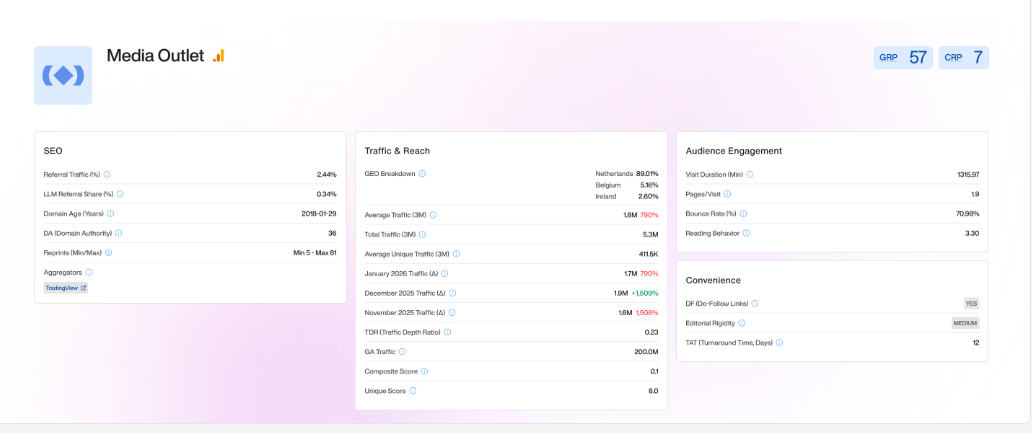
By integrating these signals into a single system, OMI provides a holistic view of media performance, rather than a fragmented one .
Why a multi-dimensional approach matters
The key advantage of OMI is not just the number of metrics, but how they are structured.
Metrics are:
-
normalized to allow fair comparison
-
combined into a consistent analytical model
-
benchmarked across a dataset of outlets
This makes it possible to understand not just how an outlet performs in isolation, but how it compares to others across multiple dimensions.
Instead of choosing between traffic and domain authority, teams can assess:
-
which outlets drive engagement
-
which contribute to search visibility
-
which shape industry narratives
-
which combine multiple forms of impact
This transforms media selection into a data-driven process rather than an interpretive one .
From guesswork to decision-making
With a unified framework, PR teams no longer need to reconcile conflicting signals manually.
They can:
-
compare outlets side by side
-
align media choices with campaign goals
-
prioritize placements based on expected outcomes
This reduces uncertainty and improves consistency across campaigns.
It also shifts PR from a reactive discipline—focused on securing placements—to a strategic one focused on maximizing impact.
Conclusion
PR without structured data is no longer sustainable. Traffic and domain authority still have value, but only as part of a broader system. Outset Media Index standardizes fragmented data into a unified framework, it enables teams to move beyond surface-level indicators and make decisions based on a complete view of media performance.
Disclaimer: This article is provided for informational purposes only. It is not offered or intended to be used as legal, tax, investment, financial, or other advice.