

The idea of a 0% APR crypto loan attracts attention for a reason. Borrowing against BTC or ETH without paying interest sounds like free liquidity. In practice, these offers exist, but only under specific conditions.
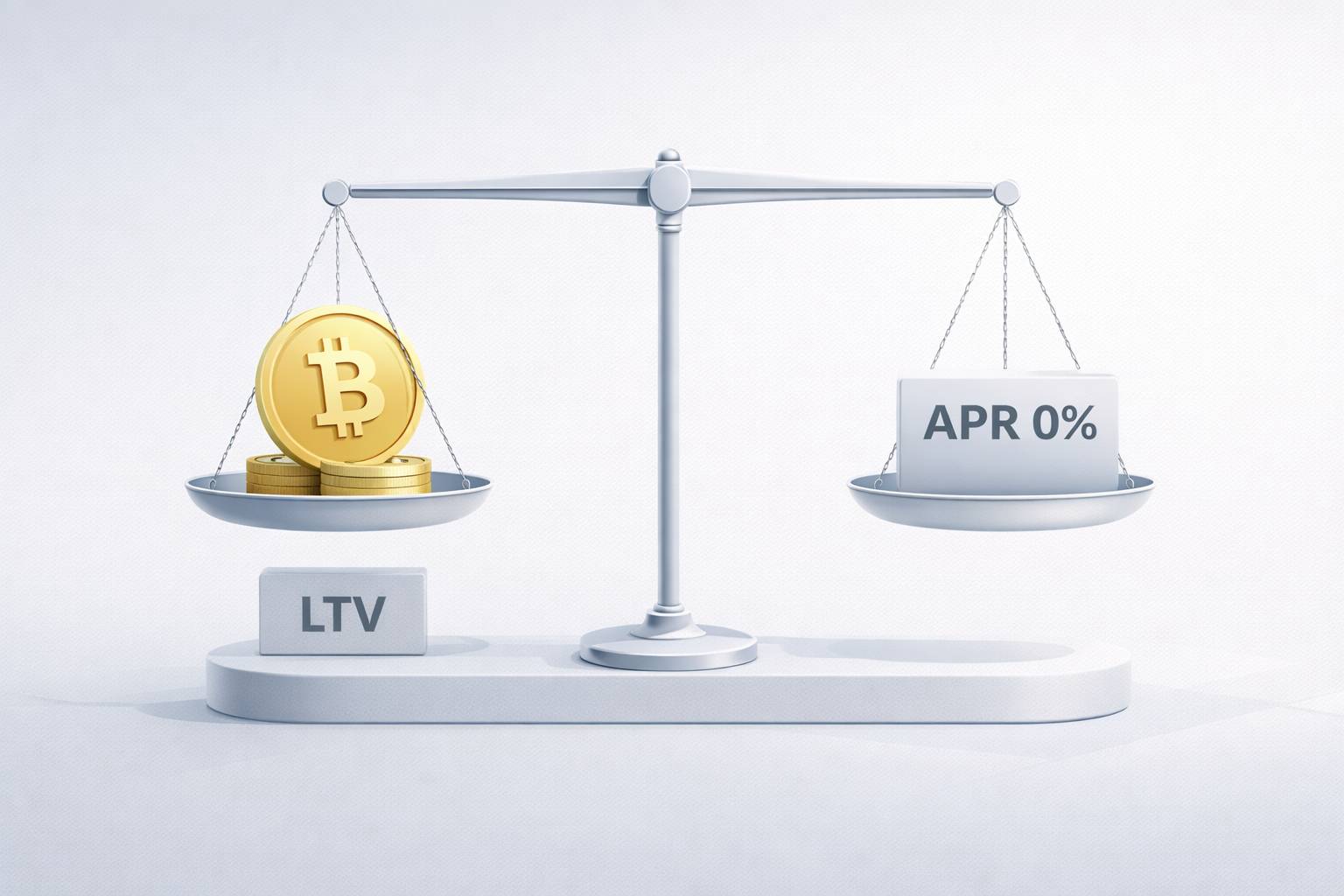
In 2026, the cost of borrowing against crypto is not defined by headline APR. It is defined by LTV, loan structure, and how the credit is used. Zero-cost borrowing is possible, but only if these variables are controlled.
What “0% APR” Means in Crypto Lending
Most platforms do not offer unconditional 0% interest.
Instead, pricing is tiered:
-
At low LTV (typically ≤20%), APR can drop to 0% or near zero
-
As LTV increases, rates adjust upward
-
Terms are dynamic, not fixed
A second interpretation of 0% APR appears in credit-line models. Here, unused credit carries no cost. You can secure a borrowing limit without paying interest unless funds are actually drawn.
Strategy 1: Keep LTV Below the Critical Threshold
LTV is the primary lever.
A borrower who deposits €10,000 in BTC and borrows €2,000 operates at 20% LTV. At this level:
-
APR is at its lowest tier
-
liquidation risk is minimal
-
pricing stability is higher
If BTC drops, LTV rises automatically. A 30% market decline pushes a 20% LTV position toward ~28–30%. This is still manageable.
At higher starting LTV, the same move creates immediate pressure.
For users searching how to get a 0% APR crypto loan, the answer is consistent: borrow less than you can.
Strategy 2: Use a Credit Line Instead of a Fixed Loan
Traditional crypto loans create cost immediately. You borrow €5,000 and start paying interest on the full amount from day one.
A credit-line structure changes this.
Clapp, for example, assigns a borrowing limit instead of issuing a full loan. Interest applies only to the portion that is actually used. The rest of the credit remains at 0% APR .
This allows a different approach:
-
secure liquidity in advance
-
draw funds only when needed
-
repay quickly to stop interest accrual
For users searching to borrow against crypto low APR or 0% APR crypto credit line, this structure is often more efficient than chasing the lowest advertised rate.
Strategy 3: Treat Borrowing as a Liquidity Buffer
The cheapest loan is the one that is not fully used.
Instead of borrowing a lump sum, advanced users treat credit as a reserve:
-
keep a €10,000 credit line
-
use €500–€1,000 when needed
-
repay as soon as possible
In this setup, most of the capital remains unused and therefore free.
This aligns with how Clapp’s model is designed. Unused credit carries no cost, and interest applies only during active usage periods .
The result is closer to on-demand liquidity than a traditional loan.
Strategy 4: Monitor and Act on LTV Drift
LTV is not static.
If BTC or ETH declines:
-
LTV increases
-
APR tiers may change
-
liquidation thresholds move closer
Maintaining low cost requires active management:
-
add collateral when markets fall
-
repay part of the loan
-
avoid high initial leverage
This is particularly important for users targeting 0% APR tiers, since these are usually tied to strict LTV limits.
Strategy 5: Use Multi-Collateral to Stabilize Risk
Single-asset collateral introduces concentration risk.
If BTC drops sharply, the entire loan is affected.
Platforms that support multi-collateral pools allow combining assets such as BTC, ETH, and stablecoins. This can stabilize the overall collateral base and reduce volatility impact.
Clapp supports multi-asset collateral within a single credit line, which can improve borrowing capacity and reduce the likelihood of sudden LTV spikes .
This does not eliminate risk, but it changes how it behaves.
Strategy 6: Avoid Long-Term High Utilization
Even low APR becomes expensive over time if the loan is fully utilized and left open.
A common mistake is treating crypto borrowing as long-term leverage rather than short-term liquidity.
Cost-efficient usage follows a different pattern:
-
short borrowing periods
-
partial utilization
-
active repayment
This keeps effective APR close to zero, even if the nominal rate is higher.
How Clapp Handles Low-Cost Borrowing
Among platforms offering crypto-backed loans in Europe, Clapp aligns with strategies focused on minimizing cost.
Its structure combines:
-
LTV-based pricing, with lower rates at conservative leverage
-
interest applied only to used funds
-
0% APR on unused credit
-
no fixed repayment schedule
This allows users to maintain a credit line as a liquidity tool rather than a fixed liability.
For someone searching to borrow EUR against crypto at low cost, the efficiency comes from how the credit is used, not just the rate itself.
Bottom Line
A 0% APR crypto loan is not a default product. It is the result of disciplined borrowing.
-
Keep LTV low
-
avoid full utilization
-
use flexible credit structures
-
manage positions actively
APR is only one part of the equation. Structure and behavior define the outcome.
For borrowers who treat crypto loans as optional liquidity rather than leverage, the effective cost can approach zero.
Disclaimer: This article is provided for informational purposes only. It is not offered or intended to be used as legal, tax, investment, financial, or other advice.