


The modern media landscape runs on abundance—and confusion. Hundreds of outlets publish crypto news, analysis and opinion daily. Yet for communications teams, the problem isn’t access.
The industry has long relied on a patchwork of proxies to answer that question. Traffic estimates are sourced from Similarweb, and domain authority from Ahrefs. Occasional editorial outreach to test responsiveness. None of these metrics were designed to work together, and they don’t. The result is a decision-making process that mixes data with instinct, often leaning heavily on the latter.
Outset Media Index (OMI) is the first media intelligence platform to formalize what has, until now, remained loosely defined.
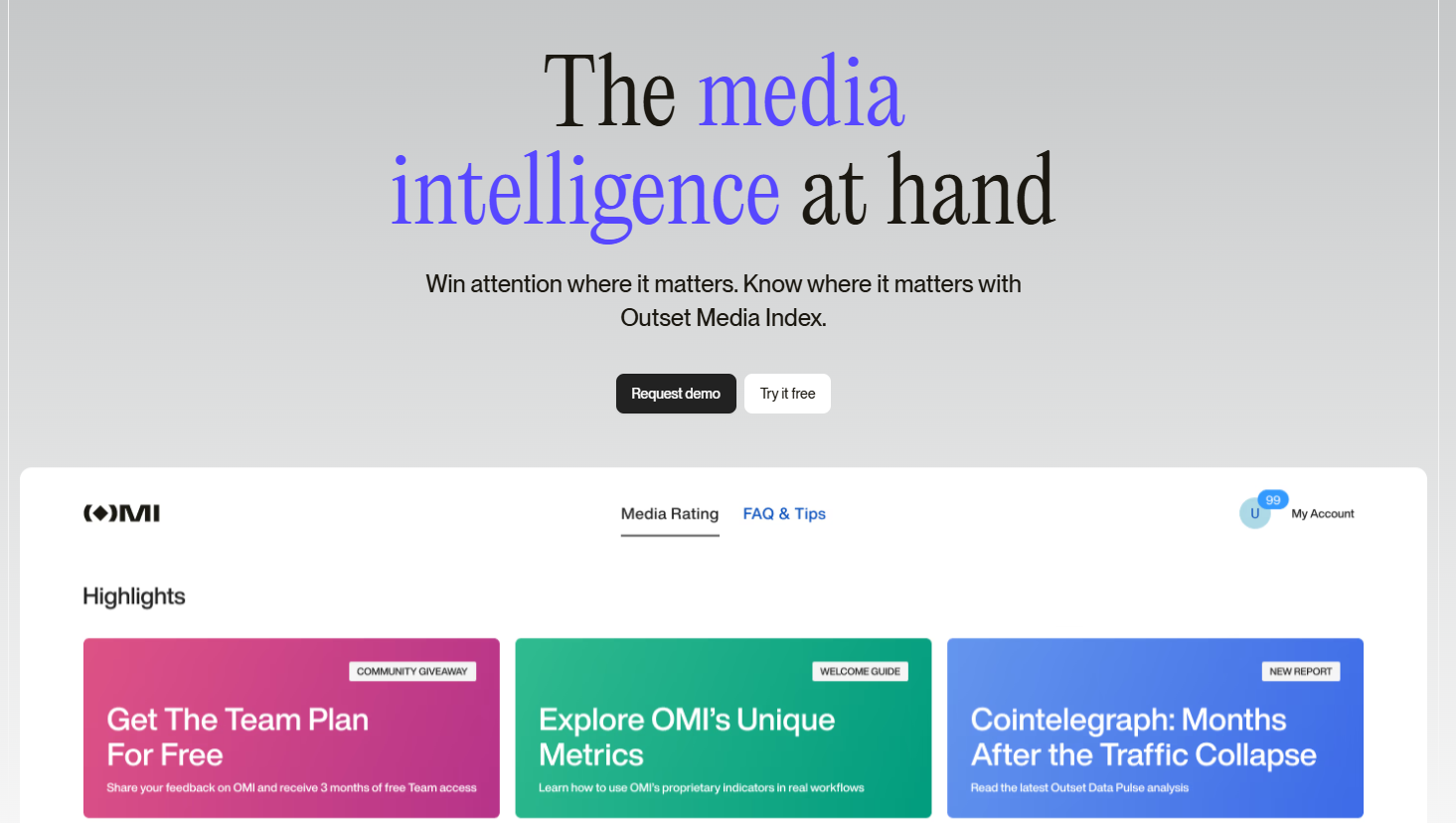
At its core, OMI reframes media analysis as a structured dataset rather than a collection of disconnected signals. It aggregates more than 37 metrics into a unified index, covering traffic, engagement, SEO and AI visibility, editorial flexibility, syndication depth and regional reach. The goal is straightforward: make media outlets comparable on consistent terms.
The platform is currently in a soft launch phase. Early users can access OMI, test its methodology and contribute feedback on metric design and usability. In exchange, participants receive a plan upgrade that remains in place after full release.
Share Feedback on OMI and Get Free Upgrade
The Limits of Existing Metrics
Consider a typical scenario. A PR manager chooses between Cointelegraph, CryptoSlate and a smaller niche publication. One outlet leads in raw traffic. Another ranks higher in search authority. A third may have stronger relationships with analysts or a more engaged audience in a specific region.
These differences matter, but they are rarely measured together. Traditional tools flatten them into isolated scores, forcing teams to interpret trade-offs manually.
The blind spot becomes more pronounced when influence—not just reach—is at stake. Some publications publish less but shape narratives through citations and secondary coverage. Others produce volume without downstream impact. Most analytics platforms fail to distinguish between the two.
OMI addresses this by treating media performance as multidimensional. Instead of asking which outlet is “largest,” it asks what role each outlet plays: visibility driver, SEO asset, narrative shaper, or some combination.
From Fragmentation to Structure
OMI is built around three principles: unified, independent and decision-ready.
Unified means consolidation. Media teams no longer need to reconcile metrics across multiple tools. The platform standardizes inputs into a single analytical layer, allowing side-by-side comparison without manual interpretation.
Independent refers to benchmarking. Media rankings often reflect promotional positioning or recycled datasets. OMI uses its own methodology to evaluate how outlets perform within the crypto media ecosystem, focusing on observable indicators rather than claims.
Decision-ready is where the model becomes operational. Data alone rarely answers practical questions. OMI translates its dataset into actionable outputs: identifying relevant outlets by region, mapping competitor coverage, prioritizing placements under budget constraints, and supporting allocation decisions.
In other words, it shifts media planning from descriptive analytics to prescriptive use.
Adding Context: The Role of Outset Data Pulse
A dataset, however structured, still has to be interpreted, which is done via Outset Data Pulse, an intelligence system that tracks how metrics evolve over time, highlighting changes in engagement patterns and editorial practices. It distinguishes between short-term spikes and sustained performance. It also contextualizes differences between high-volume publishers and those with outsized influence.
This layer matters because media dynamics are not static. A publication’s relevance can shift quickly, especially in crypto, where narratives move faster than most analytics cycles can capture.
By connecting metrics into a narrative, Outset Data Pulse addresses a common failure in media analysis: knowing the numbers but not what they imply.
Built From Practice, Not Theory
OMI reflects the perspective of practitioners. It was developed by PR specialists and media analysts who operate within the constraints it aims to solve—limited time, competing signals and the need to justify decisions with evidence.
That origin shapes its utility. The platform does not attempt to redefine media, but to make it legible.
For brands and agencies, the value is less about discovering new outlets and more about understanding existing ones with greater precision. For publishers, it introduces a framework that analyses their performance against the backdrop of existing competition.