
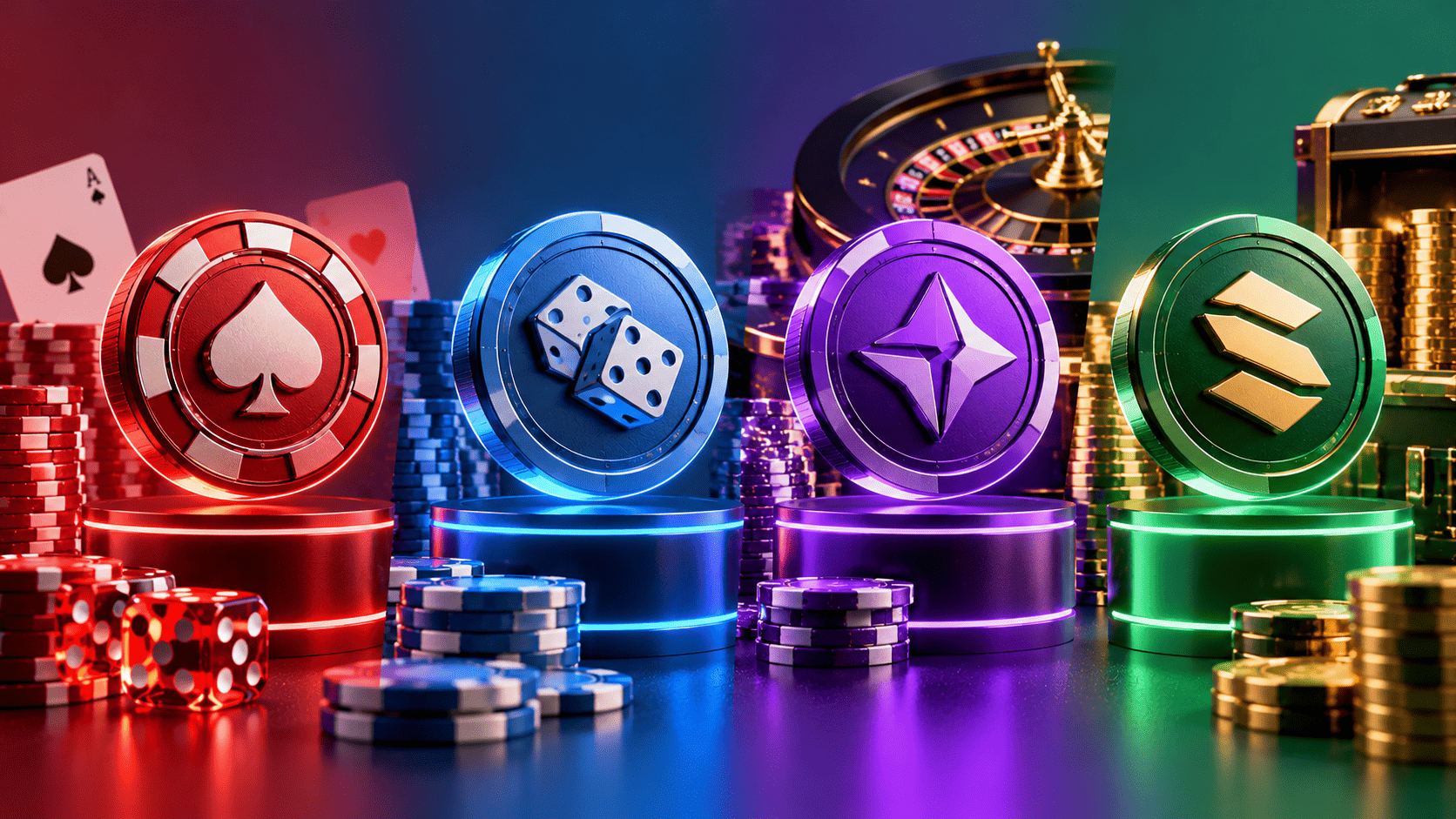
Casino tokens answer one question in very different ways: how, if at all, should platform revenue reach the people who hold the token? Rollbit burns supply, Shuffle funds a weekly lottery, Dexsport offers staking and a deposit role, and BC.Game pays holders hourly from a reward pool.
Each design sends value through a different channel and asks something different of the holder. Some reward holders who simply wait, others reward play, and one shrinks the supply over time.
Set side by side, the four show what each model promises, what it depends on and which details public data can confirm.
Four Tokens at a Glance
Supply, chain, and the route back to holders differ sharply across the four tokens, so the basics belong in one view before the detail.
|
Detail |
RLB |
SHFL |
DESU |
$BC |
|
Platform |
Rollbit |
Shuffle |
Dexsport |
BC.Game |
|
Chain |
Ethereum |
Ethereum |
BNB Chain |
Solana, also on TON |
|
Starting supply |
5 billion, over half since burned |
About 1 billion |
1 billion |
10 billion, fixed |
|
Main value route |
Revenue-funded buyback and burn |
Weekly lottery funded by revenue |
Staking and in-platform earn routes |
Hourly reward pool for holders |
|
Earned through play |
Rakeback perks for holders |
Wagers can use SHFL |
Betting games, contests, referrals |
Allocated automatically from wagering |
Supply and mechanics drawn from project materials and public reports. Last verified: October 2026
RLB: Revenue Buys Tokens and Burns Them
Rollbit switched RLB to a deflationary model in August 2023. One 2024 research report described a tiered split: a tenth of casino income, a fifth of sports betting income and almost a third of futures income, all used for open-market buybacks, and the bought tokens go to a burn address visible on Etherscan.
Supply started at 5 billion, and burns have removed more than half since then. Holders also receive perks such as casino rakeback and lower fees on Rollbit's crypto futures desk.
Burns reward holders only indirectly, through a smaller supply. The model depends on steady revenue, so slower trading at Rollbit means fewer tokens leave circulation.
SHFL: A Weekly Lottery Funded by Revenue
Shuffle issued SHFL on Ethereum, with roughly 1 billion tokens in total. Its signature feature is a weekly lottery, with 15% of net gaming revenue directed into the prize pool, according to published project figures.
Holders who stake SHFL receive lottery entries each week, while a further share of revenue funds buybacks and burns. Players can also wager directly in SHFL across the casino and sportsbook.
Lottery returns come unevenly, since prizes depend on each draw. Weekly pool size moves with Shuffle's revenue, so a quieter month shrinks the prizes for every staker.
DESU: A Deposit Asset With Staking Routes
Dexsport issued DESU as a BNB Chain token with a supply of 1 billion, first sold in November 2021. CertiK and Pessimistic both audited the contract, and the token trades on PancakeSwap, with a MEXC listing added in June 2026.
Dexsport names several routes to earn DESU: staking, referral commissions, the lottery, betting games, the Wheel of Fortune, contests and tips. DESU also works as a deposit and withdrawal asset at the Dexsport cashier on BNB Chain.
DESU itself stays optional, since the casino, sportsbook and prediction markets accept dozens of other coins. Value depends on demand for the token, as with any utility asset.
$BC: Earned by Wagering, Paid Out Hourly
BC.Game distributed $BC only through airdrops, including 400 million tokens sent to Pump.fun addresses in February 2025, with total supply fixed at 10 billion. The token lives on Solana and also appears on TON.
BC Engine, launched in April 2026, allocates $BC to players automatically as they wager. Every hour, holders receive payouts in BCD, BC.Game's dollar-pegged internal unit, from a pool fed by 10% of expected profit on qualifying activity.
Withdrawals from the Engine within seven days lose 1% to a burn. Rewards track platform activity, so a slower period at BC.Game means smaller hourly payouts.
Burn, Lottery, Stake or Earn
Each model asks a different commitment from the holder and returns value in a different form:
-
Buyback and burn: passive, since value grows only through a smaller supply over time
-
Lottery: uneven, with occasional large prizes and many weeks of modest or nil returns
-
Staking and earn routes: steady, tied to activity and token demand
-
Hourly reward pool: frequent, paid in a stable unit, though the size moves with platform volume
Every route still ties back to revenue at the platform. Fewer players or weaker volume reduce burns, prizes and payouts alike. Our look at the MDAO token shows how another gambling token reaches players across several sites.
What Public Data Can Confirm
Token pages make many claims, and outside checks confirm only some of them. Block explorers settle the most important ones.
Burn addresses on Etherscan or Solscan show how many tokens have left circulation and when. Contract pages confirm the total supply and the largest holders, which reveals how concentrated ownership looks. Audit reports, where published, describe what reviewers tested in the contract, though they say little about the business behind it.
Revenue shares and pool sizes usually come from the platforms themselves, so they deserve caution. Our guide to fan tokens explores a different kind of token tied to sport.
Network choice matters as well, since fees and wallet support follow the chain. Our piece on Solana casinos covers the network behind $BC.
Conclusion
RLB, SHFL, DESU and $BC show four ways to link a token with casino activity. Rollbit burns supply with a share of revenue, Shuffle funds a weekly lottery, Dexsport combines staking and earn routes with a cashier role, and BC.Game pays holders hourly from a reward pool.
Each model leans on platform revenue, so lower activity weakens every route back to holders. Block explorers can confirm supply and burns, while revenue figures rest on the platforms' own reports.
Casino tokens are volatile, speculative assets. Check local gambling and financial rules, use platforms only at legal age, and remember that KYC or AML checks may apply to any account.
Disclaimer: The information here is provided for general purposes only and is not legal, tax, investment, or financial advice. Token mechanics, supply figures and reward rates change over time and come partly from project materials, and the tokens named here are not a recommendation to buy. Crypto assets are volatile and can lose value. Gambling involves risk, and rules vary by country, so check the law where you live. Please play responsibly, within your means, and only if you are of legal age.