



The Federal Reserve’s Overnight Reverse Repurchase Agreement facility, usually called ON RRP, is an overnight transaction through which the New York Fed temporarily sells Treasury securities to eligible counterparties and agrees to repurchase them on the next business day. It moves a liability on the Fed’s balance sheet from reserve balances into reverse-repurchase obligations for the life of the trade; it does not, by itself, reduce the size of the Fed’s System Open Market Account (SOMA) securities portfolio.
That distinction matters. ON RRP can draw cash out of private overnight markets and into the Fed, but the cash returns with interest when the transaction matures. The facility is therefore best viewed as a short-term cash-management and monetary-policy implementation tool, not as a permanent sale of Treasury holdings or a standalone measure of the money supply.
What the Fed’s Overnight Reverse Repo Facility Actually Does
A reverse repurchase agreement is described from the perspective of the party selling the security. In an ON RRP operation, the New York Fed is the seller: it provides Treasury securities temporarily and receives cash from approved counterparties. The agreement includes a commitment for the Fed to buy those securities back on the next business day.
The securities involved are drawn from the SOMA portfolio, but the transaction does not mean the Fed has permanently disposed of them. The New York Fed explains that reverse repos shift liabilities from reserves to reverse-repo obligations without changing the portfolio’s size. When the agreement is unwound, the same temporary shift reverses.
This is different from an outright securities sale. An outright sale would permanently reduce the Fed’s securities holdings unless offset by another transaction. An ON RRP operation instead has a prearranged end date and repurchase leg. Its immediate purpose is to offer an overnight investment at the central bank and influence conditions in short-term funding markets.
The word “overnight” is operationally important. The trade normally spans one business day, rather than representing a long-term placement of funds. That short maturity lets the facility respond to daily demand for a safe overnight investment while preserving the Fed’s ability to return the cash promptly.
The Overnight Cash-and-Securities Sequence
The mechanics are easier to follow as a sequence:
- An eligible counterparty submits cash to the ON RRP facility.
- The New York Fed temporarily sells Treasury securities to that counterparty under an agreement to repurchase them on the next business day.
- For the term of the transaction, cash has moved to the Fed and the Fed records a reverse-repurchase obligation. Reserve balances decline as the operation absorbs cash.
- At maturity, the Fed repurchases the securities, returns the cash plus interest, and the temporary transaction is unwound.
The Federal Reserve Board’s research describes the balance-sheet effect directly: rising ON RRP use absorbs counterparties’ cash and reduces reserve balances; maturity returns cash and interest to the financial system. Calling the first leg a “liquidity drain” is reasonable so long as the temporary nature of the drain remains clear.
Consider a simplified one-day example. A money-market fund with cash can place it in ON RRP rather than lend it in a private overnight market. During that day, the cash is in the Fed facility and the fund holds the temporary securities interest associated with the agreement. On the next business day, the Fed repurchases the securities and the fund receives its original cash and the agreed interest.
The example does not mean every dollar placed in ON RRP comes directly from a bank reserve account in a simple one-for-one behavioral sense. It illustrates the facility’s aggregate accounting and funding effect: the Fed absorbs cash for the term of the agreement, then releases it at maturity. The size of the SOMA portfolio is unchanged by that temporary exchange.

Which Investors Use ON RRP Instead of Private Money Markets
ON RRP is not an open retail product and it is not a general-purpose account for every investor. Eligible counterparties include nonbank investors such as money-market funds and government-sponsored enterprises, as well as certain banks, according to the Federal Reserve Board’s description of ON RRP operations.
These participants operate in the market for very short-term cash investments. They may otherwise consider private repo, Treasury bills and other money-market instruments, depending on availability, operational needs, risk limits and relative returns. ON RRP provides an alternative: an overnight investment directly with the Federal Reserve, backed by the transaction structure established by the facility.
The facility was designed to absorb excess liquidity from a broad set of money-market participants. As the Board notes in its interest-on-reserve-balances FAQs, abundant liquidity can move from private markets into this risk-free Federal Reserve facility.
That design helps explain why ON RRP attracts particular attention during periods when cash is plentiful relative to attractive private overnight investment opportunities. It is a destination for eligible cash investors, rather than a direct lending program for households, companies or most individual market participants.
How the ON RRP Rate Sets a Floor for Overnight Rates
The ON RRP offering rate helps establish a floor under overnight money-market rates. An eligible investor that can place cash overnight at the Fed has little reason, all else equal, to lend in an alternative eligible private transaction at a lower rate. That outside option can limit downward pressure on rates when cash is abundant.
The mechanism is especially relevant because many important cash investors are not banks. Interest on reserve balances is paid to eligible depository institutions, while ON RRP gives a broader specified group of counterparties a Federal Reserve overnight investment option. Together, such administered rates support the Fed’s implementation of monetary policy through money-market conditions.
A floor is not a guarantee that every private transaction will occur at precisely the offering rate. Private-market rates can reflect transaction terms, counterparties, collateral, timing and other conditions. The policy role is narrower and more concrete: the facility gives eligible users an alternative below which they generally should not be willing to lend elsewhere.
Nor should the facility be read as a signal that the Fed is trying to direct every movement in market liquidity. It is described by the New York Fed as a supplementary monetary-policy tool. Its rate and availability influence the choices of qualifying cash investors, while actual take-up reflects those choices.
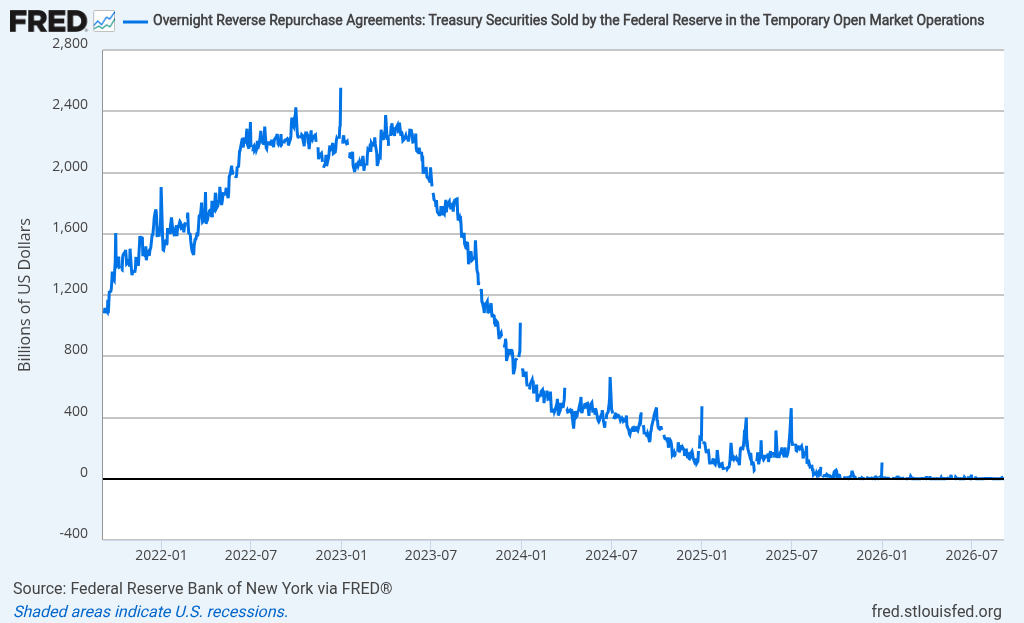
Daily overnight reverse repurchase agreements: Treasury securities sold by the Federal Reserve in temporary open market operations. — Source: Federal Reserve Bank of St. Louis, FRED
Why a Falling or Rising ON RRP Balance Is Not a Simple Liquidity Verdict
Daily ON RRP take-up shows how much cash is flowing into the facility on a given day. A higher amount indicates greater use of that Federal Reserve overnight option; a lower amount indicates less use. It does not, on its own, establish that the Fed has permanently removed money from markets, sold down its securities portfolio or tightened policy through an outright balance-sheet reduction.
The reason is built into the contract. A reverse repo drains reserve balances temporarily, but maturity returns the funds and interest to counterparties. The securities sale is temporary as well. The New York Fed’s explanation of repo and reverse-repo agreements characterizes the facility as supplementary, rather than a permanent reduction in Fed asset holdings.
A falling balance can mean eligible counterparties are finding other uses for cash, including private money-market investments. A rising balance can mean more cash is choosing the facility. Neither observation, without additional evidence, identifies a single cause or provides a complete verdict on system-wide liquidity.
Readers tracking the series should also separate the daily stock of outstanding operations from broader measures such as the Fed’s securities holdings, reserve balances or money-market rates. Those measures can move for different reasons and on different timetables. ON RRP is one part of the monetary-policy plumbing, not a comprehensive scorecard for financial conditions.
The Federal Reserve Bank of St. Louis publishes the New York Fed’s aggregated daily transaction amount as FRED series RRPONTSYD. The series is useful for observing facility usage, but it is most informative when interpreted as what it is: a measure of daily cash placed in overnight reverse repos with the Fed.
Frequently Asked Questions
What is the difference between a repo and a reverse repo for the Fed?
In a repo, the Fed buys securities and agrees to sell them back later; in a reverse repo, it sells securities and agrees to buy them back later. The naming convention follows the Fed’s side of the transaction.
Is ON RRP the same as quantitative tightening?
No. Quantitative tightening concerns a reduction in the Federal Reserve’s securities holdings. ON RRP temporarily shifts liabilities and does not change the size of the SOMA portfolio through the transaction itself.
Who can use the ON RRP facility?
Only eligible counterparties can access the facility: the Fed identifies money-market funds, government-sponsored enterprises and certain banks among the types of participants. Ordinary retail investors cannot place funds directly in it.
How long does an ON RRP transaction last?
The standard operation is overnight: the New York Fed sells Treasury securities and repurchases them on the next business day. Cash and interest return when the trade matures.
Does higher ON RRP usage mean the Fed has permanently drained liquidity?
No. Higher take-up means more cash is in the facility for that operation’s term. Since the agreements mature overnight, the cash returns when the Fed repurchases the securities, unless counterparties enter new transactions.
Where can I see daily ON RRP take-up?
The St. Louis Fed’s FRED database publishes the aggregated daily amount in series RRPONTSYD. It is a facility-use measure, not a complete measure of market liquidity or the Fed’s balance sheet.