

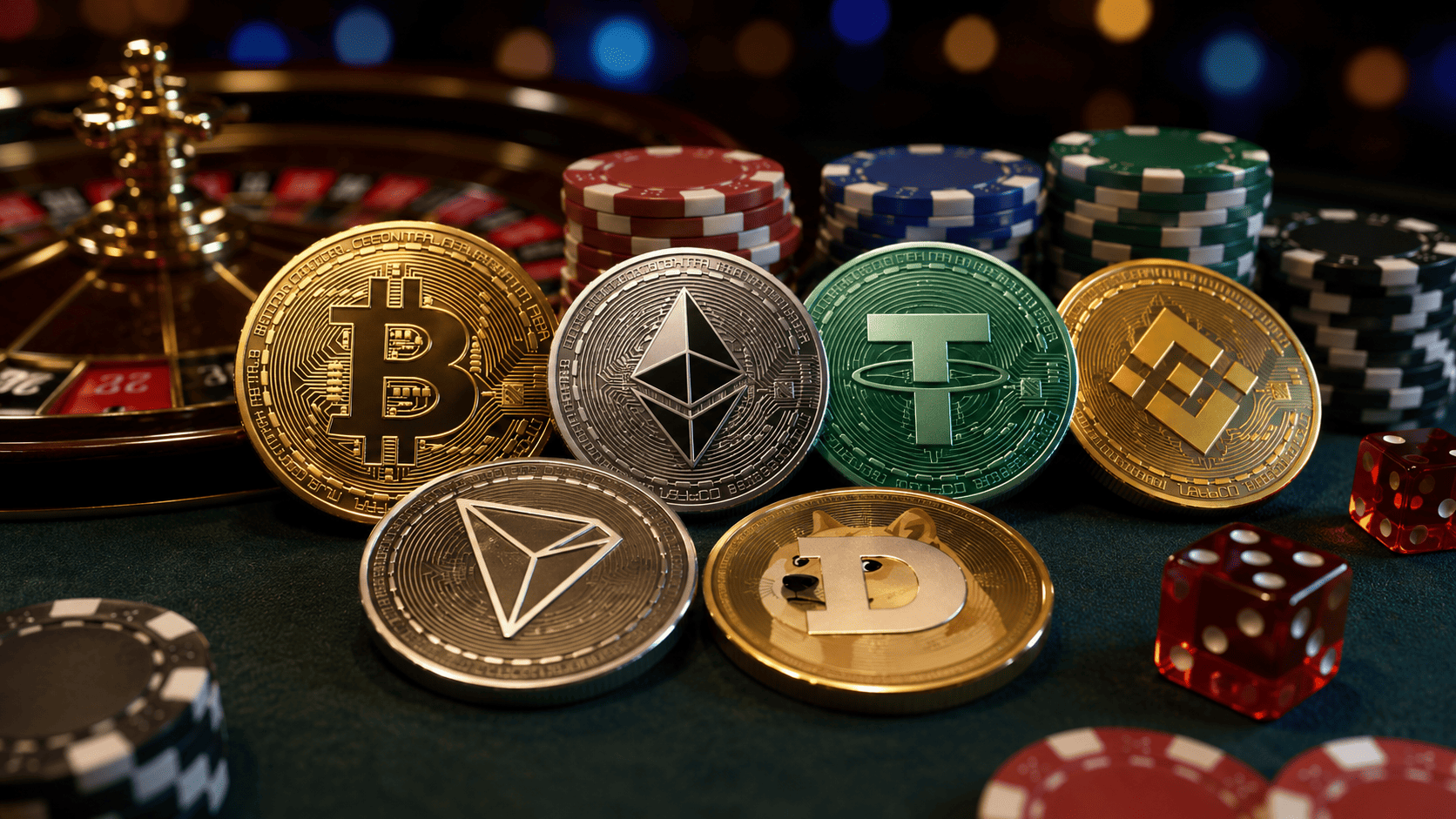
Crypto casinos have moved well beyond Bitcoin-only deposits. Players can now fund accounts with stablecoins, major smart-contract assets, low-fee payment networks, and even meme coins.
The choice of cryptocurrency affects more than the currency shown in the casino balance. Network fees, confirmation times, price volatility, wallet compatibility, and supported networks can all change the practical cost and speed of moving money in and out.
Bitcoin, Ethereum, Tether, BNB, TRON, and Dogecoin are among the cryptocurrencies commonly supported by crypto gambling platforms. Dexsport, for example, supports dozens of cryptocurrencies across multiple blockchain networks, including BTC, ETH, USDT, BNB, and TRX. Other crypto casinos covered in our research show a similar pattern, with Bitcoin, Ethereum, Tether, Dogecoin, and several lower-cost networks appearing repeatedly among accepted payment methods.
Here is how the six options differ in actual casino use.
1. Bitcoin (BTC): The Standard Crypto Casino Currency
Bitcoin remains the obvious starting point because it has the broadest recognition in crypto gambling. Many platforms that accept cryptocurrency support BTC, including Dexsport, Stake, Cloudbet, Thunderpick, BetPanda, and other operators covered in our research.
Its main advantage is compatibility. Players who already hold Bitcoin can usually deposit directly rather than swapping into another asset specifically for gambling.
Bitcoin also has a simple monetary model. There is no separate issuer controlling the asset, and transactions settle through the Bitcoin network. That makes BTC fundamentally different from stablecoins such as USDT.
The downside is volatility. A casino balance worth $500 when deposited could be worth more or less in dollar terms before it is withdrawn, regardless of the gambling result.
Transaction costs can also vary substantially according to Bitcoin network demand. For small deposits and withdrawals, that can make BTC less economical than cheaper networks.
Best suited for: Players who already hold Bitcoin and want broad casino compatibility.
2. Tether (USDT): Practical for Stable Casino Balances
USDT solves one of Bitcoin's biggest practical problems for gambling: volatility.
Tether is designed to track the U.S. dollar, so a 500 USDT bankroll remains approximately $500 unless the stablecoin loses its peg. That makes deposits, bets, wins, and losses easier to measure in familiar monetary terms.
This characteristic is particularly useful when gambling sessions extend over several days. With BTC or ETH, changes in the underlying cryptocurrency price can affect the fiat value of the bankroll. USDT largely removes that additional variable.
There is one important complication. USDT exists on multiple networks.
A casino might support USDT on Ethereum, TRON, BNB Chain, or another blockchain. The withdrawal address and network must match. Sending tokens through an unsupported network can result in lost funds or require intervention from the operator.
Dexsport illustrates why network support deserves attention. The platform supports dozens of cryptocurrencies across 20 networks, allowing players to select among multiple blockchain payment routes rather than relying on one chain.
Best suited for: Players who want to keep their casino bankroll denominated close to U.S. dollars.
3. Ethereum (ETH): Widely Supported, but Fees Matter
Ethereum is another common currency at crypto casinos. Its large user base and extensive wallet ecosystem make ETH relatively easy to use for players already active in Web3.
The drawback is transaction cost. Ethereum mainnet fees fluctuate according to network activity. A transfer that looks reasonable during quiet periods can become considerably more expensive when blockspace demand increases.
That makes ETH more suitable when the player already holds Ethereum and the casino supports an economical deposit route. Buying ETH solely to make a small casino deposit may introduce unnecessary exchange and network costs.
Ethereum also exposes an important distinction between the asset and the network. A casino accepting ETH does not automatically support every Ethereum-compatible token or every Layer 2 network. Players should check the exact deposit network before sending funds.
Best suited for: Existing ETH holders and Web3 users comfortable checking network details before transferring funds.
4. TRON (TRX): Built Around Cheap, Frequent Transfers
TRON has become a common payment network in crypto gambling, particularly because of its relatively inexpensive and fast transactions.
The network is also closely associated with USDT transfers. Players therefore encounter TRON in two different forms: TRX as the native cryptocurrency and TRC-20 USDT as a dollar-linked token running on the TRON blockchain.
For casino users who deposit and withdraw regularly, transaction economics can matter considerably. Paying several dollars for every movement of funds has a much larger effect on a $50 bankroll than on a $5,000 bankroll.
TRX appears among the cryptocurrencies supported by several crypto gambling platforms in our research, including Dexsport, Stake, Vave, and Mega Dice.
The main trade-off is price exposure. TRX itself fluctuates against the dollar. Players interested primarily in TRON's inexpensive payment infrastructure may therefore prefer USDT on TRON where the casino supports it.
Best suited for: Players prioritizing inexpensive transfers and frequent deposits or withdrawals.
5. BNB: A Low-Cost Alternative for BNB Chain Users
BNB is another option increasingly found at multi-chain casinos.
Its practical appeal is similar to TRX: transfers on BNB Chain can be relatively inexpensive, making the network useful for smaller deposits and regular movement between wallets and gambling platforms.
BNB makes particular sense for users who already operate within the BNB Chain ecosystem. There is little benefit in buying an unfamiliar cryptocurrency purely because a casino accepts it if an existing BTC, USDT, or other supported balance can be deposited more conveniently.
Dexsport includes BNB among its major supported assets, while platforms such as BetPanda, Lucky Block, Mega Dice, and Instant Casino also list BNB among their cryptocurrency options in the material reviewed for this article.
As with ETH and TRX, players need to distinguish between BNB the asset and BNB Chain the network. Always copy the deposit address directly from the casino and confirm the selected network before approving the transaction.
Best suited for: BNB Chain users looking for relatively inexpensive transfers.
6. Dogecoin (DOGE): Simple Payments with Price Risk
Dogecoin began as a meme coin, but its widespread exchange availability has given it a practical secondary role as a payment cryptocurrency.
Crypto casinos frequently include DOGE alongside Bitcoin, Ethereum, Litecoin, and stablecoins. Stake, BetPanda, Vave, Lucky Block, Thunderpick, Mega Dice, and several casino-focused operators in our source material accept Dogecoin.
For gambling, its main attraction is straightforward transfers without Ethereum-style gas mechanics. The bigger issue is volatility. DOGE can move sharply against fiat currencies, so the final dollar value of a withdrawal depends on both gambling performance and DOGE's market price.
That can make accounting surprisingly confusing. Winning 10% more DOGE does not necessarily mean leaving with 10% more purchasing power if DOGE falls during the same period.
Best suited for: Existing DOGE holders who value simple crypto transfers and accept the additional price exposure.
BTC vs USDT vs ETH vs TRX vs BNB vs DOGE
|
Cryptocurrency |
Main Strength for Casino Use |
Main Limitation |
Best Use Case |
|
Bitcoin (BTC) |
Broad casino acceptance |
Volatility and variable network fees |
General crypto gambling |
|
Tether (USDT) |
Stable dollar-linked value |
Network selection requires care |
Bankroll management |
|
Ethereum (ETH) |
Strong wallet and Web3 compatibility |
Mainnet fees can be expensive |
Existing ETH holders |
|
TRON (TRX) |
Low-cost, fast transfers |
Price volatility |
Frequent transactions |
|
BNB |
Relatively inexpensive transfers |
Less universally accepted than BTC |
BNB Chain users |
|
Dogecoin (DOGE) |
Simple transfers and broad crypto-casino support |
High price volatility |
Existing DOGE holders |
Dexsport Shows How Multi-Chain Gambling Works
Dexsport combines a sportsbook with more than 10,000 casino games and supports dozens of cryptocurrencies across 20 blockchain networks. Its supported assets include BTC, ETH, USDT, BNB, and TRX. Users can register through email, Telegram, MetaMask, or Trust Wallet, according to the supplied platform information.
This setup gives players more control over the payment rail they use. Someone holding Bitcoin can deposit BTC directly. A player concerned about volatility can use USDT. Someone prioritizing transaction costs can select an appropriate lower-cost supported network.
Dexsport also states that crypto deposits and withdrawals are fee-free on the platform side. Blockchain network fees remain a separate consideration because they are determined by the relevant network rather than the casino.
The casino itself covers slots, live dealer games, crash titles, roulette, and other categories from providers including Pragmatic Play, Evolution Gaming, NetEnt, Play'n GO, and PGSoft.
Which Cryptocurrency Is Best for Online Gambling?
There is no universal winner because each cryptocurrency solves a different payment problem.
For the broadest compatibility, Bitcoin remains the safest starting point. For players who measure their bankroll in dollars and want to limit crypto price exposure, USDT is usually more practical. TRX and BNB can make sense when transaction costs are a priority, while ETH fits users who already keep funds within the Ethereum ecosystem. DOGE offers another widely supported option but introduces substantial price volatility.
Before depositing, check three details: the cryptocurrency, the blockchain network, and the casino's minimum deposit and withdrawal rules. The asset name alone is not enough. USDT sent through the wrong network, for example, can create a much bigger problem than paying a slightly higher transaction fee.
For most players, the best casino cryptocurrency is therefore the one they already understand, can transfer cheaply, and can withdraw through a network supported by both their wallet and the casino.
Disclaimer: The information here is provided for general purposes only and is not legal, tax, investment, or financial advice, and nothing here is a betting tip or prediction. Market availability and platform features change over time, so confirm current details before betting. Betting carries risk, and rules vary by country, so check the law where you live. Please gamble responsibly, within your means, and only if you are of legal age.