


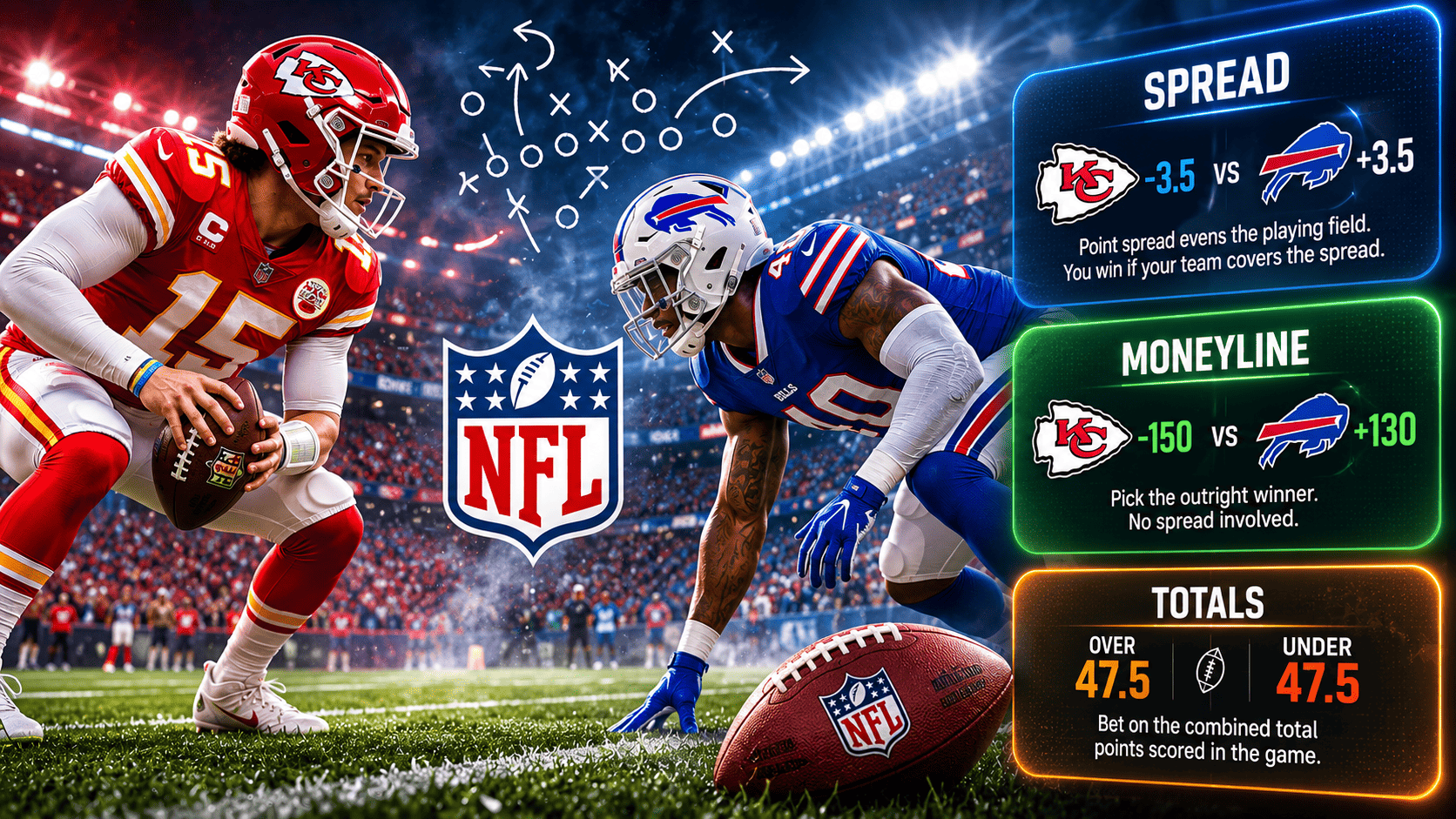
American football betting runs on three markets, and they cover most of what appears on an NFL board. The spread handicaps the favourite, the moneyline asks who wins outright, and the total prices the combined points.
Understanding all three, and the pricing convention behind them, makes an NFL board readable in a few minutes.
This explains each market, the odds notation used, and the quirks specific to American football.
The Pricing Convention Comes First
Before the markets themselves, the numbers beside them, because NFL boards often display American odds instead of decimals.
A price of -110 means you stake 110 to win 100. A price of +250 means a stake of 100 wins 250. Negative numbers indicate favourites and positive numbers indicate underdogs, and the scale is built around 100 as the reference unit.
Spreads and totals are conventionally priced at around -110 on both sides. That is not an accident: if a book took even money on both, it would break even. Charging -110 each way is how the margin is built in, and it is the single most useful thing to understand about American sports pricing.
Three Markets in Worked Examples
The figures below are illustrative and show how each market settles.
-
Point spread, half-point line. A favourite listed at -6.5 must win by seven or more. Win by six, and the bet loses, even though the team won the game. The underdog at +6.5 covers by losing by six or fewer, or by winning outright. A half-point line cannot land exactly, so there is no void outcome.
-
Point spread, whole number. A favourite at -7 that wins by exactly seven produces a push: the bet is void, and the stake returned. This is the same mechanic as a whole-goal handicap in football, and it is why whole-number spreads and half-point spreads behave differently.
-
Moneyline on a favourite. A team at -300 requires a stake of 300 to win 100. No spread applies, so the team simply has to win the game. Short prices on heavy favourites are the norm in a sport with frequent mismatches.
-
Moneyline on an underdog. A team at +240 returns 240 on a stake of 100 if it wins outright, regardless of margin. The moneyline and the spread often point in different directions for the same bettor, since backing an underdog to cover is a different proposition from backing it to win.
-
Total points. A game with a total of 44.5 settles over if the two teams combine for 45 or more, and under at 44 or fewer. A whole-number total, say 44, pushes if the teams combine for exactly that, returning the stake.
Key Numbers Are a Real Feature Here
American football has something football does not: scoring in fixed increments that cluster margins around particular numbers.
Because a touchdown with the extra point is worth seven and a field goal is worth three, games finish decided by three or seven more often than by other margins.
Those two numbers therefore matter disproportionately on the spread, and moving a line across one of them changes its value more than moving it elsewhere.
This is why the half-point, often called the hook, is discussed so much in American sports betting. The difference between -3 and -3.5 is far larger in practice than the difference between -5 and -5.5, because it straddles one of the common margins.
Alternate Lines, Buying Points and Teasers
Three variations appear on most NFL boards and follow from the key-number point above.
-
Alternate lines offer the same game at different spreads or totals, with prices adjusted accordingly. A shorter spread costs more; a longer one pays more.
-
Buying points is the same idea expressed as a transaction, moving a line half a point or more in your favour and accepting worse odds for it.
-
Teasers are an American football speciality: a multi-selection bet where each spread is shifted in the bettor's favour by a set number of points, typically six, in exchange for reduced combined odds. Every leg must still win, so a teaser is a multiple with adjusted lines and not a safer bet, and the odds reduction reflects the advantage given.
In-Play Behaves Differently in the NFL
Live betting on American football has a rhythm the sport's structure produces.
Play stops constantly, between downs, at timeouts and between quarters, so live markets reprice in discrete jumps instead of continuously. A single play can change a total or a spread substantially, particularly a turnover or a long touchdown, and markets suspend around reviews as they do in any sport.
The frequent stoppages mean there is more opportunity to place live bets than in a continuously running sport, which is worth knowing as a matter of pacing, and what changes when betting these markets in crypto is the funding side and not the market side.
Dexsport's American Football Board
Dexsport carries American football within a board of 30-plus sports, with more than 100 markets on major matches, covering spreads, moneylines and totals alongside the player and quarter-by-quarter markets an NFL game produces.
Odds are priced off-chain by the operator while settlement is written to a public on-chain desk, so a resolved market, including a spread that pushes on its number, leaves a record independent of the account screen. Cash Out is available on eligible bets.
Because the platform is non-custodial, a settled bet returns to a wallet the player holds across 50-plus coins and 23 networks. Dexsport holds an Anjouan licence, a lighter regime than Curacao or Malta, and depth of coverage varies between books on American sports as much as on football.
Reading an NFL Board Confidently
Three markets cover most NFL betting: the spread handicaps, the moneyline asks who wins, and the total prices the points. Learn what -110 means, remember that whole numbers can push and half-points cannot, and know that three and seven are the margins the sport keeps producing.
Confirm what is legal where you live, keep stakes within a set budget, and play only if you are of legal age, since KYC or AML checks may apply.
Responsible gambling applies to a sport with a short season and heavy weekly coverage, where a single Sunday can carry more betting opportunities than a full week of football.
Disclaimer: The information here is provided for general purposes only and is not legal, tax, investment, or financial advice, and nothing here is a betting tip or prediction. The odds and lines used are illustrative examples of how markets settle. Pricing conventions and settlement rules vary by operator, so confirm current terms before betting. Betting carries risk, and rules vary by country, so check the law where you live. Please gamble responsibly, within your means, and only if you are of legal age.