



A high-yield credit spread is the additional yield investors require to hold below-investment-grade corporate debt rather than a comparable U.S. Treasury. Because that premium reflects perceived default risk, liquidity conditions and other credit risks, a rising spread can show that investors are becoming more cautious about companies’ ability to service their debt—often before an actual missed payment or a broad equity sell-off occurs.
High-yield bonds are generally securities rated below investment grade, along with unrated debt considered to have comparable credit quality. Their issuers face a greater risk of being unable to pay interest or repay principal, making this corner of the corporate-bond market particularly sensitive to changing expectations about profits, financing and the economy. That sensitivity is why investors watch high-yield spreads as a gauge of stress, rather than as a standalone forecast. Federal Reserve Board; U.S. Securities and Exchange Commission filing
What a high-yield credit spread measures
Yield is the return demanded by investors on a bond. A credit spread isolates the premium over a comparable risk-free Treasury: if a corporate bond offers a higher yield than the Treasury, the difference is its spread. Investors require that extra compensation because corporate bonds can default, may be less liquid than Treasuries and carry other credit-related risks.
The comparison matters. Treasury yields can change because of shifts in interest-rate expectations or demand for safe assets, while a spread is intended to focus attention on the incremental compensation for taking corporate credit risk. A falling Treasury yield, for example, does not necessarily mean corporate credit has become safer. The spread may be stable, narrowing or widening at the same time.
In high yield, the risk premium is especially consequential. Lower-rated issuers often have less room to absorb weaker earnings or more difficult borrowing conditions than higher-rated companies. Investors therefore scrutinize the price and yield of their bonds for indications that the market is revising its view of repayment prospects.
Spreads are usually expressed in basis points, where 100 basis points equal one percentage point. The arithmetic is simple: a corporate bond yielding 8% when a comparable Treasury yields 4% has a 4-percentage-point, or 400-basis-point, spread. That example explains the measure, not what level is normal or what any given reading predicts.
Why spreads widen before defaults occur
A bond price does not need to wait for a default to fall. If investors begin to expect more defaults, weaker corporate profits, reduced market liquidity or a lower willingness to bear risk, they may demand a higher yield immediately. Since bond prices and yields generally move in opposite directions, that repricing lowers the market value of outstanding bonds and widens their spreads.
The sequence is forward-looking. A company can still be making every scheduled interest payment while investors reassess whether it will have sufficient earnings, access to funding or refinancing capacity later. Those concerns can spread beyond a single issuer when investors believe the pressures affect a sector or the economy more broadly.
That does not mean a widening spread proves that defaults are imminent. It means the compensation investors demand for uncertainty has increased. Federal Reserve research describes corporate credit spreads as incorporating expectations about future defaults and economic activity, and finds that they can help anticipate downturn risk. Federal Reserve Board research
Risk appetite is an important part of this distinction. A spread can rise both because investors see weaker fundamentals and because they are less willing to hold risky assets at the same price. In practice, markets are pricing both expected losses and the price of bearing uncertainty; neither element alone can be cleanly inferred from the headline spread.
Option-adjusted spread and the high-yield benchmark
Not every bond can be compared with a Treasury using a simple yield difference. Some bonds contain embedded options, including call or put features, that can affect their value. A call may allow an issuer to redeem debt early, while a put may give an investor the right to sell it back under specified terms.
Option-adjusted spread, or OAS, adjusts a bond’s spread for the value of those embedded options. It is therefore a more useful comparison tool for many portfolios and bond indexes than an unadjusted yield spread. OAS does not eliminate credit risk or turn an index reading into a forecast; it refines the measurement by accounting for contract features that can otherwise distort the apparent yield premium.
A widely watched gauge is the ICE BofA U.S. High Yield Index Option-Adjusted Spread, available through the Federal Reserve Bank of St. Louis’s FRED database. Index measures are useful because they show changes across a broad basket of high-yield debt rather than the idiosyncratic move of one company’s bonds.
Even a broad index has boundaries. It reflects the securities and methodology within that benchmark, not every form of corporate borrowing. Its clearest use is often as a common reference point: investors can track whether compensation for broad U.S. high-yield credit risk is becoming more or less demanding over time.

Using spreads as an early stress signal
Credit investors use the direction and character of spread moves to assess whether market concern is building. Persistent widening across a broad high-yield index can indicate that investors are assigning greater weight to weaker earnings, tighter funding conditions, prospective defaults or diminished liquidity. Those are conditions that can become visible in company results and economic data only later.
This can make high-yield spreads informative ahead of stocks in some episodes. Equity holders participate in upside as well as downside, whereas creditors are principally focused on whether they will receive promised interest and principal. When repayment risk appears to be increasing, bond investors may reprice that risk sharply even while equity-market optimism remains intact.
The relationship is neither mechanical nor guaranteed. Equity prices and high-yield spreads respond to overlapping forces, but they are different markets with different claims, valuations and participants. A widening spread may accompany an equity decline, precede one, or remain largely a credit-market event. It should be read as evidence of changing probabilities and risk tolerance, not as a trigger that says stocks must fall next.
A practical approach is to ask three questions: Is the move broad or confined to a few issuers? Is it persisting rather than reversing quickly? And is there corroboration from other measures of credit conditions? Those questions shift attention from a single daily index change to the underlying source and breadth of the repricing.
When a spread spike is not a broad market warning
History offers reasons to take sharp increases seriously, but also reasons not to overread them. The Bank for International Settlements has noted episodes in which high-yield spread increases preceded broader economic downturns, including technology-sector stress before the 2000 bubble burst and financial-sector stress before the global financial crisis.
Those episodes do not establish a universal rule. Sector-specific shocks can push spreads wider without signalling a general recession. If the weakness is concentrated in one industry, the move may primarily reflect that sector’s cash-flow, balance-sheet or funding concerns rather than a deterioration in the entire corporate sector.
That is why breadth matters. An index can widen because its constituents are affected unevenly, and individual bond moves can be much more dramatic than the aggregate measure. Investors need to distinguish a market-wide reassessment of credit risk from stress that is concentrated in a vulnerable group of borrowers. Bank for International Settlements analysis
Another misconception is that high yield is synonymous with the economy. High-yield debt is an important risk-sensitive market, but it is not a complete map of household finances, bank lending, government borrowing or equity valuation. Its strongest contribution is a specific one: it captures the price investors place on bearing risk in a lower-rated segment of corporate credit.
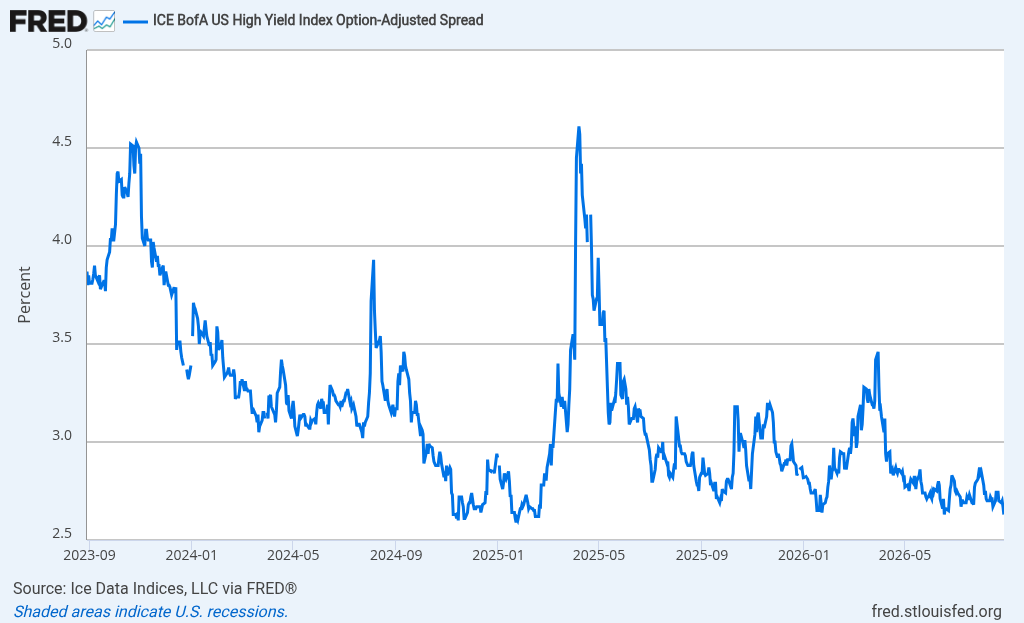
Historical ICE BofA U.S. High Yield Index Option-Adjusted Spread, a market gauge of the additional yield demanded for below-investment-grade corporate debt. — Source: Federal Reserve Bank of St. Louis / ICE Data Indices
Compare high-yield spreads with other credit indicators
Compressed spreads mean investors are demanding relatively little additional compensation for credit risk; wider spreads mean they are demanding more. Neither condition is self-explanatory, so interpretation should consider changes in expected defaults, liquidity, corporate profits and risk appetite, as well as whether those changes are consistent across credit markets.
That comparison can include leveraged-loan spreads, private-credit conditions and broader signs of funding or liquidity pressure. Investors should also follow whether a move is sustained and how broadly it is occurring. Agreement across measures can be more informative than a headline reading in isolation.
A BIS assessment published in March 2026 found that U.S. and European high-yield spreads remained compressed relative to historical norms, while leveraged-loan spreads began rising and strains emerged in private credit. The example is not a general prediction from those conditions; it shows why a calm-looking high-yield index should not end the analysis when other credit-market signals are moving differently. BIS Quarterly Review
For readers monitoring market stress, the disciplined approach is to assess the trend and its breadth, compare related credit indicators, and distinguish broad repricing from a localized shock. High-yield spreads can signal rising concern about corporate credit without providing a precise timer for the next stock-market or economic turn.
Frequently Asked Questions
Do high-yield credit spreads predict stock-market declines?
They can signal rising concern about corporate credit before a broader equity decline, but they do not reliably dictate what stocks will do next. A spread move reflects changing assessments of credit risk and risk appetite, not a guaranteed equity-market outcome.
What does it mean when high-yield spreads widen?
Widening means investors are demanding more yield over comparable Treasuries to own lower-rated corporate bonds. It may reflect higher expected defaults, weaker profit expectations, liquidity concerns or lower willingness to bear risk.
Why do investors use option-adjusted spread instead of a simple yield spread?
OAS accounts for the value of embedded call and put options in bonds. Adjusting for those features makes comparisons across securities and index constituents more meaningful.
Are high-yield bonds the same as investment-grade bonds?
No. High-yield bonds are generally rated below investment grade, or are unrated securities viewed as having comparable credit quality. They carry greater risk that the issuer may not pay interest or repay principal.
Can a surge in high-yield spreads be limited to one sector?
Yes. Historical experience shows sector-specific shocks can widen high-yield spreads without pointing to a general recession. Looking at the breadth of the move and other credit indicators helps separate a localized problem from broader stress.