
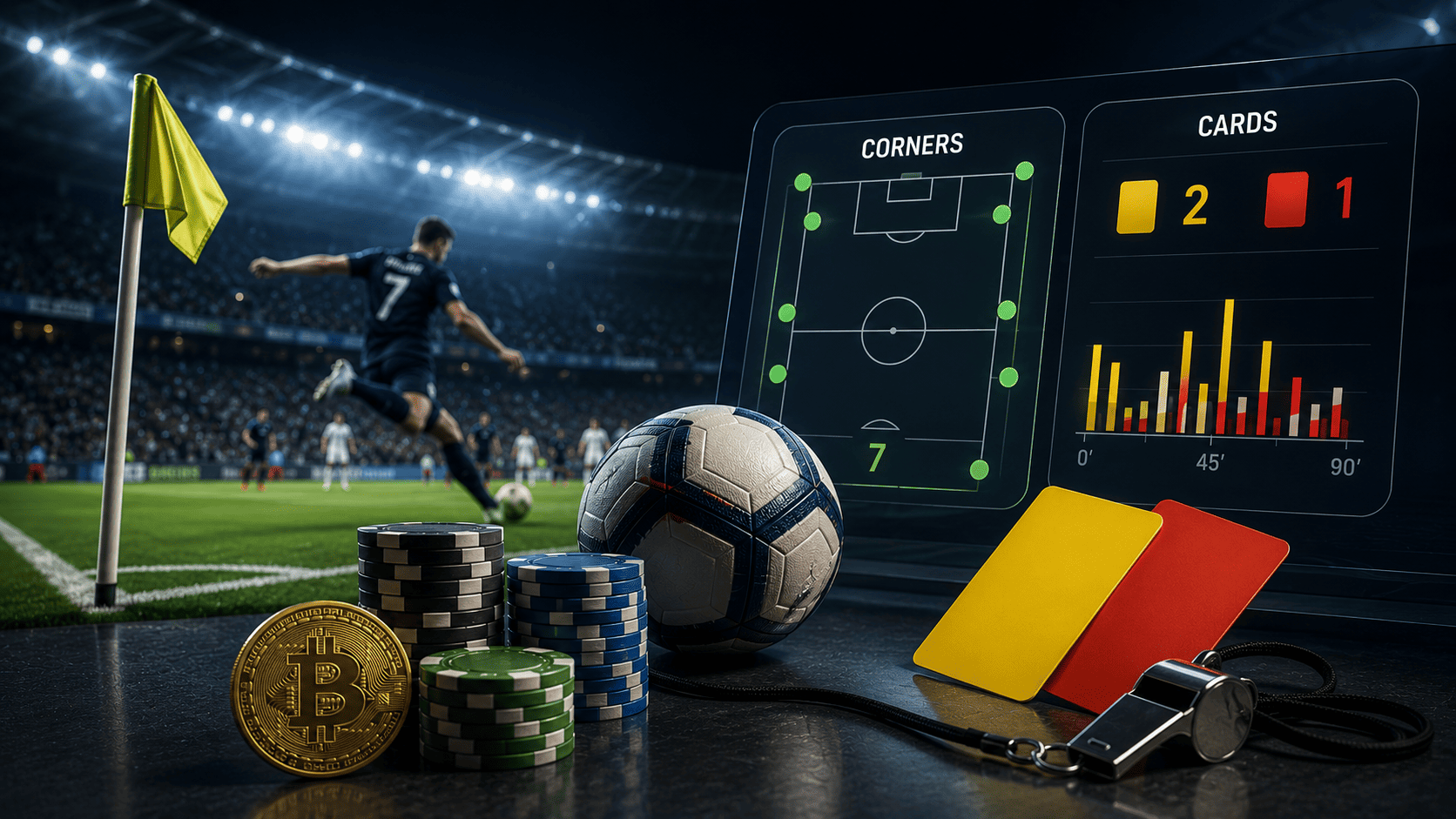
Corners and cards price something the scoreline does not capture. A match can finish 0-0 and still deliver twelve corners and six bookings, and a bettor holding those markets has a completely different afternoon from one holding the result.
These are the texture markets, and they run on most European fixtures at any book with a full board. This explains both families, what drives them, and where they sit on a card.
Texture Markets Are Independent of the Result
The shared feature is worth stating before the detail.
Neither market cares who wins. A corner is a corner whether the team taking it is three goals up or three down, and a booking counts the same in a thrashing as in a stalemate. That independence is the appeal: these markets let a bettor act on a view about how a match will be played and not how it will finish.
It also means they can be held alongside a result bet without simply doubling the same view, though the two are not entirely unconnected, as the sections below explain.
Corners
Corner markets price the number of corner kicks awarded, and the board is more varied than most bettors expect.
-
Total corners is the main line, priced over or under a figure that typically sits somewhere around nine or ten on a European fixture, with the exact line set per match.
-
Corner handicap applies a spread, giving one team a head start on the corner count.
-
Team corners price one side's tally independently.
-
Race to a set number asks which team reaches, say, five corners first.
-
First and last corner price single events within the match.
What drives the count is territorial pressure. A side attacking persistently against a deep defence generates corners whether or not it scores, which is why a dominant team held at 0-0 can still be winning the corner count comfortably.
One in-play dynamic is worth understanding: a team chasing a deficit late in a match usually pushes more players forward and generates more corners. So the corner count and the scoreline interact, even though the market itself is scoreline-independent.
Cards
Card markets price disciplinary outcomes, and most books settle them using a points convention instead of a raw count.
-
Bookings points is the common system, where a yellow card scores 10 and a red scores 25, with a player who receives two yellows and a resulting red usually capped at a set maximum.
-
Total cards prices the raw number instead, over or under a line.
-
Team cards split the count by side.
-
Player to be carded prices individuals, usually defenders and defensive midfielders.
-
First card prices which team or player is booked first.
Settlement conventions differ between operators more here than in most markets, particularly around second yellows and cards shown to substitutes or staff after the whistle. Reading a book's specific rules before placing a cards bet is worth the minute it takes.
The Referee Is a Real Variable
Cards markets have a factor no other football market shares: the individual applying the rules.
Referees differ measurably in how readily they book players, and appointments are typically published in the days before a fixture. That makes the official a genuine input and not background noise, and it is the reason cards markets often move when an appointment is confirmed.
Match context matters alongside it. Derbies and fixtures with something specific at stake tend to be more combative, which is why cards boards draw heavier interest around rivalry weekends.
None of that makes bookings predictable in any single match, and treating a reputation as a forecast is the standard error to avoid.
Coverage Varies More Than for Goals Markets
A practical point for anyone who wants to bet these regularly.
Corners and cards are secondary markets, so they are the first to disappear when a sportsbook prices a fixture thinly. A book may offer a full result and goals board on a smaller European fixture while showing nothing for corners at all, and depth varies by competition as well as by platform.
That makes these markets a useful test of a sportsbook's seriousness. If corners and cards appear on a second-tier fixture, as in the Championship or a mid-table Bundesliga match, the platform is investing in its football board instead of covering the headlines only.
Dexsport's Secondary Football Board
Dexsport carries football within 30-plus sports with more than 100 markets on major matches, a count that only makes sense if a board reaches past the result and goals lines into corners, cards and player markets.
Settlement is written to a public on-chain desk, so a resolved corners or cards market leaves a record independent of the account screen, which matters on markets where settlement conventions can be disputed. Odds are priced off-chain by the operator.
Cash Out is available on eligible bets, and because the platform is non-custodial, a settled bet returns to a wallet the player holds across 50-plus coins and 23 networks. Dexsport holds an Anjouan licence, a lighter regime than Curacao or Malta.
Betting the Texture of a Match
Corners and cards give a bettor a way to act on how a game will be played instead of who will win. Corners follow territorial pressure, cards follow temperament and the official, and both settle independently of the scoreline.
Check the settlement rules before placing either, since conventions vary. Confirm what is legal where you live, keep stakes within a set budget, and play only if you are of legal age, since KYC or AML checks may apply.
Responsible gambling applies to secondary markets as much as to the main board, because a fixture offering thirty ways to bet is a fixture offering thirty ways to overspend.
Disclaimer: The information here is provided for general purposes only and is not legal, tax, investment, or financial advice, and nothing here is a betting tip or prediction. Settlement conventions, lines and market availability vary by operator and change over time, so confirm current rules before betting. Betting carries risk, and rules vary by country, so check the law where you live. Please gamble responsibly, within your means, and only if you are of legal age.