



The battle over which blockchain architecture will serve as the definitive execution engine for crypto trading has entered an aggressive structural phase. The core debate positions the frictionless execution of high-throughput monolithic networks directly against the expanding array of modular Ethereum Layer-2 (L2) rollups.
On the monolithic side, Solana (SOL) is flashing signs of structural accumulation as derivative markets recalibrate, seeing a steady rebuilding of perpetual futures open interest (OI). Simultaneously, Solana’s preeminent optimization layer, Jupiter (JUP), is tightening its grip on ecosystem capital, capturing an increasingly dominant share of decentralized exchange (DEX) routing and trade execution. Together, they represent a highly integrated, performance-driven thesis: Solana provides the ultra-fast, cheap blockspace, and Jupiter functions as the intelligent liquidity router.
However, looking at their 30-day technical ranges, the market has not yet issued a final verdict. Both assets are in a post-run cooling period, hovering near short-term support floors. Over the next month, their ability to reclaim overhead moving averages will decide whether SOL and JUP can lock in the definitive on-chain trading stack or if they will continue to share trading volumes with Ethereum rollup aggregators.
Solana (SOL): High‑Speed Leg In A 82–102 Range
Source: tradingview
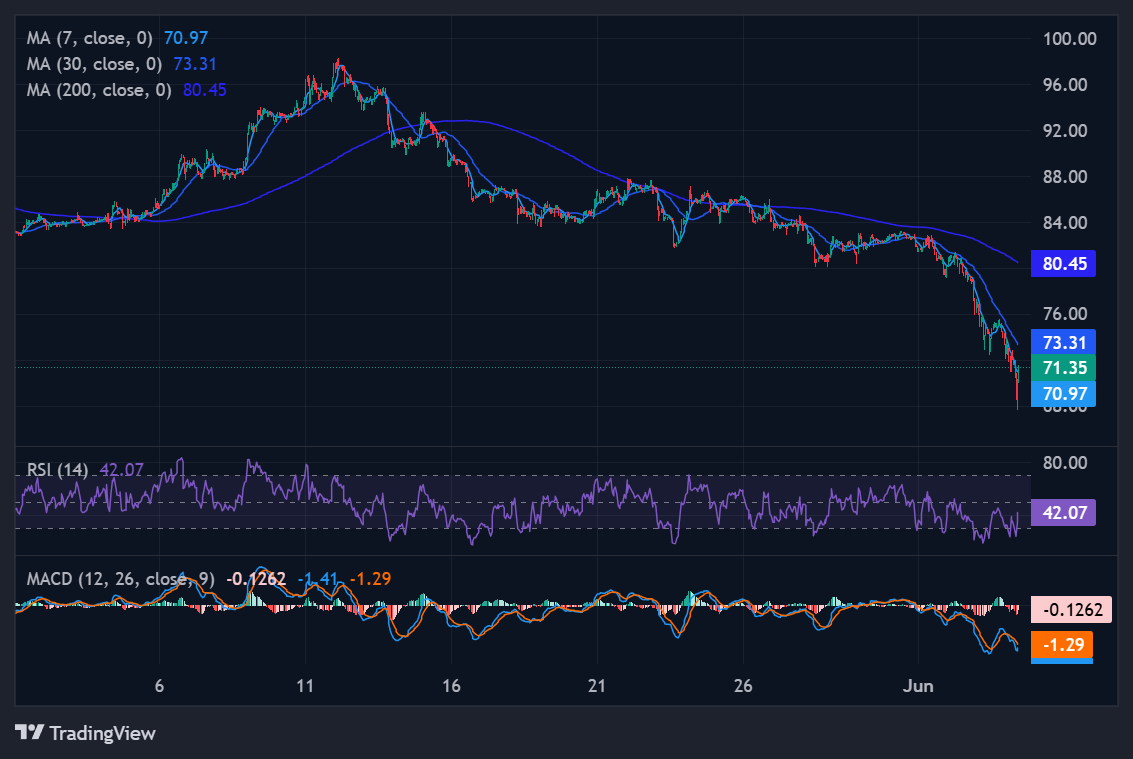
Solana is currently tracing a very clean "post-run cooldown" profile. Trading slightly below its 30-day Simple Moving Average (SMA) but safely above its structural 200-day baseline ($80–$82 band), the asset is coiling inside a well-defined $82–$102 channel.
Immediate Support:
-
$86 to $90: This is the immediate support cluster where the vast majority of recent daily closes have concentrated. Defending this band successfully ensures that the broader push from $82 to $102 remains a healthy corrective retracement, rather than a deeper technical breakdown.
-
$82 to $84: The 30-day swing low and the 200-day SMA boundary. A daily close falling below $82 would signal a much deeper structural reset. It would suggest that the rebuilding perpetual open interest is not fundamentally strong enough to hold the previous upward leg.
Immediate Resistance:
-
$92 to $96: The initial overhead block. The 30-day SMA hovers right around $92, and repeated intraday sellers have shown a willingness to cap rallies near $94–$96 when the broader tape is correcting. SOL needs to reclaim and hold above this zone to demonstrate it is ready to assume market leadership again.
-
$100 to $102+: The local monthly high zone. Sustained daily closes above $102 historically coincide with a major surge in Solana perp open interest, massive DEX volume, and an obvious ecosystem-wide "risk-on" phase.
The Read: SOL is mid-range with clear room to run in either direction. To cement its role as the high-speed base layer of a core trading stack, dips must be bought aggressively between $86 and $90. Price action needs to chew through the $92–$96 moving average block, and the next approach to $102 must be driven by sustainable, multi-day institutional trading volume rather than a fleeting retail wick.
Jupiter (JUP): DEX Router Beta Just Below Trend
Source: tradingview
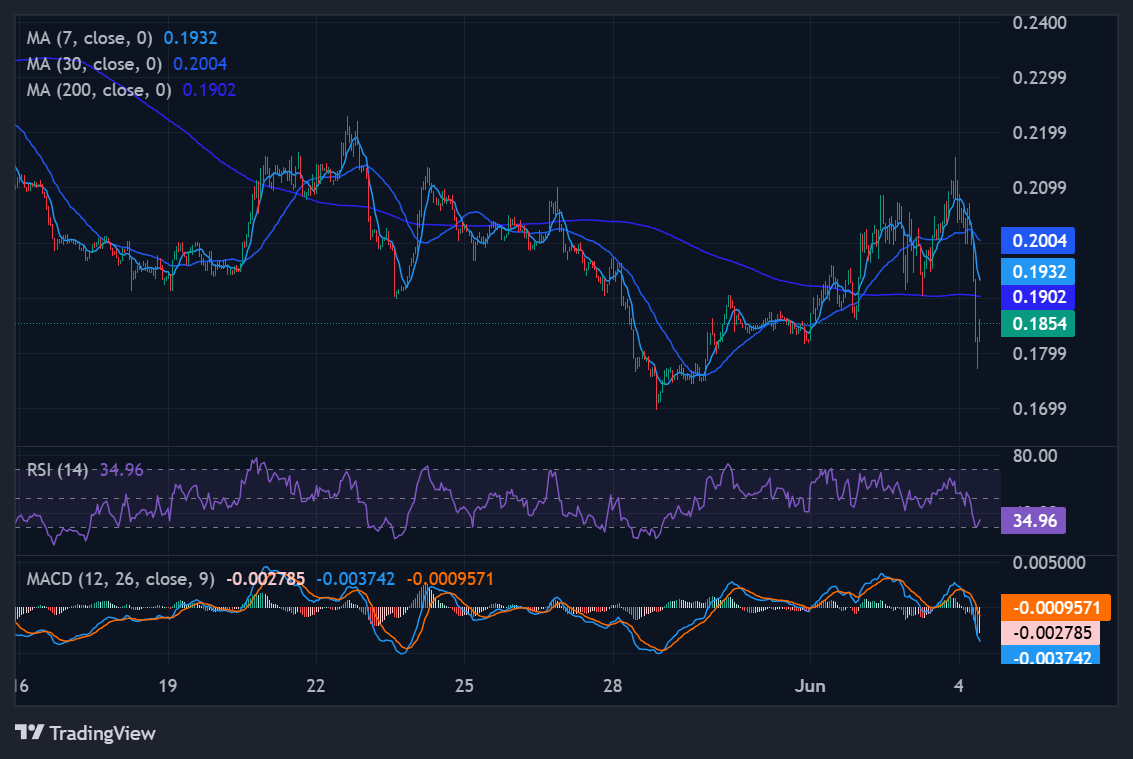
As the higher-beta routing layer of the Solana network, Jupiter's chart reflects a "hot, now cooling" technical profile. It is currently trading beneath its 30-day SMA but hovering safely around its long-term 200-day average baseline ($1.05–$1.10).
The Fibonacci Map ($0.95 to $1.45):
-
23.6% Retracement: ~$1.07
-
38.2% Retracement: ~$1.14
-
50.0% Retracement: $1.20
-
61.8% Retracement: ~$1.31
Immediate Support:
-
$1.07 to $1.10: JUP is currently trading at $1.10, sitting directly atop this shallow Fibonacci support band. Holding this floor on a daily closing basis keeps the entire $0.95 to $1.45 leg intact as a normal, healthy market correction.
-
$0.95 to $1.00: The 30-day swing low. A clean daily close below $0.95 completely unwinds the recent upward expansion. It would serve as a structural warning that on-chain router and launchpad velocity are fading.
Immediate Resistance:
-
$1.14 to $1.20: The primary trend-repair block. This zone houses the 38.2% Fib ($1.14), the 50% Fib ($1.20), and the overhead 30-day SMA ($1.18). JUP must reclaim and sit safely above this moving average cluster to prove it is being valued as a core infrastructure routing primitive, rather than a highly volatile campaign token.
-
$1.31 to $1.45+: The 61.8% Fib and local high. Sustained daily closes above $1.45 are historically accompanied by absolute DEX routing dominance on Solana and heightened native launchpad activity.
The Read: JUP is currently leaning on its very first line of Fibonacci support, with all critical trend-repair work stacked directly overhead between $1.14 and $1.20. To act as the definitive routing leg of this pair, it must preserve the $1.07 floor, turn the 30-day SMA into a supportive floor, and challenge $1.31+ on the back of rising organic execution metrics (volume routed, active trade pairs), rather than short-term network airdrops.
Conclusion: Lock In The Trading Stack Or Share Flow?
The technical alignment shows both assets in highly coiled positions. They are structurally healthy but pinned beneath their short-term averages, waiting for an injection of momentum to break their respective resistance bands.
They Lock in the On-Chain Trading Stack If:
-
SOL holds the $86–$90 support, reclaims the $92–$96 block, and consistently tests the $102 ceiling while Solana DEX and perpetual venues regularly top global on-chain volume charts.
-
JUP successfully defends $1.07–$1.10, climbs into and stabilizes above the $1.14–$1.20 resistance band, and attacks $1.45 as network data confirms an increasing share of aggregate trades are passing through Jupiter.
-
Cross-chain liquidity routers and market makers begin defaulting to "route via JUP on Solana" as a primary execution leg, prompting allocators to treat "SOL + JUP" as the standard index for high-performance trading exposure.
They Keep Sharing Flow with Rollup Aggregators If:
-
SOL's relief rallies repeatedly stall out beneath the $96 moving average, trapping the token in a sluggish $82–$96 range-bound environment.
-
JUP fails to conquer the $1.20 resistance block, spending the summer oscillating between $1.00 and $1.20 while selling pressure mounts on any positive ecosystem announcements.
-
On-chain trading volume remains split, with Ethereum L2 hyper-scalable aggregators and derivative platforms (operating across Arbitrum, Base, Blast, or zkSync) capturing a comparable or larger share of global trader mindshare and fee generation.
Final Verdict: The charts confirm a "coiled setup with clearly defined step-up bands" for both market leaders. They are perfectly positioned to act as a unified trading stack, but the market has not yet definitively chosen them over rollup alternatives. Whether they break upward over the coming weeks will reveal exactly where the cycle's trading liquidity intends to park.
Disclaimer: This article is provided for informational purposes only. It is not offered or intended to be used as legal, tax, investment, financial, or other advice.