

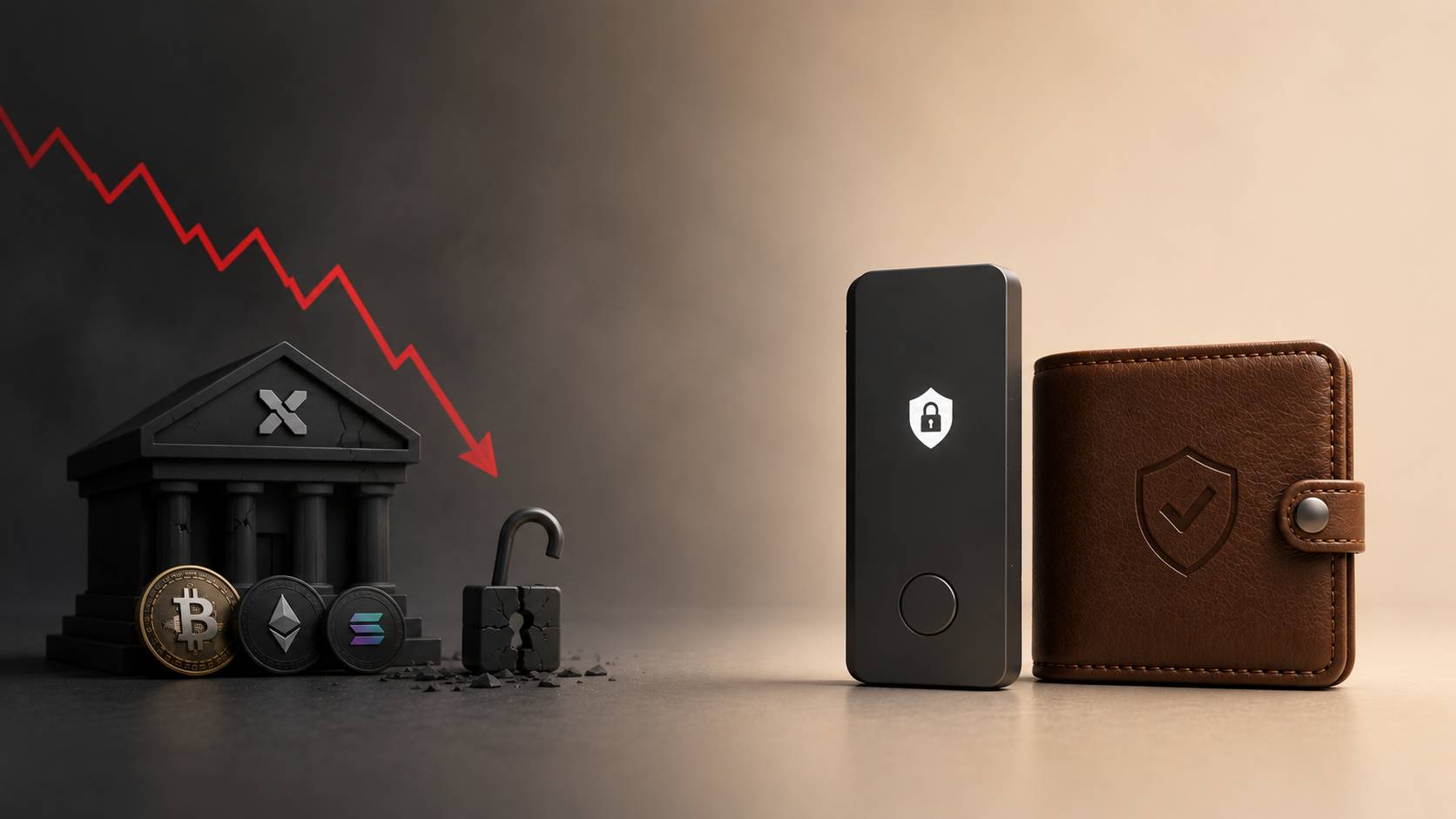
When prices drop fast, the first instinct is to move funds, and the worst moment to discover you cannot is mid-crash. That is exactly what some traders hit in early 2026, when a sharp selloff met withdrawal screens that would not load.
The episode revived a familiar worry for anyone wondering if my crypto is safe on an exchange when the market turns. The honest answer is that your coins might be fine, but your access depends on a platform staying solvent and online at the precise moment it is under the most strain.
Self-custody changes that equation. Knowing how to protect crypto in a market crash starts with understanding why an exchange balance and a wallet you control are not the same thing.
When the Exit Door Locks
Market crashes and withdrawal freezes tend to arrive together. In February 2026, as Bitcoin fell sharply in a single day, both Binance and Bybit briefly suspended withdrawals, citing technical strain from the surge in activity, and restored service within roughly twenty minutes.
That case was short and not a sign of insolvency. The deeper warning comes from 2022, when Celsius, Voyager, BlockFi, and FTX each halted withdrawals during market stress, and several never reopened them before filing for bankruptcy.
The lesson behind every exchange withdrawal freeze is the same. Understanding why exchanges freeze withdrawals comes down to one structural fact: when a platform faces a liquidity crunch or technical overload, it can pause access for every user at once, and no individual did anything to cause it.
Access Is Not the Same as Ownership
A balance on an exchange is a claim, not direct possession. The platform holds the private keys, which means it controls the actual coins, while the user holds an entry in a database that promises those coins on request.
That promise is only as reliable as the company behind it. The phrase not your keys, not your coins captures the point exactly: whoever holds the keys holds the crypto, and an account balance is a request that depends on the platform honoring it.
So keeping crypto safe on an exchange always carries a quiet assumption that the exchange stays solvent, online, and willing to process the withdrawal. Most of the time, it does, until a crash tests all three at once.
Why a Crash Is When It Matters Most
Custody risk stays invisible in calm markets. An exchange processes withdrawals smoothly for years, which builds the habit of treating an account balance as the same thing as owning the asset.
A crash breaks that habit. The moment a crowd rushes for the exit is the moment platforms face their heaviest load and their greatest liquidity strain, so the freeze tends to land precisely when access matters most.
This is the case for self-custody vs exchange during a crash in a single sentence. A wallet you control has no withdrawal button for anyone to switch off, so a falling market cannot lock you out of your own funds.
What Self-Custody Actually Protects, and What It Does Not
Self-custody is not a shield against losses. Prices fall the same whether coins sit on an exchange or in a personal wallet, so moving to self-custody protects access and control, not market value.
The honest tradeoff is responsibility. Holding your own keys means no company can freeze your funds, and it also means no company can recover them if the seed phrase is lost, so the security of the backup rests entirely with the owner.
Seen clearly, the self-custody wallet benefits are specific: uninterrupted access, no platform solvency risk, and direct control. None of those promises a profit, and it is worth being precise about the difference.
Holding Through a Crash With IronWallet
A non-custodial wallet is the practical form of this safe harbor, and IronWallet fits the role for someone who wants funds reachable no matter what the market does. The reasons line up directly against the way an exchange can lock up.
-
Keys on your device mean there is no central withdrawal system for anyone to freeze, so access does not pause during a selloff.
-
Non-custodial by design removes company solvency from the picture, since no platform sits between the owner and the funds.
-
No KYC or account gate means access never waits on an identity review or a support queue.
-
Multi-chain in one app lets a user hold Bitcoin, Ethereum, Solana, and stablecoins together, all reachable at any hour.
The scope stays honest. IronWallet protects access and control, not the market value of what it holds, and the owner takes on the duty of backing up the seed phrase that secures it.
Moving Funds Off an Exchange Calmly
The time to act is before a crash, not during one. Anyone weighing should I move crypto off the exchange is best served by deciding in a calm market, when transfers are smooth and there is no panic clouding the steps.
Moving funds is an ordinary process. Open the wallet, get the receive address for the right asset and network, send a small test amount first, confirm it arrives, then move the rest, keeping the seed phrase backed up offline.
None of this is financial advice, and it is not about timing the market. It is about deciding how much of your holdings you want to be reachable under your own control, independent of any platform's condition.
Exchange Custody and Self-Custody Side by Side
The table sets the two approaches against the points a crash brings to the surface.
|
Factor |
Exchange custody |
Self-custody |
|
Who holds the keys |
The platform |
You |
|
Access during a freeze |
Paused for all users |
Always open |
|
What it protects |
Convenience, trading speed |
Access and control |
|
Main risk |
Platform solvency and uptime |
Losing your own seed phrase |
|
Value in a crash |
Falls, and may be frozen |
Falls, but stays reachable |
Reading across the rows shows the trade clearly: an exchange offers convenience that depends on the platform, while self-custody offers control that depends on you.
Conclusion
A crash tests more than nerves. It tests whether you can actually reach your funds, and the 2022 collapses and the 2026 freezes both showed that an exchange balance can lock up at the worst possible time.
Self-custody answers that by removing the gate entirely. It does not stop prices falling, and it asks the owner to guard a seed phrase, but it keeps the exit open when every exchange door might not be.
Deciding how much to hold under your own control is the part of crash planning that has nothing to do with predicting the crash.
Disclaimer: This article is provided for informational purposes only. It is not offered or intended to be used as legal, tax, investment, financial, or other advice.