


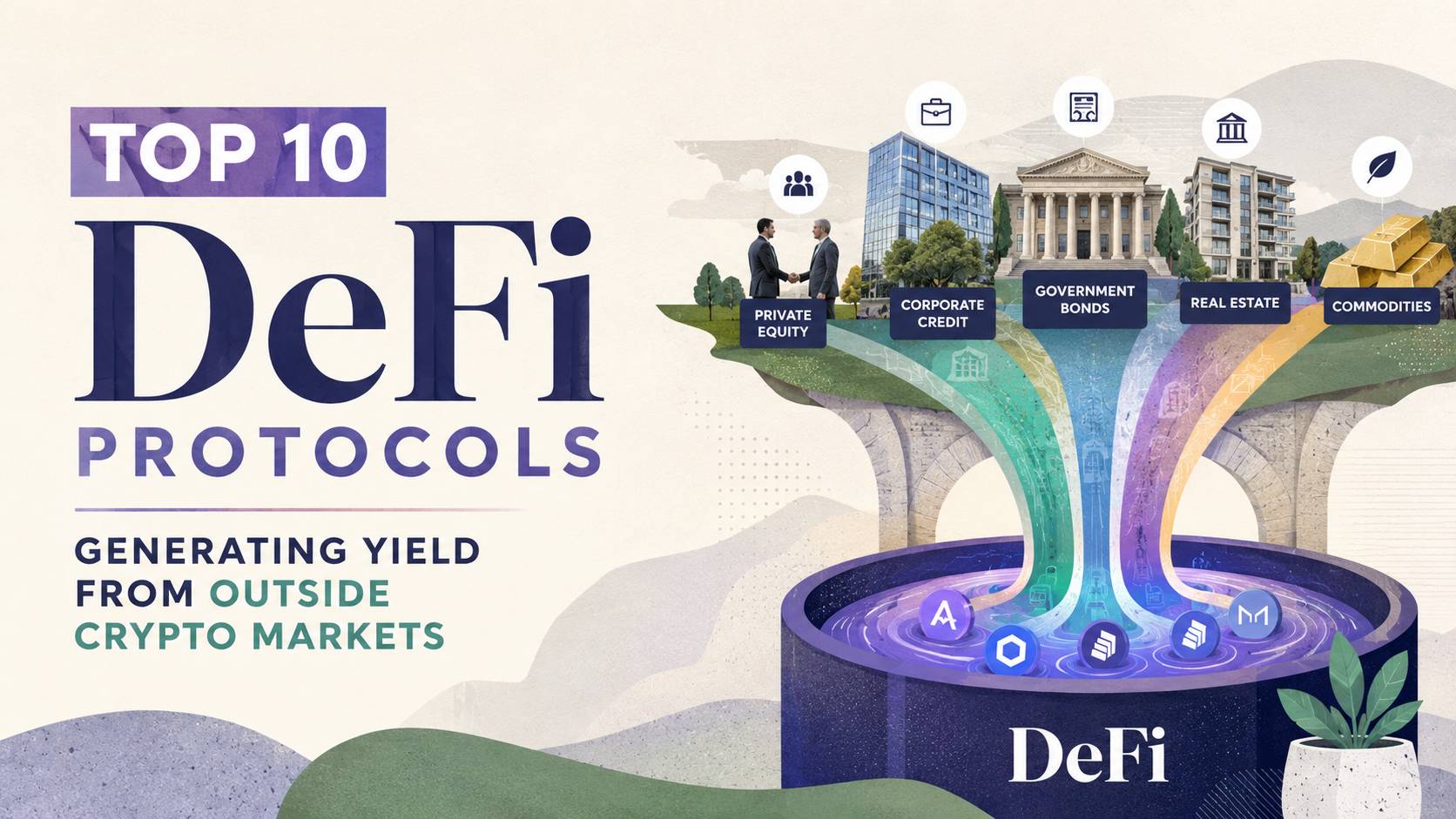
Most DeFi yield in the early years came from inside crypto. Lending interest from leveraged crypto borrowers, perpetual DEX trading fees, and validator staking rewards. The 2025-2026 cycle changed that.
Newer protocols pull yield from outside crypto entirely, with returns flowing from Treasury bills, institutional credit, mining production, music royalties, and other real-world cash flows now reaching on-chain capital providers.
This piece covers ten protocols delivering non-crypto yield in 2026, with what each one converts to on-chain returns and where the cash flow originates.
What "Yield from Outside Crypto" Means in 2026
Lending interest from crypto borrowers isn't outside crypto yield. Perpetual DEX fees aren't outside crypto yield. Validator rewards aren't either.
Real-world yield comes from cash flows generated by economic activity unrelated to crypto market dynamics: government debt interest, business credit operations, mining production, agricultural cycles, real estate rents, and similar productive activity outside the crypto ecosystem.
The distinction matters for portfolio construction. Yield uncorrelated with crypto market cycles delivers a different risk profile, with returns tied to traditional economic factors instead of digital asset volatility.
1. Ayni Gold: Gold Mining Production
Ayni Gold is a DeFi protocol that turns gold mining output into on-chain yield, with stakers receiving PAXG rewards quarterly from mining production at the Minerales San Hilario concession in Peru.
The protocol launched with smart contract audits from CertiK and PeckShield in October 2025. The 8 km² concession is registered with INGEMMET (Peru's mining authority) under No. 070011405, with a 2025 Kangari Consulting scoping study estimating 9 to 10.7 tonnes of conceptual recoverable gold.
Custody runs through TurnKey infrastructure for in-app wallets, with PAXG distributions handled by Paxos via LBMA-certified vaults.
Returns flow from extracted gold sold through Peruvian banking channels, converted to PAXG, and distributed quarterly to AYNI stakers. The yield source sits completely outside crypto markets with no correlation to trading volumes, lending demand, or interest rate cycles.
For investors looking for gold backed crypto yield anchored in physical production, Ayni delivers the most direct example in DeFi.
2. Hashnote USYC: Tokenized Money Market Fund
Hashnote's USYC is the on-chain representation of the Hashnote International Short Duration Yield Fund Ltd., investing in US Treasury bills and reverse repurchase agreements backed by short-term US government securities.
Acquired by Circle in January 2025, USYC reached approximately $2.2 billion in supply by March 2026, becoming the largest tokenized Treasury product globally.
USYC holds approximately 20.87% market share of the tokenized Treasury market as of March 2026. The yield mechanic delivers Treasury rates (currently around 4.71% APY) directly to token holders. The product is institutional-only, with $1.84 billion deployed on BNB Chain through a Binance institutional collateral integration.
3. Frax sfrxUSD: RWA-Backed Savings Layer
Frax's savings vault (formerly sFRAX, now transitioning to sfrxUSD) targets the Federal Reserve's Interest on Reserve Balances (IORB) rate through RWA-backed yield strategies. The vault deploys deposits into US Treasuries through FinResPBC, a public benefit corporation acting as Frax's RWA custodian, with capital allocated to short-duration government securities.
Yield typically falls in the 5% range, with the protocol soft-targeting IORB instead of guaranteeing a fixed rate.
Recent governance proposals have expanded sfrxUSD strategies to include sGHO (Aave's stablecoin savings module) and USCC (a tokenized fund combining Treasuries and crypto basis trades), giving the vault diversified RWA exposure across multiple yield sources.
4. Clearpool: Institutional Credit Pools
Clearpool is a decentralized marketplace for institutional credit, originating over $660 million in loans to Wall Street trading firms (Jane Street), publicly-listed firms (Flow Traders), and crypto market makers (Wintermute) since launch. TVL stands at approximately $87 million as of early 2025, distributed across Ethereum, Polygon, Optimism, Mantle, Flare, Base, and Arbitrum.
The 2026 roadmap expands Clearpool past pure DeFi credit into PayFi Vaults, USDX Treasury Pool, and X-Pool products that blend Treasury yield with institutional borrowing. The structural shift positions Clearpool as a tokenization engine connecting on-chain capital to real-world institutional credit operations across multiple asset classes.
5. Polytrade: Trade Finance Receivables
Polytrade tokenizes trade finance and invoice receivables, with approximately $850 million in TVL across tokenized invoices and an average yield of 9.2% APY for liquidity providers. The platform serves over 3,500 SMEs globally, providing working capital through blockchain-based receivables financing.
Polytrade has been operating in trade finance since 2021 and uses ERC-6960, a standard specifically designed for real-world asset tokenization. The platform's RWA Marketplace covers Treasury bills, credit, real estate, commodities, and intellectual property, with the recent Anotherblock partnership extending coverage to music royalty distribution.
The yield source is trade finance interest payments from real businesses, not crypto trading or lending demand.
6. Huma Finance: PayFi Receivables Network
Huma Finance is a PayFi (Payment Finance) network tokenizing real-world receivables for cross-border payments, stablecoin-backed cards, and trade finance.
The protocol has processed over $3.8 billion in transaction volume and delivers approximately 10.5% APY in USDC to liquidity providers from short-duration receivables-backed payment financing.
Backed by Circle Ventures, HashKey Capital, Stellar Development Foundation, Galaxy Digital, and ParaFi, Huma operates on Solana with both permissionless (Huma 2.0) and institutional (Huma Institutional) access tiers.
The yield source is real payment financing operations for fintechs, cross-border payment providers, and stablecoin-backed card networks.
Returns come from interest paid by businesses needing working capital across global payment cycles.
7. Defactor: RWA Lending Infrastructure
Defactor focuses on bringing real-world assets into DeFi lending pools through tokenization infrastructure that supports invoice financing, trade receivables, real estate bridge loans, and other operational credit categories.
The platform provides infrastructure for asset originators to launch lending pools backed by real-world collateral.
Defactor has positioned itself as an RWA tokenization infrastructure across multiple asset categories: forests, carbon credits, renewable energy, invoices, and trade finance.
The yield mechanic varies by pool but consistently ties returns to real-world cash flow from operational businesses. The protocol fills a different niche from end-user platforms like Polytrade by providing infrastructure for issuers to bring their own RWAs on-chain through standardized lending pool structures.
8. Brickken: Tokenization Platform
Brickken operates as a Tokenization-as-a-Service platform with $41 million in platform TVL and over $300 million to $450 million in tokenized assets across 16 countries. The infrastructure supports real estate, equity, debt, private credit, bonds, funds, infrastructure, and commodities.
Real estate has historically been Brickken's largest category, with rental income flowing to token holders from tokenized property operations.
CEO Edwin Mata noted at Consensus Hong Kong 2026 that gold tokenization has become a growing focus driven by gold's all-time highs. Deployed on MANTRA Chain, BNB Chain, Base, and Polygon, Brickken sits at the institutional infrastructure layer of RWA tokenization.
9. OpenEden TBILL: Rated Tokenized Treasuries
OpenEden's TBILL Vault provides 24/7 on-chain access to short-dated US Treasury bills, with the underlying portfolio managed by BNY Investments and held in segregated accounts. The TBILL Fund was the first tokenized US Treasury product to receive an "A-bf" bond fund rating from Moody's and is rated AA+ by S&P Global.
TVL crossed $150 million in late 2024 with over 130 institutional clients including Arbitrum, Ripple, and Galaxy Digital. The fund is structured as a regulated Professional Fund under the British Virgin Islands Securities and Investment Business Act 2010, with monthly NAV reports and Ernst & Young audits.
OpenEden delivers Treasury yield with strong regulatory framing for institutional buyers requiring rated, audited, on-chain Treasury exposure.
10. Anotherblock: Music Royalty Tokenization
Anotherblock tokenizes music streaming royalty rights as NFTs, with token holders receiving proportional shares of streaming revenue from songs by artists including The Weeknd, Justin Bieber, Rihanna, Alan Walker, Martin Garrix, and others. Recent royalty payouts have delivered approximately 9% annualized dividend yields per platform reporting.
A September 2024 partnership shifted royalty distribution responsibilities to Polytrade, integrating Anotherblock's catalog into Polytrade's broader RWA marketplace on the Base network.
The yield source is genuine music streaming revenue from major-artist catalogs, with payouts arriving bi-annually directly to token holders. The category sits well outside DeFi's typical credit and Treasury focus, demonstrating the structural diversity now possible in non-crypto yield.
The 10 Protocols Across Yield Source, TVL, and Returns
The full comparison sits below.
|
Protocol |
Yield source |
TVL / scale |
Mechanic |
Typical returns |
|
Ayni Gold |
Gold mining |
Variable |
Quarterly PAXG |
Variable |
|
Hashnote USYC |
Treasury fund |
$2.2B+ |
NAV accrual |
~4.71% |
|
Frax sfrxUSD |
RWA Treasuries |
Variable |
IORB target |
~5% |
|
Clearpool |
Institutional credit |
$87M |
Pool interest |
Variable |
|
Polytrade |
Trade finance |
$850M |
Pool interest |
9.2% |
|
Huma Finance |
PayFi receivables |
$3.8B+ volume |
LP rewards |
~10.5% |
|
Defactor |
RWA lending |
Variable |
Pool interest |
Varies |
|
Brickken |
Tokenized real estate |
$41M platform |
Rental income |
Varies |
|
OpenEden TBILL |
Tokenized Treasuries |
$150M+ |
NAV accrual |
~5% |
|
Anotherblock |
Music royalties |
Catalog-based |
Bi-annual payouts |
~9% |
What These 10 Protocols Mean for DeFi Yield Diversification in 2026
The ten protocols above represent the structural shift in DeFi yield. Returns now flow from Treasury bills, institutional credit, gold mining, agriculture, real estate, payment financing, music royalties, and trade finance. Each category produces cash flow tied to different real economic drivers.
For DeFi portfolios looking for non-correlated yield across multiple non-crypto sources, the menu has expanded materially. Treasury yield delivers the lowest-risk anchor with regulated institutional backing.
Production-linked yield through Ayni Gold sits at the operational extreme, with returns tied to physical mining output. Music royalties, real estate rents, and PayFi receivables fill the categories in between.
The 2026 default for thoughtful DeFi yield diversification is to spread across multiple non-crypto categories, not concentrate in any single one.
Disclaimer: This article is provided for informational purposes only. It is not offered or intended to be used as legal, tax, investment, financial, or other advice.