
PAXG and XAUT settled the basic question of putting gold on-chain. Neither pays yield. Kinesis and Ayni Gold both go further, but the source of that yield is structurally different.
Kinesis pays from platform transaction fees, distributed monthly in KAU. Ayni Gold pays from mining production, distributed quarterly in PAXG. Same category of gold-backed crypto yield, different engines.
For holders comparing where to earn yield in gold without giving up gold-denominated exposure, the choice between these two products comes down to which yield engine fits the portfolio.
Side by Side: KAU vs AYNI
Both products are gold-backed, and both pay yield. The differences lie in how each is structured underneath.
|
Kinesis (KAU) |
Ayni Gold (AYNI) |
|
|
What the token represents |
1 gram of vaulted investment-grade gold |
Tokenized exposure to gold-mining capacity at licensed concessions |
|
Yield source |
15% of platform transaction fee revenue |
Mining output minus operational costs and success fee |
|
Distribution |
Monthly |
Quarterly |
|
Reward asset |
KAU (more gold) |
PAXG (gold-backed stablecoin) |
|
Operating since |
2019 |
2025 |
|
Best for |
Holders who want a monthly yield from platform activity |
Holders who want a yield tied to physical gold production |
Kinesis (KAU): Yield from Platform Activity
Each KAU token is backed by one gram of investment-grade gold bullion, stored in fully insured vaults across the ABX (Allocated Bullion Exchange) network.
Gold reserves are audited semi-annually by Inspectorate International, and the platform has been operating since 2019.
KAU has practical utility most gold-backed tokens lack. Holders can spend it globally through the Kinesis Virtual Card on the Mastercard network, with instant fiat conversion at the point of sale.
Physical redemption is available from 100 grams of gold bullion, processed through the global vault network.
The total Kinesis yield system distributes 57.5% of platform fees back to participants through five different yields, with KVT (Kinesis Velocity Token) holders receiving an additional 20% share. In 2026, Kinesis had paid out more than $168k to KAU holders cumulatively.
How Yield is Generated
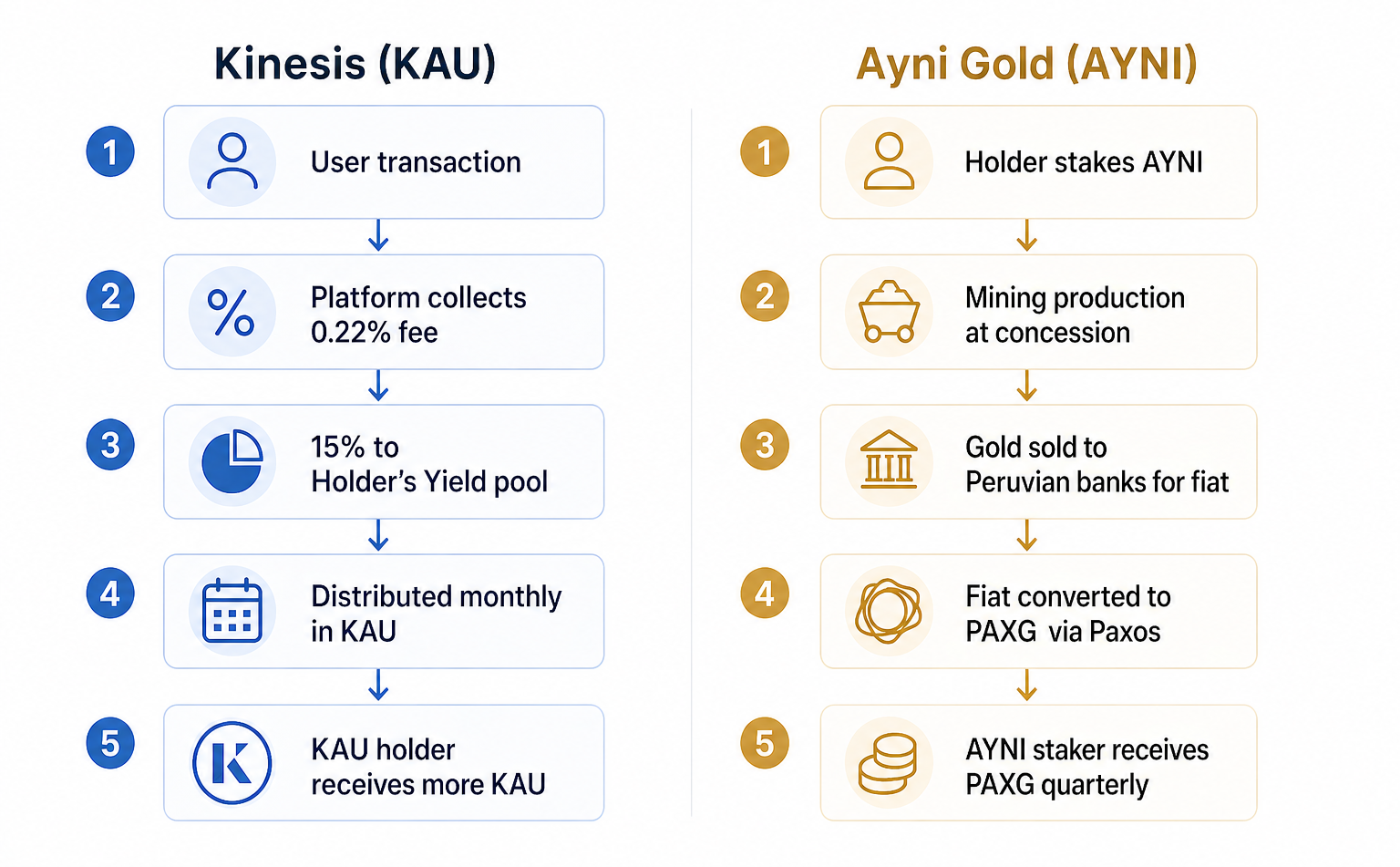
The yield mechanic is fee-share. Kinesis takes a 0.22% transaction fee on platform activity. Of that, 15% flows to the Holder's Yield pool, distributed monthly in KAU to anyone holding gold on the platform.
Holders receive their share proportional to how much KAU they hold against the platform's total. There are no lock-ups and no minimum holding period. Storage is free.
The structural trade-off is clear. KAU yield is variable and tied directly to platform usage. Months with high transaction volume produce higher yields. Quiet markets compress them.
This makes Kinesis a form of DeFi gold yield where holders are taking exposure to platform activity, not to gold production.
Ayni Gold (AYNI): Yield from Mining Production
Ayni Gold takes a different route to gold-backed yield. The protocol does not tokenize stored bullion. It tokenizes operating mining capacity instead.
Each AYNI token represents 4 cm³ per hour of processing capacity at the Minerales San Hilario concession in Peru, an 8 km² alluvial site in Madre de Dios.
The token has a fixed supply of 806,451,613 AYNI and no minting after launch. Two licensed concessions are now active under the protocol: the primary site (INGEMMET No. 070011405) and a secondary one acquired in Q4 2025.
The verification stack covers four independent layers: CertiK and PeckShield for the smart contracts (both audits completed in October 2025), TurnKey for institutional custody, and Kangari Consulting for the geological assessments.
How Yield is Generated
Yield comes directly from mining output. Holders stake AYNI to receive staking rewards in gold, paid in PAXG every quarter.
The conversion path runs through Peru's banking system: extracted gold is sold to local banks, the proceeds are converted to fiat, and the fiat buys PAXG through Paxos. Settlement uses daily gold pricing, and distribution is proportional to staked AYNI.
Staking is tiered. Longer lock-ups earn higher reward weights via a dynamic success fee, which means loyal holders capture more of the net return. The protocol also burns 15% of accumulated success fees each quarter, which gradually reduces the circulating supply.
The concession's projected daily production capacity is up to 8,000 grams, contingent on operational ramp-up.
The 2025 scoping study at the site identified more than 9 metric tonnes of conceptual recoverable gold potential, with the caveat that scoping studies are early-stage assessments and not confirmed reserves.
Holders considering PAXG yield staking find a different shape of exposure here. The position pays gold-backed DeFi yield from physical extraction at the concession, not from platform usage or new token issuance.
How the Yield Engines Differ
Three structural differences separate the two products:
-
Yield source variability: Kinesis yield rises and falls with platform transaction volume. Ayni Gold yield rises and falls with mining output. Different exposure types.
-
Reward denomination: Kinesis pays in KAU, the same asset holders already own. Ayni Gold pays in PAXG, a different gold-backed asset. Both keep yielding gold-denominated, but the mechanics differ.
-
Token representation: A KAU represents stored gold. An AYNI represents operating mining capacity. The first tokenizes a static asset; the second tokenizes ongoing productive activity.
The structural difference is not which model is better. It is the one a holder is choosing to have exposure to. Kinesis yield depends on people transacting on the platform. Ayni Gold yield depends on people extracting gold from a concession in Peru. They scale on different inputs.
Both deliver gold backed stable yield in the sense that both reward assets are gold-backed and both keep returns denominated in gold. The yield engines underneath operate on a different economic logic.
Choosing Between KAU and AYNI
The right product depends less on yield expectations and more on what kind of gold exposure the portfolio needs.
Kinesis fits holders who:
-
Want gold they can spend globally through a debit card
-
Prefer monthly yield distribution
-
Want exposure to platform usage as the yield engine
-
Value a six-year operating track record
Ayni Gold fits holders who:
-
Want yield tied to physical gold production
-
Are comfortable with quarterly distribution
-
Prefer yield paid in PAXG, separate from the staked asset
-
Want exposure to mining output as the yield engine
The two products serve overlapping but distinct needs. Both occupy the broader category of commodity backed DeFi, where returns trace back to real physical assets rather than synthetic strategies. The right framing is not platform-fee yield versus production yield. It is which yield engine matches the portfolio.
Frequently Asked Questions
How are Kinesis and Ayni Gold different?
Kinesis pays yield from platform transaction fees, distributed monthly in KAU. Ayni Gold pays yield from mining output at licensed concessions in Peru, distributed quarterly in PAXG. Both are gold-backed; the yield engines are structurally different.
Which one pays more?
Both yields are variable. Kinesis depends on platform transaction volume. Ayni Gold depends on mining output. Neither offers a fixed APY. The right comparison is which yield source fits a holder's allocation thesis, not headline rate.
Can I redeem either token for physical gold?
Kinesis allows physical gold redemption from 100 grams minimum through its vault network. AYNI is not directly redeemable for gold, but stakers receive PAXG rewards, which can be redeemed for physical gold through Paxos.
How does Ayni Gold convert mining output to PAXG?
Extracted gold is sold to Peruvian banks, converted to fiat, then to PAXG via Paxos. Settlement is based on daily gold pricing and distributed quarterly to AYNI stakers proportional to stake size.
Which has the longer track record?
Kinesis has been operating since 2019, with $11 million+ paid to holders by November 2025. Ayni Gold launched its smart contracts in October 2025, audited by CertiK and PeckShield. Different maturity stages, different risk profiles.
Disclaimer: This article is provided for informational purposes only. It is not offered or intended to be used as legal, tax, investment, financial, or other advice.