


Media teams today operate in a landscape rich in data but poor in clarity. Evaluating a single outlet often requires switching between multiple tools and manual checks of editorial practices and audience reach. Each of these signals is measured differently, updated independently, and interpreted in isolation.
This fragmentation creates a fundamental issue. The data exists, but it does not form a coherent picture. Metrics frequently contradict one another, and there is no consistent way to weigh their importance. As a result, media selection becomes slow, inconsistent, and often subjective.
Even experienced teams encounter the same friction: one outlet shows strong traffic, another ranks higher in SEO tools, and a third appears more influential within industry conversations. Without a standardized framework, these signals remain disconnected.
Why media ranking is needed
Media ranking addresses this structural gap by introducing a system for comparison. Instead of evaluating outlets through isolated indicators, a ranking framework aggregates multiple performance signals and normalizes them into a unified scale. This allows media teams to compare outlets directly, rather than attempting to reconcile mismatched data points.
Without such a system, teams often fall back on internal media lists, past experience, or general brand recognition. These methods can work in stable environments, but they struggle in fast-moving sectors where media dynamics change quickly. Ranking introduces structure, reducing reliance on intuition and enabling a more systematic approach.
Why selecting the right media matters
Media selection remains one of the most consequential decisions in any PR or content strategy. The same story can produce entirely different outcomes depending on where it is published.
Some outlets generate large volumes of traffic but have limited influence on broader industry narratives. Others publish less frequently but are consistently cited by analysts, researchers, and aggregators. There are also publications that perform well in search rankings yet show weaker audience engagement.
These differences are not always visible through traditional metrics. Without a way to compare outlets across multiple dimensions, teams risk allocating budgets to placements that do not align with their goals.
Existing media intelligence platforms and their limitations
The current ecosystem offers a range of tools designed to support media work, but most focus on execution rather than analysis.
PR platforms such as Cision, Muck Rack, and Agility provide access to media databases, journalist contacts, and outreach workflows. They are effective for distributing content and managing relationships, yet they offer limited capabilities for comparing outlets in a structured way.
SEO and traffic tools are often used as proxies for media analysis. Platforms like Similarweb, Ahrefs, and SEMrush are widely used in media selection.
They provide:
-
traffic estimates
-
domain authority scores
-
keyword visibility
However, they measure web performance, not media influence. They do not account for editorial practices, audience quality, or syndication depth.
This leads to a common problem: teams compare incompatible metrics and draw incomplete conclusions.
Outset Media Index standardizes fragmented media metrics
Outset Media Index (OMI) was developed to address this exact gap. Rather than introducing another isolated metric, it provides a unified framework that standardizes how media outlets are analysed.
OMI aggregates data from multiple sources and reviews outlets across more than 37 normalized metrics. These include audience reach, engagement patterns, SEO and AIO performance, editorial flexibility, syndication depth, and LLM visibility. By combining these dimensions, the platform produces a structured view of how each outlet performs within the broader media ecosystem.
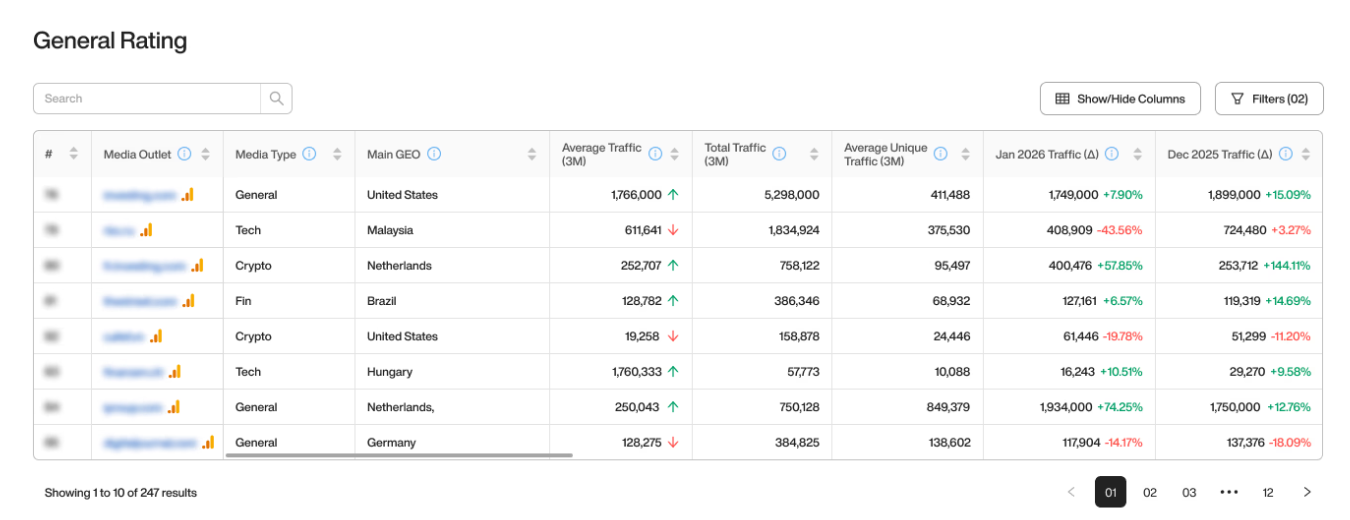
The key distinction lies in standardization. Instead of requiring teams to interpret conflicting signals across different tools, OMI aligns these signals within a single analytical system. Outlets can be compared side by side using consistent criteria, eliminating much of the ambiguity that defines traditional media research workflows.
The Outset Media Index (OMI) is now in a soft launch period, so early users can explore the platform and share their feedback. Participants who offer their thoughts on OMI will qualify for complimentary plan upgrades.
Share Feedback on OMI and Get Free Upgrade
From analysis to decision-making
By normalizing and structuring media data, OMI enables teams to:
-
identify which outlets drive visibility vs. SEO vs. influence
-
match media choices to specific campaign goals
-
compare outlets objectively across regions and categories
-
allocate budgets based on expected communication impact
It also introduces independent benchmarking, reducing reliance on promotional claims, paid placements, and opaque ranking lists. Instead, rankings are derived from consistent, data-driven criteria.
Conclusion
As the media landscape continues to expand, the challenge is no longer access to data but the ability to interpret it consistently. Fragmented metrics, disconnected tools, and subjective benchmarking methods limit the effectiveness of even well-resourced teams.
Media ranking offers a way to address this by introducing comparability and structure. Outset Media Index builds on this concept by standardizing how media performance is verified, transforming scattered signals into a unified framework.
In doing so, it reframes media analysis as a system rather than a collection of tools, enabling teams to make decisions with greater clarity and precision.