



Crypto loans have quietly become part of everyday financial behavior across Latin America. In Brazil, Argentina, and Mexico, people use them to access liquidity, cover short-term needs, or simply avoid selling assets they would rather hold.
There is nothing particularly exotic about it anymore. You deposit crypto, receive funds, and manage the position over time. What matters is not the process itself, but how the loan is structured and how carefully it is handled.
Some platforms still offer fixed loans with rigid terms. Others, including Clapp.finance, take a different route and provide a credit line instead. That small difference tends to change how borrowing is actually used.
What a Crypto Loan Is
A crypto loan is a collateralized loan. You lock your digital assets and receive liquidity in return, usually in stablecoins or fiat.
The key variable is the loan-to-value ratio, or LTV. It defines how much you can borrow.
If you deposit $10,000 in BTC:
-
At 20% LTV, you borrow $2,000
-
At 40% LTV, you borrow $4,000
The math is straightforward, though the implications are not always obvious at first. Lower LTV gives you more breathing room. Higher LTV increases the available amount, but it also leaves less margin if the market moves against you.
Why People Use Crypto Loans in Latin America
The demand for crypto lending in the region is driven by practical constraints. A freelancer in Brazil may need cash between invoices. Selling BTC solves the problem, but it also reduces long-term exposure. Borrowing keeps the position intact.
In Argentina, where currency instability is a constant factor, holding debt in USDT can feel more predictable than dealing with local currency. A loan becomes a way to access dollars without going through the banking system.
Some users simply want optionality. They hold assets, and they want to be able to act quickly if something comes up. That could be a market opportunity, or just an unexpected expense.
These situations are different, though the underlying idea is the same: access liquidity without breaking the portfolio.
How to Get a Crypto Loan
The process is not complicated. Most platforms follow roughly the same steps, although the details can vary.
Account and Verification
You start by creating an account and verifying your identity. This usually involves uploading an ID and completing a quick biometric check.
It takes a few minutes. It also reflects the fact that most platforms now operate within regulatory frameworks and follow KYC and AML requirements
Deposit Collateral
Once verified, you transfer crypto to the platform.
BTC and ETH are the most common choices. Stablecoins are also accepted in many cases. Some platforms allow you to combine assets, which can be useful if your portfolio is diversified.
Clapp supports this approach. You can use multiple assets together as collateral, rather than relying on a single position
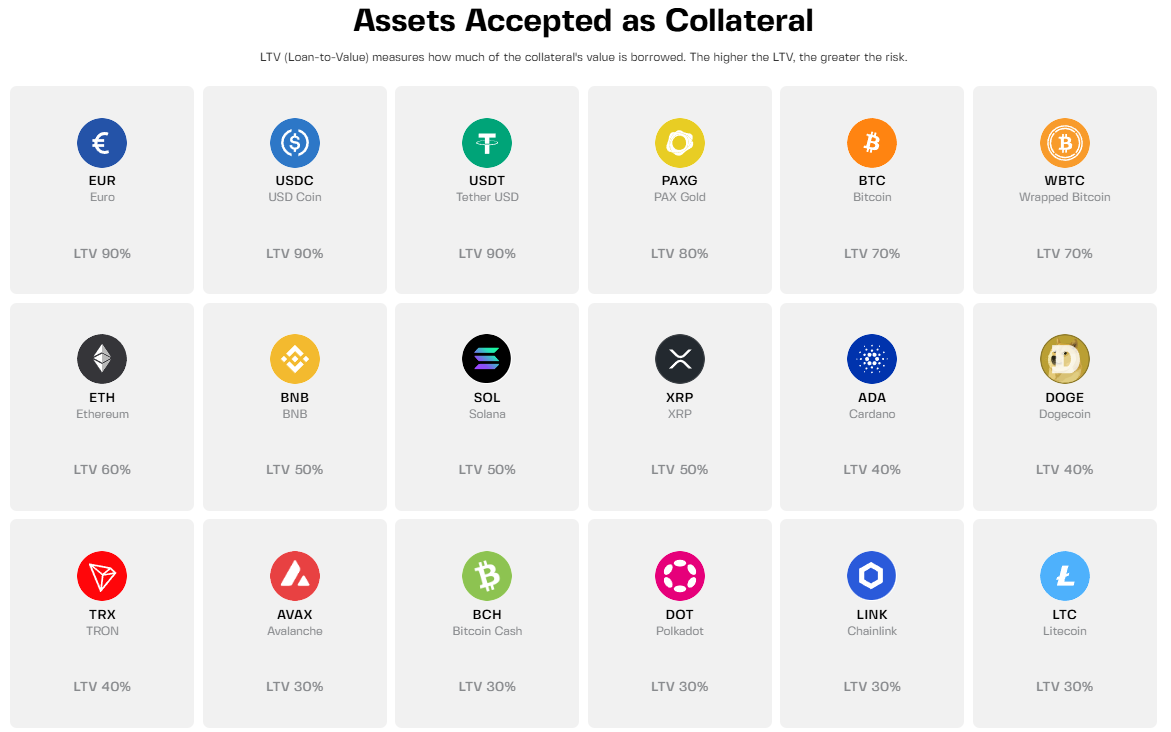
The image is sourced from clapp.finance
Getting Access to Funds
This is where platforms start to differ. With a traditional loan, you receive a fixed amount and interest begins immediately. With a credit line, you receive a limit instead. You can borrow from it when needed, or leave it untouched.
On platforms like Clapp, interest applies only to the amount you actually use. The unused portion of the credit line remains available and does not generate cost
That changes how people think about borrowing. It feels less like taking on debt and more like keeping liquidity within reach.
Withdrawing Funds
Once the credit line is set, you can withdraw funds at any time. In Latin America, most users choose stablecoins such as USDT or USDC. They are widely accepted and easy to move. Fiat options exist, although availability depends on the platform and local infrastructure.
A Simple Example
Suppose you hold $12,000 in BTC and need $2,000.
You deposit the BTC and receive a credit limit. You withdraw only what you need.
Interest applies to that $2,000, and nothing else. The remaining credit stays unused.
If the market moves up, your position remains intact. If it moves down, your low LTV gives you time to react.
There is nothing particularly clever here. It is simply a matter of using the tool in a measured way.
Costs, Without Overcomplicating It
The cost of borrowing depends mostly on LTV.
Lower LTV tends to result in lower rates. Higher LTV increases both cost and risk.
Some platforms advertise very low rates or even 0% APR. These usually apply under specific conditions, often tied to keeping LTV at a conservative level
It is worth reading the details. The headline number does not always tell the full story.
Risk, Which Is Easy to Ignore at First
The main risk is liquidation.
If the value of your collateral drops, your LTV rises. At a certain point, you may need to add collateral or repay part of the loan.
If you do nothing, part of your assets may be sold automatically.
This is where initial decisions matter. A loan at 20% LTV behaves very differently from one at 60%. There is no way around that. The structure defines the outcome.
Why Credit Lines Tend to Work Better Here
Financial conditions in Latin America are not always predictable. Income can be uneven, and markets can move quickly.
A fixed loan assumes a clear plan from the start. A credit line leaves room for adjustment.
Platforms like Clapp offer that flexibility. You can access funds when needed, repay at your own pace, and keep the rest of the credit untouched without cost
It is not necessarily better in every situation, though it often fits the way people actually use liquidity.
Final Thoughts
Getting a crypto loan in Latin America is straightforward. The tools are accessible, and the process is quick.
What matters more is how the loan is used. A conservative LTV, a clear sense of cost, and a bit of restraint tend to go a long way. Without those, even a simple loan can become difficult to manage.
Used carefully, a crypto loan can do exactly what it is supposed to do. It gives you access to liquidity, and it lets you keep your position at the same time.
Disclaimer: This article is provided for informational purposes only. It is not offered or intended to be used as legal, tax, investment, financial, or other advice.