



DTCC plans to connect its Tokenization Service to Solana in the second half of 2027, opening a route for eligible securities held in custody at its Depository Trust Company subsidiary to become available on the network. The planned connection was announced on Nov. 12, 2026, less than three weeks after DTCC launched the service with its first blockchain links.
The move places Solana on the roadmap of a market-infrastructure operator whose depository subsidiary held about $114 trillion in securities at the end of 2025. But the headline figure associated with the service—roughly $30 trillion—describes assets eligible for tokenization at launch, rather than securities that have already moved on-chain.
Solana connection scheduled for H2 2027
DTCC said its Tokenization Service will connect with Solana during the second half of 2027. Under the plan, eligible DTC-custodied assets are expected to become available through the network, according to DTCC’s announcement.
Although the timetable is a forward-looking implementation target rather than a report of securities already being issued or settled through Solana, DTCC did not specify an exact launch date in the second half, identify which securities would be first to use the connection, or provide a projected volume in the announcement.
For the company, the integration would extend a service designed to make eligible traditional securities accessible across more than one blockchain environment. That multi-network approach is central to the announced rollout: Solana is a planned addition rather than the network on which the service initially went live.
Securities lifecycle framework
The planned integration, DTCC said, is intended to support both tokenization and lifecycle functionality for eligible traditional securities. The latter generally refers to the events and administrative processes attached to a security after it is issued, not simply the creation of a digital representation of an asset.
The company said the service is intended to preserve existing ownership rights, investor protections and regulatory safeguards. That stated boundary is consequential because the planned network connection is being presented as an extension of traditional-securities infrastructure, not as a replacement for the regulated custody framework surrounding eligible DTC-held assets.
DTCC has not said that every security in its custody will be available through the service or through Solana. Availability remains limited to assets that meet the service’s eligibility criteria, and the operational scope of the Solana connection will depend on the planned 2027 rollout.
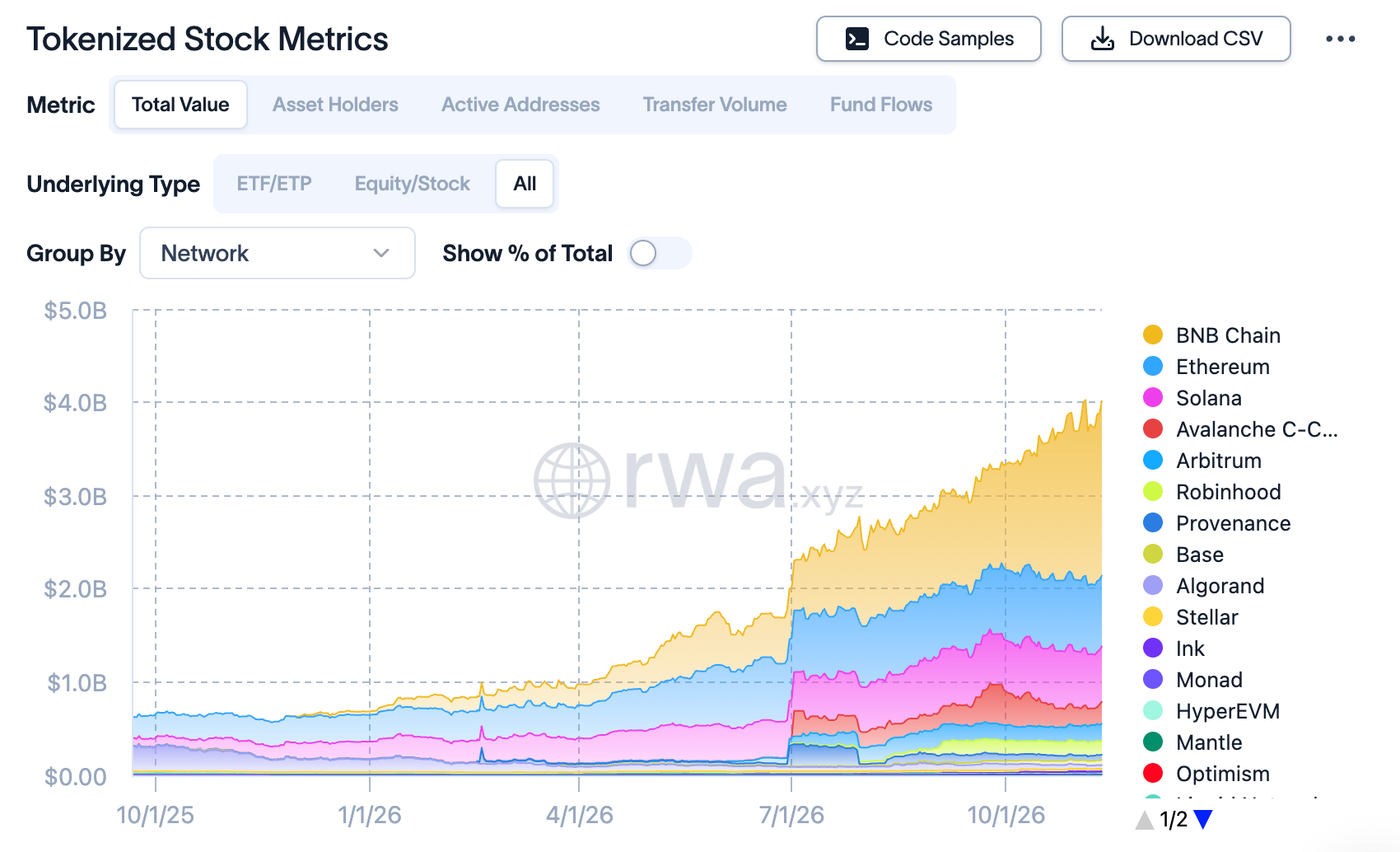
Chart showing the tokenized stock market by blockchain, relevant to Solana’s planned addition to DTCC’s tokenization network roadmap. — Source: CoinDesk / RWA.xyz
Eligible assets, not assets already on-chain
At launch, the Tokenization Service supported 34 eligible securities representing approximately $30 trillion in DTC-custodied assets available for tokenization.
DTCC said the figure refers to eligibility, not assets already on-chain, according to CoinDesk. The 34-security set was the pool identified as available for tokenization at launch, rather than all securities held by DTCC.
That distinction leaves the figure as a measure of potential initial scope. It does not establish current tokenized issuance or that the securities have been migrated, traded or settled on a blockchain; use of a particular blockchain connection also depends on the service’s staged network rollout.
Service launch and network roadmap
DTCC launched the Tokenization Service on Oct. 28, 2026, with initial connections to the Canton Network and DTCC’s private Besu-based blockchain. The company said additional network connections were planned for 2027, and its roadmap now includes Solana, where eligible DTC-custodied assets are expected to become available in the second half of 2027, according to DTCC.
The Solana connection adds another network to the service’s planned expansion; it does not replace the initial Canton and private Besu-based connections.
DTCC’s depository subsidiary held approximately $114 trillion in securities from more than 150 countries and territories at the end of 2025, according to the company. That custody footprint indicates the institutional scale behind the initiative, although only eligible assets fall within the Tokenization Service’s initial tokenization universe.