



R-star, usually written as r*, is the real short-term interest rate consistent with an economy operating at full strength and stable inflation. Put more simply, it is an estimate of the real rate at which monetary policy is neutral: neither adding meaningful stimulus nor applying meaningful restraint.
The Federal Reserve cannot directly observe or set r-star: the federal funds rate is an observed nominal policy rate, whereas r-star is an estimated real benchmark. That distinction matters because the same funds rate can be restrictive in one economic setting and accommodative in another. The Federal Reserve Bank of New York describes r-star as unobservable and therefore something that must be estimated.
R-star is the real rate that leaves policy neutral
The word “real” means inflation-adjusted. A useful simplified relationship is:
real policy rate ≈ nominal federal funds rate − expected inflation
Policymakers compare that real policy rate with their estimate of r-star. When the real policy rate is below r-star, policy is generally considered accommodative. Borrowing conditions, in that broad sense, are easier than the neutral benchmark. When it is above r-star, policy is generally considered restrictive. The Federal Reserve Board’s FOMC Secretariat has framed the neutral real rate in those terms.
Neither label means that every household, business or market participant experiences conditions identically. Lending rates also reflect credit risk, loan terms, bank funding costs and conditions in financial markets. R-star is instead a macroeconomic reference point for judging the overall policy stance.
It also should not be confused with the Fed’s inflation objective, the longer-run policy setting published by participants, or a promise about where the funds rate will go next. It is a concept used to interpret a policy rate, not a mechanical destination for that rate.
From r-star to the nominal neutral federal funds rate
Because the federal funds rate is quoted in nominal terms, inflation expectations have to be added back to turn a real neutral-rate estimate into a nominal neutral-rate approximation:
nominal neutral rate ≈ r-star + expected inflation
The Federal Reserve Board has described r-star as an important determinant of the longer-run federal funds rate and other nominal interest rates for this reason.
Consider a purely illustrative sequence. If r-star were unchanged while expected inflation rose, the nominal neutral rate would rise under this approximation. That would not mean the economy’s underlying real neutral rate had necessarily changed. It would mean that a higher nominal rate could be needed to deliver the same inflation-adjusted stance.
The reverse also applies. Falling expected inflation can lower the nominal neutral benchmark even when r-star itself is steady. This is why commentary that compares a nominal policy rate with r-star directly can be misleading: the two are expressed in different terms.
How the Fed uses a moving benchmark to judge policy restraint
R-star enters monetary-policy analysis through the gap between the real policy rate and neutral. A higher real rate relative to r-star tends to weaken aggregate demand and reduce the output gap, though the effects work with a lag, according to a Federal Reserve Board FEDS Note. The output gap is commonly used to describe the difference between actual economic activity and its sustainable level.
One simplified transmission path runs from the policy rate to broader financing conditions, then to spending and investment decisions, and eventually to demand, employment and inflation. The chain is neither immediate nor fixed. Mortgage rates, corporate borrowing costs, exchange rates, asset prices and credit availability can all affect how changes in policy reach the economy.
That is why r-star informs an assessment rather than dictating a rate decision. Fed officials must also evaluate inflation, labor-market conditions, financial conditions and incoming evidence about demand and supply. A neutral estimate cannot tell policymakers, on its own, how quickly prior rate changes are working or whether other developments are offsetting them.
The uncertainty is consequential. Former Fed Chair Jerome Powell noted that estimates can be revised substantially and that policymakers risk misjudging whether a given funds rate is stimulative or restrictive when r-star is uncertain. His remarks are available from the Federal Reserve Board.

Why bonds, stocks and valuations react to r-star assumptions
For bond investors, the central question is often where short-term nominal rates might settle over a longer horizon. Since the nominal neutral rate can be approximated by r-star plus expected inflation, a change in either assumption can alter views on the longer-run level of nominal interest rates.
That does not mean r-star alone determines Treasury yields. Yields at different maturities also reflect expected future policy rates, inflation expectations, compensation for interest-rate risk and other market forces. But a higher perceived neutral rate can support the view that rates may settle at a higher level than previously assumed; a lower perceived neutral rate can point the other way.
The valuation connection follows from discounting. Investors value a future stream of cash flows by translating it into a present value using a required return or discount rate. All else equal, a higher discount-rate assumption reduces the present value of distant cash flows, while a lower assumption raises it. Long-duration assets—those whose expected cash flows lie further in the future—are generally more sensitive to that arithmetic.
For equities, however, a higher r-star is not automatically bearish. The same underlying conditions that lift neutral-rate estimates could be associated with stronger trend growth or productivity, which may improve expectations for revenues and earnings. The market outcome depends on how investors weigh prospective cash flows against the discount rate, as well as risk appetite and many company-specific factors.
For that reason, “higher r-star means lower stock prices” is too blunt a rule. It captures one valuation channel but omits the economic forces that may be affecting expected profits at the same time.
Productivity, saving and safe-asset demand can move r-star
R-star is not presumed to be constant. The Federal Reserve has associated changes in neutral-rate estimates with trend productivity and growth, demographics, fiscal conditions, risk appetite, saving behavior and demand for safe assets. In a Federal Reserve speech, those forces were identified as factors relevant to the evolution of r-star.
The intuition is that long-run saving and investment conditions help shape the real return needed to balance the economy at stable inflation and full strength. Faster productivity growth, for example, can be associated with stronger investment opportunities. Greater saving or stronger demand for safe assets can influence the other side of that relationship. These are conceptual links, not a formula that converts any single economic release into a new r-star figure.
The New York Fed’s official Laubach-Williams chart of r-star and trend economic growth illustrates that its estimates have varied materially over time. That historical movement is central to the concept: neutral is a moving benchmark, not a timeless number.
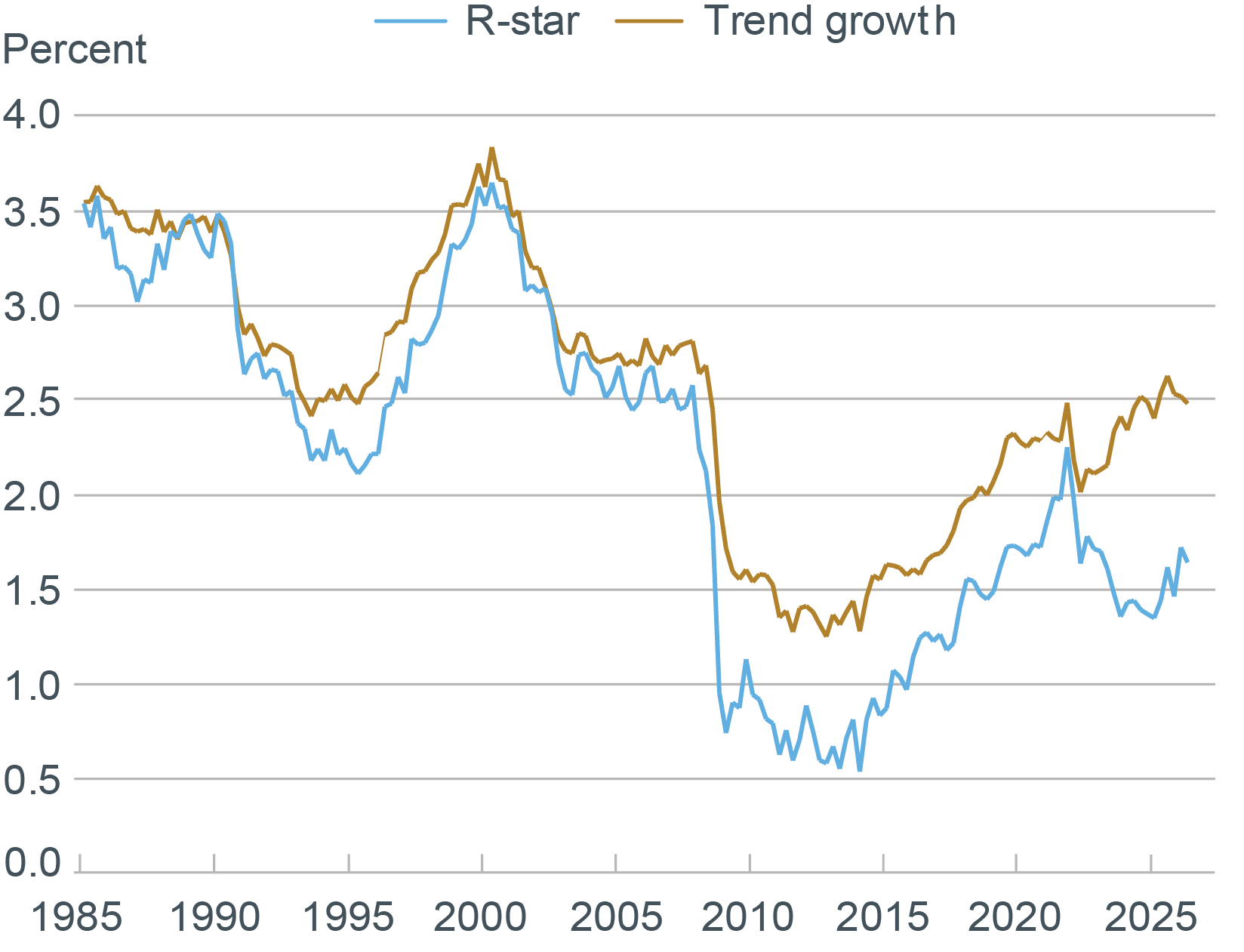
Official chart of U.S. Laubach-Williams estimates of R-star and trend economic growth, showing substantial variation over time. — Source: Federal Reserve Bank of New York
Why no one can observe r-star in real time
R-star cannot be read directly from a market screen, a Fed announcement or one economic report. It is inferred from economic data and a model’s assumptions. The New York Fed says its Laubach-Williams estimates use real GDP, inflation and the federal funds rate to infer trends in r-star and economic growth.
Model construction matters. The New York Fed’s post-COVID methodology incorporates time-varying volatility and persistent supply shocks, reflecting an effort to account for features of the economy that may not be well handled by a fixed historical relationship. Details of the approach are published on the New York Fed’s r-star page.
Different models can reasonably produce different estimates because they make different choices about data, time horizons and how economic relationships evolve. Estimates can also change after data revisions or as later observations clarify an earlier period. An estimate available today is therefore not a final verdict on the stance of policy at a particular moment.
This limitation is more than technical. If policymakers overestimate r-star, they may view policy as less restrictive than it really is. If they underestimate it, they may conclude policy is tighter than it is. The appropriate response is not to ignore neutral-rate estimates, but to treat them as one uncertain input alongside a wider body of evidence.
Frequently Asked Questions
Is r-star a Federal Reserve target?
No. R-star is an estimated neutral real rate that helps assess whether policy is accommodative or restrictive. The Fed sets a nominal federal funds rate, not r-star.
How is r-star different from the federal funds rate?
The federal funds rate is an observed nominal policy rate. R-star is an unobservable, inflation-adjusted benchmark, so comparing the two requires accounting for expected inflation.
Does a higher r-star automatically hurt stocks?
Not automatically. A higher neutral-rate assumption can raise discount-rate assumptions, which can weigh on valuations, but the forces behind it may also improve expected economic growth and corporate earnings.
Why do inflation expectations matter for neutral rates?
They bridge the real and nominal concepts. The policy-relevant nominal neutral rate is commonly approximated by adding expected inflation to r-star.
Why do r-star estimates change?
They respond to incoming data, data revisions and model assumptions. Structural forces including productivity, demographics, saving behavior and safe-asset demand can also shift the underlying estimate over time.