


Asian equities are finally getting a proper on-chain price feed, and that shifts what’s possible for DeFi, tokenized markets, and risk tools. If you’ve been waiting to build perps or options on Toyota, Samsung, and the rest of the region’s heavyweights, this is the moment to pay attention.
This piece breaks down what Pyth Pro is shipping for Hong Kong, mainland China, South Korea, and Japan, what’s live right now, the real limitations that come with equity data, and where the opportunities sit for builders and market makers.
We’ll keep it practical. No hype. Just what you can do today, what to watch for this quarter, and how to avoid tripping over the edge cases that eat PnL.
Pyth Pro is rolling out on-chain price feeds for Asian equities across Hong Kong, mainland China, South Korea, and Japan, giving DeFi protocols market-grade prices for household names and new listings. More than 100 feeds are live and expanding toward hundreds more, with session-aware updates, local quote currencies, and support aimed at perps, options, and risk tooling.
- Coverage is live now across four major markets, with 100+ feeds and a roadmap toward 450+ according to Pyth Network updates (Pyth Network (blog)).
- Day-one IPO coverage was demonstrated with ChangXin Memory Technologies on the STAR Market, priced at 8.66 yuan per share (Pyth Network (blog)).
- Live Korean equity feeds like SK Hynix show stable status and market-hour schedules on Pyth Terminal (Pyth Terminal (Pyth Network)).
- Builders get session-aware data, confidence intervals, and local quote currencies, but must handle FX, halts, and corporate actions.
How does Pyth actually bring these stocks on-chain?
Pyth’s model is aggregation-first: multiple institutional publishers contribute signed price updates. The network blends those into an aggregate price and confidence interval, then makes that data available to consumers across supported chains. For equities, that includes market-session logic and local quote currencies so you aren’t reading stale or off-hours prints as if they were live.
Pyth Pro is the professional, licensed track of the network designed for assets where data licensing, redistribution, and market rules matter. Think listed stocks from exchanges in Japan, Korea, Hong Kong, and mainland China. In practical terms, that means onboarding and access agreements for projects, rather than a fully open public endpoint. It’s still on-chain, but with gates where regulation and vendor terms require them.
From a builder’s point of view, the workflow is familiar: you request or subscribe to the price, handle confidence intervals, and respect the feed’s status indicators. When the feed is within its local session, your app reads frequent updates. Once the market closes, status and update cadence reflect that, and you decide how your product behaves after hours.
What’s live today, and how solid is it?
Pyth says it now covers Asian equities across Hong Kong, mainland China, South Korea, and Japan, with more than 100 feeds live today and expansion toward 450+ in progress (Pyth Network (blog)). That’s the first time we’ve seen broad, session-aware equity data for this region available on-chain at this scale.
The team also delivered a day-one, real-time on-chain price feed for ChangXin Memory Technologies on its STAR Market debut. The IPO priced at 8.66 yuan per share and raised up to 66.6 billion yuan including the overallotment, with a valuation near 85 billion dollars at the offer price (Pyth Network (blog)). In short: they’re not just listing blue chips; they’re aiming to be there for the moment liquidity first appears.
As a spot check, SK Hynix (KR.000660/KRW) shows as a live Pyth Pro feed on Pyth Terminal with Feed ID 2166, quote currency in KRW, status marked Stable, and a Monday to Friday 09:00–15:30 local-session schedule. That confirms Korean equity coverage is functional on-chain today (Pyth Terminal (Pyth Network)).
Reliability in equities isn’t the same as crypto. Exchanges halt. Opens are spiky. Holidays vary by country. The good part: feed status aims to reflect whether a market is open, paused, or halted. You still need to write logic that handles those states without leaking risk.
How can DeFi protocols put these prices to work?
There are obvious targets: equity perps and options. Liquidity hubs can finally quote single-name Asian stocks on-chain with reasonable confidence the underlying data matches exchange reality. That lets market makers bring in their playbook from traditional markets: skew at the open, widen spreads if halts fire, adjust carries during dividends, and so on.
Structured products and vaults get new toys. Income strategies can write covered calls on a Toyota synthetic, for instance, or sell put spreads on Samsung with guardrails that watch market-session status and circuit breakers. Protocol treasuries gain proper benchmarks for hedges and performance. Risk engines for multi-asset portfolios can finally mark to market using equity prices that update inside the same blockspace as their margin math.
Tokenization shops can map equity exposures into compliant wrappers with session-aware NAVs. Prediction and information markets get better resolution sources for corporate events and earnings reactions. And cross-asset desks can build basis strategies that reference both Asian equities and local FX feeds, instead of hand-waving the currency leg.

What’s the difference vs synthetic stocks and broker-backed tokens?
On-chain equities have been attempted a few different ways. Pyth Pro’s route is to separate price discovery from custody and routing. You get a market-grade price feed without promising custody of the actual share. Compare that with mirrors that reference a price but rely on opaque off-chain dealers, or with custodial tokens that wrap brokerage positions inside a single vendor.
| Approach | What you get | Pros | Trade-offs |
|---|---|---|---|
| Pyth Pro (licensed oracle feed) | On-chain reference price + confidence, session-aware, local quotes | Market-grade pricing, multi-publisher aggregation, on-chain composability | No share custody, licensing gates, must handle FX and corporate actions yourself |
| Custodial “wrapped” equities | Token claims on broker-held shares | Direct linkage to underlying, dividends handled by issuer | Centralized counterparty, limited venue access, regulatory perimeter risk |
| Mirror/CFD-style synthetics | Price-tracking exposure without custody | Fast to launch, flexible | Data source opacity, funding costs, depegs during volatile periods |
In other words, Pyth Pro doesn’t try to solve custody. It focuses on getting a credible price on-chain so DeFi can build perps, options, indices, or risk tools that behave like their TradFi counterparts. If you need real-world shareholder rights, you’re in a different category altogether.
What risks and quirks should you expect?
Equities are different from 24/7 crypto pairs. Market opens are jumpy, and regulated halts are part of life. Holiday calendars don’t line up across the region. Corporate actions like splits and rights issues cause discrete jumps. That’s all normal in stock land, but it hits smart contracts pretty hard if you don’t plan for it.
There’s also FX. Feeds come in local currencies like KRW, JPY, CNY, or HKD. If your collateral or PnL token is USD, you need the FX leg to mark positions. That’s a second oracle dependency and another thing to monitor for health signals.
Finally, watch infra timelines. Pyth moved the Pyth Core infrastructure upgrade cutover to August 18, 2026 from July 31, 2026. If you’re integrating at the protocol layer, plan around that window and confirm any migration steps with the team (Pyth Developer Forum).
Pro tip: treat the first and last 10 minutes of a session with kid gloves. Widen spreads, raise initial margin, or throttle quotes. Your risk engine will thank you when auctions or halts kick in.
What should builders check before shipping?
Here’s a practical preflight list to keep your launch from turning into an incident channel.
- Confirm symbol mapping and quote currency. Map tickers precisely and decide where FX conversion happens.
- Respect market sessions. Read the feed’s status and structure rules for pre-open, auction, open, halt, and close.
- Set circuit breaker behavior. Define how your product responds to halts, limit-up/limit-down, and wide confidence intervals.
- Handle corporate actions. Bake in logic for splits, special dividends, and rights issues, including index and perp adjustments.
- Build monitoring. Alert on stale updates, status transitions, and outlier spreads between oracle and synthetic prices.
- Plan failover. Specify pause conditions and fallback behavior if a feed goes stale or your FX leg drops.
- Check licensing and access. Pyth Pro is permissioned; line up your agreements before you promise a launch date.
- Dry runs around opens. Simulate the open on test feeds or paper trade logic with historical scenarios.
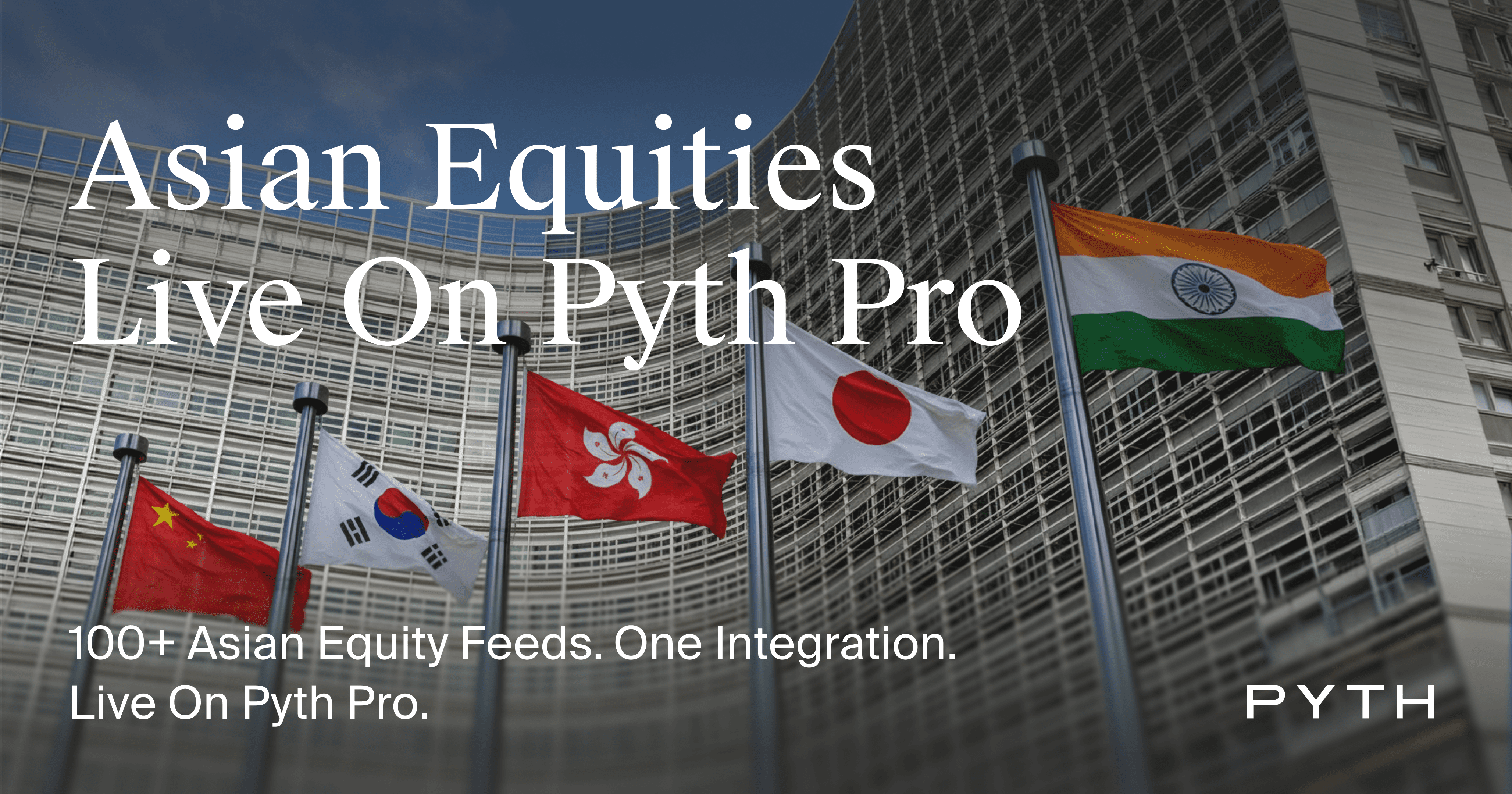
Pyth blog header: “Asian Equities Live On Pyth Pro — 100+ Asian Equity Feeds.” Visual confirmation of Pyth’s claim that 100+ Asian equity feeds are live on Pyth Pro (useful as a quick visual to show regional coverage and product packaging). — Source: Pyth Network (blog)
Is it worth it in 2026?
Short answer: if your product needs Asian equity exposure, this is as real as it’s been on-chain so far. The coverage breadth is moving from “pilot” to “production” territory, with Pyth Pro showing it can support both blue chips and marquee listings like CXMT on day one (Pyth Network (blog)).
The constraints are what you’d expect: licensing gates, market-session complexity, and FX plumbing. Those aren’t dealbreakers if you’re building a serious venue or product. They’re just the ticket price for treating real-world equity data with respect.
For traders, the payoff is new basis and volatility surfaces. A Samsung or Toyota perp opens cross-asset strategies that link Asia equities with crypto collateral. That’s a proper playground for desks that know how to manage session risk and fund inventory through the close.
Common Mistakes
- Ignoring local sessions and quoting through halts. Fix it by keying margin and spreads to feed status and confidence intervals.
- Forgetting the FX leg. If your PnL is in USD, you need a reliable FX feed and conversion logic for KRW, JPY, CNY, or HKD.
- One-feed dependency. Build pause states and fallback plans for oracle or infra events, especially around known upgrade windows.
- Skipping corporate actions. Splits and special dividends are predictable. Predefine adjustment rules and communicate them early.
- Loose symbol mapping. Map by unique identifiers where possible and maintain a registry to avoid ticker collisions across markets.
- Underestimating the open. Backtest your parameters with auction prints and initial bursts, not just midday liquidity.
Frequently Asked Questions
Can I get Toyota and Samsung prices on the chains my app uses?
Pyth Pro’s Asian equity coverage spans Japan and South Korea among other markets, and feeds are being rolled out across supported chains. Exact symbol availability varies by rollout schedule and access approvals. Check the Pyth Terminal and documentation for current listings and chains before committing roadmap items.
How are pre-market, auctions, and after-hours handled?
Equity feeds are session-aware. During pre-open and auction windows, expect different update behavior and wider confidence intervals. After the regular session closes, the feed status and cadence reflect that. Your product should treat these states explicitly and may choose to pause trading or increase margins during non-regular hours.
What about dividends, splits, and rights issues?
Corporate actions are part of equities. The oracle reports market prices; it doesn’t automatically rebase your synthetic or adjust user positions. Define how you’ll handle splits and distributions, pre-announce the rules, and implement admin actions that can apply adjustments at the effective time.
What happens if the feed goes stale or Pyth upgrades infrastructure?
You should design a safe pause mode. Monitor feed status, staleness windows, and error budgets. Pyth has communicated a Pyth Core infrastructure upgrade cutover date of August 18, 2026, so plan maintenance and dry runs around that window (Pyth Developer Forum).
Do I need special permissions to use Pyth Pro for equities?
Yes, Pyth Pro is a licensed, permissioned offering for regulated market data. Projects typically need to apply for access and align with data licensing terms. Budget time for this before setting launch dates or announcing listings.
How do I mark USD collateral if the stock is quoted in KRW or JPY?
Use a reliable FX oracle to convert local quotes into your base currency at mark time. Keep the FX service independent from your equity feed to reduce correlated failures. Also decide how you’ll treat weekend FX rates when equity markets are closed.
Is there proof that Korean equities are actually live?
Yes. As of early August 2026, the SK Hynix equity feed (KR.000660/KRW) appears on Pyth Terminal with status Stable and a listed local-session schedule, confirming live Korean coverage on Pyth Pro (Pyth Terminal (Pyth Network)).