


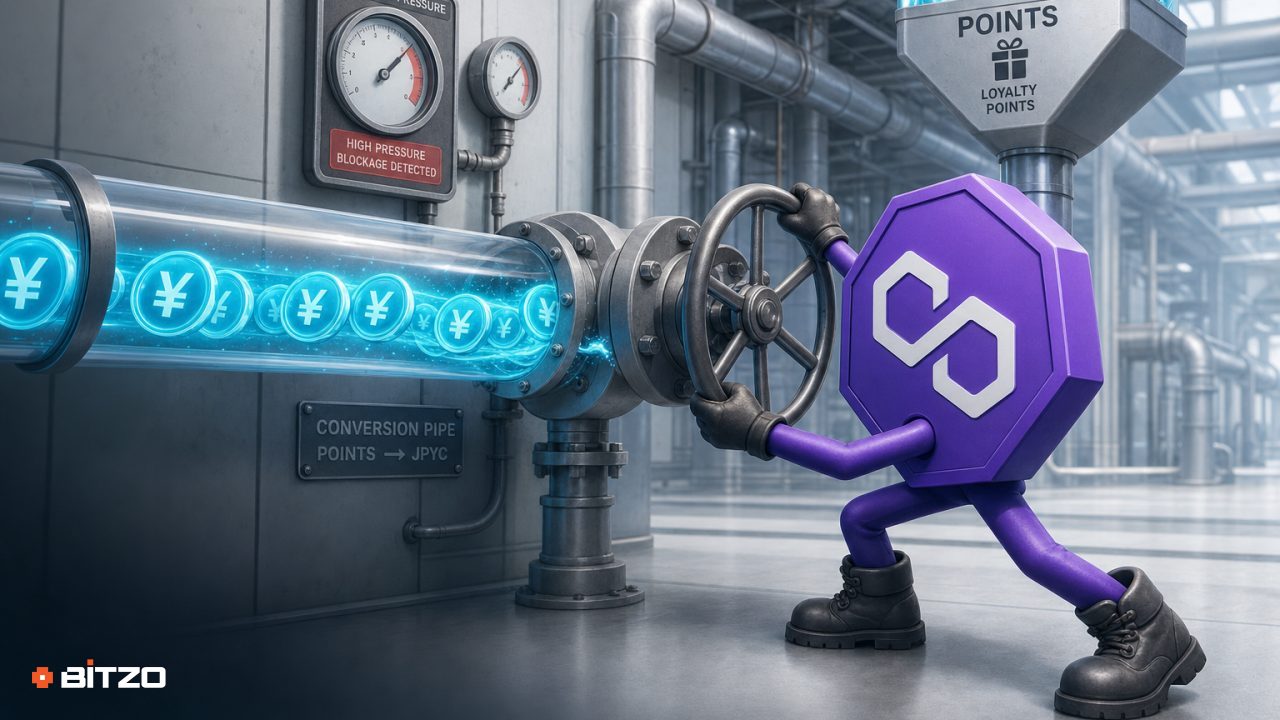
Loyalty points are everywhere in Japan, but they rarely feel like real money. You collect them, forget them, and sometimes they expire. The shift that matters now is simple: points can move on-chain and behave like cash. That turns idle value into something you can actually use.
In practice, it means a utility customer can funnel loyalty points into JPYC, a yen-pegged token that lives on Polygon. Once there, it can move between people, pay for stuff, or sit in a wallet that talks to a growing list of apps. It is early, but the rails are getting laid fast.
If you are trying to figure out whether this is worth your time, the short version is this: Polygon keeps costs low, JPYC is gaining traction, and pilots are spilling from web to store. The rest of this piece breaks down how it works, where it is going, and how to avoid the obvious mistakes.
| Aspect | What to Know |
|---|---|
| Conversion path | Moact users can convert NORM loyalty points into JPYC held in HashPort Wallet, live from July 30, 2026 (HashPort). |
| Stablecoin supply | JPYC’s on-chain amount exceeded ¥2 billion and the JPYC EX platform is being upgraded for smoother issuance and redemption with external wallets (JPYC株式会社). |
| Retail pilots | HashPort, KDDI, and Lawson are testing in-store JPYC payments at Lawson’s Takanawa Gateway City shop in August 2026 (HashPort). |
| Corporate payouts | Amazon Japan supplier AZ‑Com Maruwa plans JPYC payments to about 2,300 logistics partners and drivers, a large corporate rollout (CoinDesk). |
| Network choice | Polygon is the default for JPYC’s low fees and wide app support. That keeps small payments viable while preserving open access. |
| Who benefits first | Utility customers, retail shoppers, gig drivers, and merchants looking for faster settlement and lower fees. |
| Key risks | Wallet custody, gas management, smart contract risk, redemption limits, and tax treatment of point conversions. |
The basic flow is straightforward. Loyalty points accumulate in a traditional account. When you opt in, those points are exchanged into JPYC through a dedicated service. In the current rollout, HashPort’s exchange lets Moact users convert NORM points and auto-holds the resulting JPYC inside HashPort Wallet. From there, the token sits on Polygon like any other asset and can be sent, spent, or plugged into compatible apps (HashPort).
JPYC itself is a yen-pegged token. It is designed to mirror 1 yen per unit and circulate on public chains. The project has crossed a meaningful threshold, reporting more than ¥2 billion in on-chain supply and a major JPYC EX upgrade to make issuance and redemption smoother, including support for external wallets like HashPort Wallet (JPYC株式会社).
Why Polygon? Fees and reach. Polygon processes transactions fast at a fraction of Ethereum mainnet costs. That matters if you are sending 800 yen for coffee or paying dozens of couriers in a single batch. It also already connects to a broad web of wallets and merchant tools, which gives a real-world program somewhere to land.
On the ground, pilots are pushing this from screen to store. A joint test with KDDI and Lawson will let shoppers try in-store JPYC payments at a real Lawson location, using HashPort Wallet at the checkout. It is a small slice of the future, but it sets the pattern for how loyalty value could become spendable money in daily life (HashPort).
Glossary in plain English
- JPYC A yen-pegged token that runs on public chains like Polygon. 1 JPYC targets 1 yen.
- HashPort Wallet A wallet service where converted points become JPYC and are held for use in apps or payments.
- Moact / NORM points A loyalty program and its points that can be exchanged into JPYC via HashPort’s service for eligible users.
- Polygon A low-fee blockchain compatible with Ethereum apps. Good for small payments and fast settlement.
- JPYC EX JPYC’s platform for issuing, managing, and redeeming JPYC with improved UX and external wallet support.
Step-by-Step Playbook
- Confirm eligibility Check that your loyalty points are supported for conversion and that your account status meets the program’s requirements.
- Set up HashPort Wallet Create your wallet, complete any required verification, and save your recovery info safely offline.
- Link the loyalty account In the exchange flow, connect the account that holds your points so the system can calculate and convert the balance.
- Run a small test Convert a tiny amount first. Make sure the JPYC lands in your wallet and that you can view it on Polygon.
- Add a bit of MATIC You will need a small amount of MATIC on Polygon to move or spend JPYC. A few dozen yen worth usually covers multiple transfers.
- Decide where it goes Keep JPYC in your wallet for payments, send it to a friend, or connect a DeFi app you trust. Avoid anything you do not understand.
- Track your records Save conversion receipts and transaction IDs. If taxes apply in your jurisdiction, clear record keeping helps.
- Plan an exit If you need cash, learn the supported redemption paths on JPYC EX or approved off-ramps before you commit larger sums.
Why Polygon Is Getting the Yen Flow First
Polygon is not the only place JPYC can live, but right now it is the path of least resistance. Apps are already there, fees are trivial, and most wallets just work out of the box. If you want loyalty value to feel like money, you cannot ask people to pay a few hundred yen in gas every time they tap their phone.
The demand side is real. JPYC’s reported on-chain amount passed ¥2 billion, and the team is upgrading JPYC EX to tighten the issuance and redemption loop, with hooks for external wallets including HashPort Wallet (JPYC株式会社). On the usage side, the retail pilot with KDDI and Lawson aims to let shoppers actually tap and pay in-store, not just click on a screen (HashPort).
There is also a strong corporate angle. AZ‑Com Maruwa, a supplier to Amazon Japan, plans to route payments to roughly 2,300 logistics partners and drivers in JPYC, which is a practical stress test for payouts at scale (CoinDesk). Small transfers plus lots of recipients is where Polygon shines.
| Option | Fees for small spends | App and wallet reach | JPYC liquidity today | Merchant readiness in Japan |
|---|---|---|---|---|
| Polygon | Low enough for sub-¥1000 payments | Broad EVM support and integrations | Active and growing | Early pilots in motion |
| Ethereum mainnet | Often too high for micro-spends | Excellent app depth | Deepest liquidity overall | Little direct retail traction |
| Arbitrum/Optimism | Low, but bridging adds friction | Good EVM compatibility | Varying by pool and venue | Few merchant paths yet |
| Solana | Very low | Non-EVM stack | Separate token ecosystems | Merchant stack still forming |
Pro tip: Keep a tiny MATIC balance in every wallet you intend to spend from. Nothing is more awkward than reaching checkout with JPYC and no gas.
From Utility Points to Real-World Payments
The headline shift is not about trading. It is about turning non-cash value into money that moves. Through HashPort’s exchange, Moact users can convert NORM points to JPYC and keep the tokens in HashPort Wallet for payments and apps (HashPort). This mirrors the broader retail test at Lawson, where the point is speed, not speculation (HashPort).
For utilities and retailers, this solves a few nagging problems. Points breakage drops because people can use value anywhere the token is accepted. Settlement becomes faster because on-chain transfer finalizes quickly. And customer engagement gets simpler because the same token can move between loyalty, payouts, and actual checkout. The flywheel is obvious. But the execution details matter.
If you are designing a rollout, start small and closed. Test a few stores, a few hundred customers, and a clear support script. Use JPYC EX for issuance and track redemption patterns to calibrate inventory (JPYC株式会社). Add external wallet support early so customers do not feel stuck, but publish a short list of recommended wallets with step-by-step guides.
Trade-offs You Should Weigh
Open tokens are powerful, but they also come with new choices. A custodial wallet like HashPort Wallet is easy for first-time users. A self-custody wallet gives people control and portability, but it is easier to mess up. Many programs end up offering both, which is fine as long as you are clear about the trade-off.
On-chain risk is another lever. Polygon’s contracts are widely used, but no smart contract is perfect. Stick to audited apps, limit allowances, and review permissions monthly. For payouts, use allowlists and pre-checked addresses. For retail, cap per-transaction amounts until you see stable operations.
Finally, redemption and off-ramps define the real value. If a customer can redeem JPYC smoothly through JPYC EX or approved partners, the token feels like money. If the path is clunky or gated, people treat it like points with extra steps. Set expectations clearly and revisit them as partners and rules evolve.
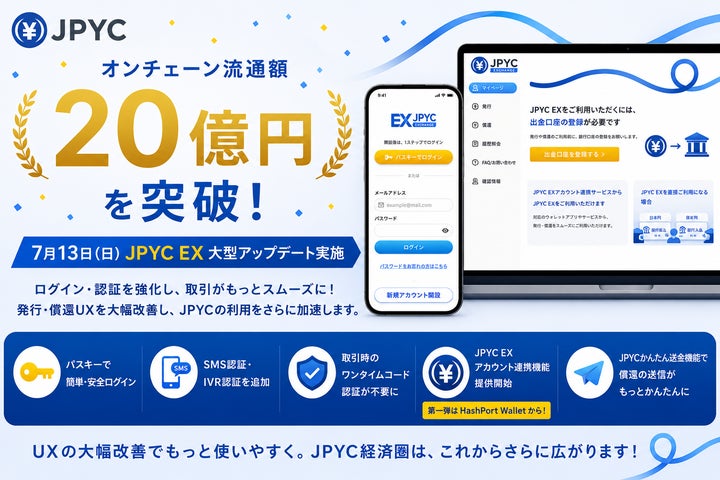
JPYC PR graphic from the July 10, 2026 release summarizing the JPYC EX upgrade and the announcement that on-chain circulation surpassed ¥2 billion — a visual summary of JPYC’s recent growth and UX changes that enable on‑ramp/off‑ramp integrations (e.g., HashPort). — Source: JPYC株式会社 / PR TIMES
Pitfalls & Red Flags
- Ignoring gas Users need a bit of MATIC to move JPYC on Polygon. Make that clear up front and consider seeding starter gas.
- Overpromising redemption If redemption paths are capacity-limited or require KYC, say so. Point people to the current JPYC EX process.
- Loose permissions Unlimited token approvals can backfire. Guide users to revoke allowances they do not need.
- Tax blind spots Converting points or spending JPYC may have tax consequences. Encourage users to keep records and check local rules.
- Unsupported wallets Not every wallet handles JPYC or Polygon well. Publish a short, tested list and update it after app changes.
- Pilot fatigue Retail pilots need real follow-through. Publish results and timelines, or users assume the effort is dead.
Frequently Asked Questions
Does this replace cash or cards right away?
No. It runs alongside them. Early rollouts focus on converting points, testing in-store payments at select locations, and ironing out UX. Cash and cards are not going anywhere for now.
Do I need MATIC to use JPYC on Polygon?
Yes. You need a small amount of MATIC to pay network fees for sending or spending JPYC. It is usually just a few yen per transaction, but plan ahead.
Where can I actually spend JPYC today?
In addition to online transfers and compatible apps, a pilot with KDDI and Lawson is scheduled to test in-store JPYC payments at Lawson’s Takanawa Gateway City shop in August 2026, using HashPort Wallet at checkout (HashPort).
What does the Kansai Electric angle mean for customers?
It means loyalty value tied to utility usage can flow into a token that behaves like money on Polygon. Through HashPort’s exchange for Moact users converting NORM points, that value lands as JPYC in a wallet and can be moved or spent as supported (HashPort).
Can JPYC be redeemed back into yen?
JPYC EX supports issuance and redemption processes subject to its terms, KYC, and fees. The platform is being upgraded to improve that experience and integrate external wallets (JPYC株式会社).
Is this safe for large corporate payouts?
It can be, with controls. A planned rollout by AZ‑Com Maruwa to about 2,300 logistics partners shows the model is being tested at scale. Use allowlists, staged limits, and clear support paths (CoinDesk).
What happens if Polygon upgrades or changes fees?
Apps and wallets typically adapt behind the scenes, but fees can fluctuate. Keep a buffer of MATIC, and if costs spike, wait for quieter periods or batch transactions.