


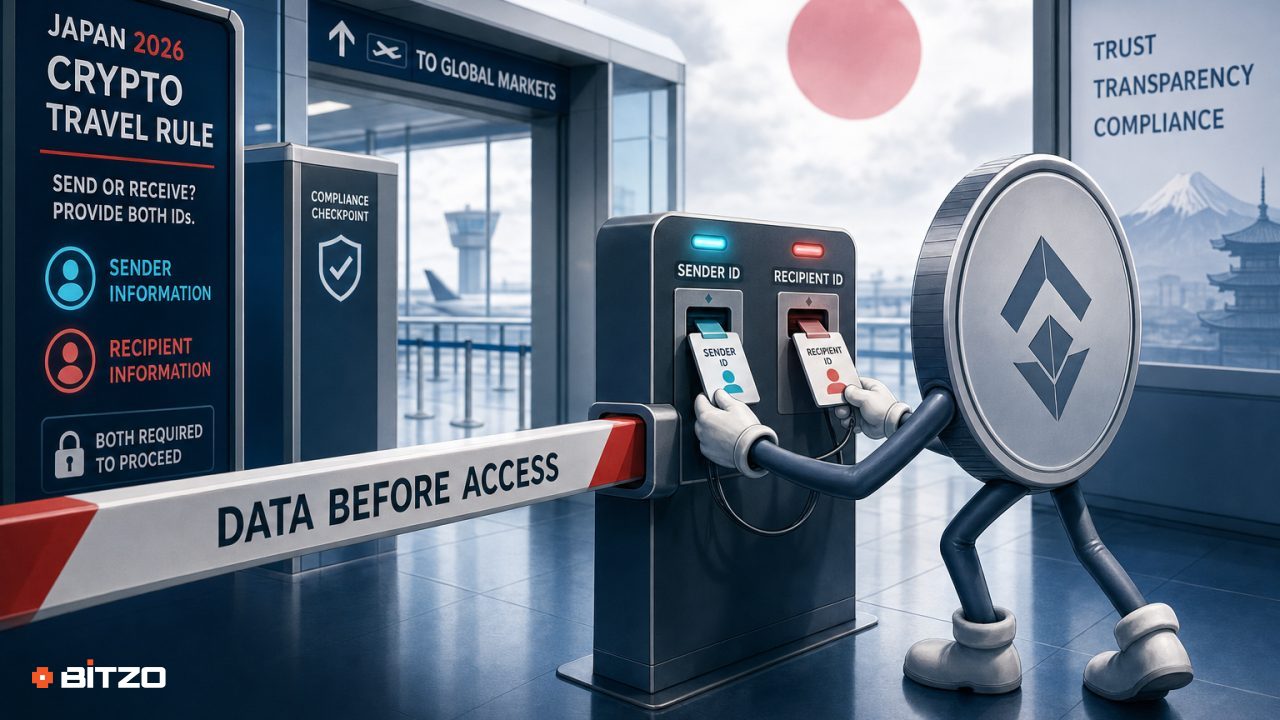
If you send crypto from a Japanese exchange to an overseas exchange, which transfers need sender and recipient details attached? That is the heart of Japan’s travel rule in 2026.
Below is a clear, practical read on what falls in scope, what does not, and what changed with the Financial Services Agency’s August 2026 amendment. Short version: pay attention to where the recipient exchange is located and what kind of asset you are moving.
From August 3, 2026, Japanese VASPs must transmit originator and beneficiary data when they send cryptoassets or electronic payment instruments (stablecoins) to foreign VASPs in jurisdictions with equivalent travel-rule regulations. The FSA expanded that list to 63 jurisdictions and confirmed the reciprocity approach for cross-border VASP-to-VASP transfers. Domestic user flows and self-hosted wallets are handled differently, mainly through broader AML rules rather than cross-border notification.
- Effective date: August 3, 2026, with scope now covering 63 jurisdictions Financial Services Agency (FSA) — attachment PDF.
- Entities: Cryptoasset Exchange Service Providers and Electronic Payment Instrument Service Providers must send originator and beneficiary info at the time of transfer FSA — attachment PDF.
- Scope principle: applies to cross-border VASP-to-VASP when the recipient VASP sits in a listed, equivalent jurisdiction FSA — press release.
- Assets: cryptoassets and stablecoins regulated as electronic payment instruments are both covered FSA — attachment PDF.
How does Japan’s travel rule actually work in 2026?
Japan follows the FATF travel rule principle: when certain transfers happen between regulated providers, the sender’s platform attaches identifying data about the originator and the intended beneficiary, and the receiving provider checks it. The goal is traceability without stopping legitimate payments.
The latest tweak kicks in on August 3, 2026. The FSA finalized an amendment that expands Japan’s recognized counterparty list to 63 jurisdictions and keeps the reciprocity model for cross-border VASP-to-VASP transfers FSA — attachment PDF. The same update confirms that the requirement applies to both cryptoassets and electronic payment instruments, which in Japan’s framework captures yen-backed and other compliant stablecoins.
In practice, this means if Exchange A in Tokyo sends customer funds to Exchange B in a listed country, Exchange A must pack the originator and beneficiary details in the travel-rule message at the time of transfer. Exchange B needs that data before crediting the funds. If Exchange B sits in a non-listed place, the specific cross-border notification rule described by the FSA does not apply, though AML controls still do.
Which transfers are in scope, exactly?
Here is the cleanest way to think about it in 2026.
| Transfer type | Travel-rule data required? | Notes |
|---|---|---|
| Japan VASP to foreign VASP in a listed jurisdiction | Yes | Obligation to transmit originator and beneficiary data at time of transfer; list expanded to 63 as of Aug 3, 2026 FSA. |
| Japan VASP to foreign VASP in a non-listed jurisdiction | Not under this reciprocity rule | Specific cross-border notification is limited to equivalent jurisdictions FSA press release. Other AML obligations remain. |
| Japan VASP to self-hosted wallet | Not covered by the FSA’s cross-border VASP-to-VASP notification | Exchanges still perform KYC, blockchain screening, and risk checks. Some may restrict or require proof of control. |
| Domestic transfers between Japanese platforms | Outside the foreign-jurisdiction list | The 2026 amendment addresses foreign counterparties. Domestic data-sharing is handled under broader AML frameworks and provider policies. |
| Transfers via DeFi protocols or on-chain smart contracts | Generally not VASP-to-VASP | May fall outside the defined notification path. Providers often apply enhanced due diligence or restrictions. |
One small but important update: the 2026 amendment adds five more places to the recognized list — Anguilla, Botswana, the Commonwealth of Dominica, Cuba, and Oman — which is how the total jumps to 63 FSA — attachment PDF. That expands the set of cross-border routes where Japanese exchanges must attach the identity payload.
Pro tip: before you try a cross-border withdrawal, ask your exchange support which destinations are on the 63-jurisdiction list. It saves you from a last-minute refusal or a compliance hold.
What about stablecoins and e-money tokens?
Japan’s rules do not leave stablecoins in a gray area. Electronic Payment Instrument Service Providers, which sit in Japan’s legal bucket for stablecoins, are pulled into the travel rule. When an EPISP sends a stablecoin to a foreign VASP in a listed jurisdiction, the same originator and beneficiary data has to go along for the ride FSA — attachment PDF.
That aligns with how Japan treats stablecoins more like regulated payment instruments than just tokens. If you are a fintech building remittance products or merchant settlements with yen-backed coins, expect the travel-rule handshake to be part of your cross-border plumbing whenever the counterparty sits in one of the 63 jurisdictions.
Design-wise, this nudges stablecoin businesses to pick counterparties and corridors that support compatible travel-rule messaging. If your foreign partner is not in the FSA’s list, the specific notification requirement under reciprocity does not bite, but your internal AML program still has to cover the risk of that route.
How do cross-border and domestic flows differ?
The August 2026 change is about foreign destinations. Japan is limiting the explicit travel-rule notification to transfers headed to VASPs located in jurisdictions with equivalent regulations FSA — press release. That is a measured, reciprocity-based way to avoid one-way data traffic.
Within Japan, providers still live under AML/CFT laws, ongoing KYC duties, sanctions screening, and suspicious transaction reporting. Those do a lot of the heavy lifting for domestic activity even when a formal cross-border travel-rule message is not in play. The practical outcome is that domestic user flows feel smoother, while cross-border flows to listed places trigger more structured data exchange between providers.
For customers, the tell is usually the pre-withdrawal screen. Japanese exchanges often ask you to select a recipient exchange, a jurisdiction, and an account reference. If the destination matches a listed jurisdiction, you may see additional required fields for the beneficiary details and get a warning if anything is incomplete.

What data is sent, and how is privacy handled?
The FSA materials define that originator and beneficiary information must be transmitted at the time of transfer. Specific field layouts vary by messaging standard, but they typically include the sender’s name and account reference, the beneficiary’s name and account reference, and technical details that bind the message to the on-chain transaction ID.
Privacy-wise, travel-rule networks use encrypted channels and counterpart discovery so personal data is not broadcast on-chain or posted to public memos. The data should travel service-to-service off-chain, and only between regulated entities that need it to process the transfer. Good implementations minimize the amount of personally identifiable information sent and avoid storage beyond legal retention periods.
If you are an end user, you will notice the privacy layer mainly as extra form fields and sometimes a delay while the receiving exchange verifies the match. That is normal. If the name or account reference does not line up, your transfer may be rejected and the funds returned to the sender wallet on the originating exchange.
What tools help with the messaging?
Most exchanges and stablecoin issuers do not roll their own travel-rule pipes from scratch. They either join a network that handles secure counterparty discovery and message exchange, or they integrate a vendor gateway that can talk to several networks at once.
Common options include projects and alliances that implement FATF-aligned messaging and encryption, such as open-source protocols and industry networks. The aim is always the same: find the right counterparty VASP, verify they are who they say they are, exchange the data privately, and bind it to the blockchain transfer so the two events match.
On the user side, you rarely see any of that. You just select the destination platform from a list, supply the beneficiary account reference if required, and let the two providers handle the handshake in the background.
A practical compliance playbook for 2026
If you run a Japanese exchange, a brokerage, or a stablecoin product, here is a tight checklist to stay on top of the August 2026 position.
- Map your corridors: tag counterpart VASPs by jurisdiction and whether they sit on the 63-jurisdiction list FSA — attachment PDF.
- Update message flows: ensure your travel-rule gateway can send and receive the required fields for cryptoassets and stablecoins.
- Tighten front-end forms: require beneficiary details only when needed, with guardrails to prevent data entry errors.
- Add pre-flight checks: validate the beneficiary reference against the recipient VASP format before broadcasting the blockchain transaction.
- Train support teams: publish simple guides for customers on what is required by corridor and asset type.
- Log and reconcile: bind message IDs to on-chain hashes, and monitor for rejected or mismatched transfers.
- Vendor diligence: document encryption, data minimization, retention, and breach procedures with any third-party gateway.
Warning: never paste personal data into blockchain memos or public notes. Keep originator and beneficiary fields inside the secure travel-rule channel only.
Common Mistakes
- Assuming every cross-border transfer needs a travel-rule payload. The 2026 rule is reciprocal and limited to listed jurisdictions. Check the destination first.
- Sending funds before the counterparty is discovered. If your system cannot find the receiving VASP, the data may go nowhere and the transfer will bounce.
- Over-collecting user data on domestic flows. Align front-end forms with actual obligations to reduce friction and data risk.
- Ignoring stablecoins. EPISPs have the same at-transfer duty as exchanges when sending to listed jurisdictions.
- Relying on email to swap PII. Use encrypted travel-rule rails. Email leaves an audit and breach risk you do not want.
Frequently Asked Questions
Is there a minimum value threshold for the travel rule in Japan?
The FSA materials linked here set the who and where clearly, but they do not spell out a monetary threshold in the summary text. Firms should follow FATF-aligned practices and any detailed guidance they receive through licensing or supervisory channels.
Does the rule apply to NFT transfers?
NFT activity is typically outside the VASP-to-VASP payments lane. If you send value from a Japanese exchange to a foreign exchange and it qualifies as a covered transfer, the messaging triggers. Pure NFT marketplace moves without a VASP counterparty generally do not hit the same path.
What about Layer 2 networks and bridges?
The rule keys off the regulated entities, not the chain. If a Japanese VASP sends to a foreign VASP in a listed jurisdiction, the data must go with it even if the settlement happens on a Layer 2 or through a bridge. The messaging should match the on-chain transaction reference.
Can a Japanese VASP send to a non-listed jurisdiction without the travel-rule message?
The specific reciprocity-based notification obligation does not apply to non-listed jurisdictions. That said, providers still apply AML/CFT controls and may block or restrict those corridors as a matter of policy.
Do self-hosted wallet withdrawals trigger the travel-rule message?
No, the FSA’s 2026 update concerns cross-border transfers between VASPs in equivalent jurisdictions. Self-hosted withdrawals are addressed by other AML measures such as KYC, wallet screening, and ongoing monitoring.
What happens if the beneficiary name does not match at the receiving exchange?
Expect the transfer to be paused or reversed. The receiving VASP needs the data to reconcile and meet its own compliance checks. If the data cannot be validated, the funds are usually returned to the originator account at the sending platform.
Which new jurisdictions were added in 2026?
Anguilla, Botswana, the Commonwealth of Dominica, Cuba, and Oman were added, bringing the list to 63 jurisdictions effective August 3, 2026 FSA — attachment PDF.