



Dubai’s crypto marketing scene moved from "anything goes" to very structured, very quickly. If you’re planning a promo, a splashy brand campaign, or an influencer push that could touch the UAE, you’ve got to build around VARA’s rulebook.
This guide walks through what’s allowed, what’s not, and how to design ads and KOL posts that pass a VARA sniff test without killing your creative.
I’ll keep it practical — labels that need to be on screen, what a risk disclaimer actually looks like in a 9:16 video, and the moment where you should ask for a copy of the VASP licence instead of hoping for the best.
| Point | Details |
|---|---|
| Only licensed VASPs can market | Marketing in or targeting the UAE must be done by a VARA‑licensed VASP, or on their behalf with approval. Unlicensed entities can’t market into Dubai/UAE (VARA). |
| Clear ad labels are mandatory | Paid ads and sponsored posts must be clearly marked as “ad”, “advertisement”, “promoted” or “sponsored”, visible on all device types (VARA). |
| Prominent risk warnings | Disclaimers stating virtual assets may lose value (even to zero) and are highly volatile must be unmissable and persistent for the medium (VARA). |
| Influencers are not journalists | KOLs must disclose sponsorship on each post and confirm the VASP they promote is VARA‑licensed; profile bios alone don’t count (VARA). |
| Substance over style | Compliance lives in the fine print, timing, and placement — labels must be legible; disclaimers must stay on screen long enough to be read; claims must be fair and not misleading. |
What counts as “marketing” in Dubai?
Short answer: a lot more than just banner ads. If you push a message that could influence someone in the UAE to buy, sell, hold, stake, lend, or otherwise engage with a virtual asset or a VA service, you should treat it as marketing under VARA’s regime.
Think paid social, sponsored creator content, programmatic display, out-of-home, advertorials, SEO landing pages with a clear call to action, email blasts, push notifications, affiliate promos, referral codes, and even in-app pop-ups. If it’s accessible in the UAE or aimed at UAE residents, assume VARA will care.
That doesn’t mean you can’t publish general news or analysis. But as soon as it becomes promotional — a call to action, a benefit claim, an offer — you’re in VARA territory.
Who can actually advertise crypto in Dubai?
This is the first gate most campaigns fail. VARA’s Marketing Regulations say marketing “in or targeting the UAE” has to be carried out by a VASP licensed by VARA, or on behalf of and approved by a VARA‑licensed VASP. In plain English: if you’re not licensed, you can’t market into Dubai. A licensed partner must front the campaign and sign off on it. See the rulebook here: VARA.
Two practical implications:
- Global brands without a VARA licence should either hold back UAE‑facing creatives or work through a licensed local entity that fully approves the materials.
- Media buyers and agencies need to verify licensing before they traffic anything with UAE geo or Arabic copy. Ask for the licence number and scope of permitted activities.
Pro tip: If the VASP you’re promoting is licensed for a narrower activity than your ad implies (say, custody only, but the creative hints at trading), fix the copy. The licence scope matters to the message.
How to label ads and sponsored posts so they pass review
VARA couldn’t be clearer on this one: if money changed hands, the content must say so in a way users can’t miss. The Guidance requires “ad,” “advertisement,” “promoted,” or “sponsored” — legible, prominent, and obvious on all devices. Source: VARA.
Where to put the label
- Short-form video: on-screen text in the first frame and a persistent bug or overlay for at least the first 3–5 seconds. The caption alone is risky if the on-screen never shows the label.
- Static images: top-left or top-right corner in a font size that remains readable on a phone in portrait. Don’t bury it under stickers.
- Stories/Reels: on-screen label plus the platform’s paid partnership toggle if available. Use both.
- Long-form copy (blogs, newsletters, advertorials): label near the headline and again before the first call to action.
Labels must survive reposts, duets, stitches, and cross-posting. If an influencer exports the video and uploads natively to another platform, the disclosure needs to be baked into the asset, not just the platform toggle.
Risk warnings that cannot be missed
VARA wants a prominent risk disclaimer that flags extreme volatility and the chance of total loss. In their words, disclaimers must be “unmissable” — legible, proportionate in size/position, and persistent enough for the medium. Reference: VARA.
What the disclaimer should say
Use plain language. For example: “Virtual assets are highly volatile. You may lose all the money you invest.” That’s the spirit VARA is after.
How to place it
- Video: keep the disclaimer on-screen long enough to be read in full. On a 15-second spot, it probably needs to be there for most of the ad, not just a flash at the end.
- Audio: read it aloud and put it on-screen as text. Podcasts should include it in the ad read and the show notes.
- Outdoor: use a font size that’s readable from a typical viewing distance. If the copy is big and bold, the warning can’t be microtext.
- Web: place it above the fold or adjacent to the CTA. Footer-only is weak.
Don’t rely on a single, tiny footer line. If someone can screenshot your ad and the warning isn’t visible, it’s probably not compliant.

Working with influencers and KOLs the right way
Influencers aren’t treated like journalists in VARA’s eyes. If a KOL is paid or otherwise incentivised, they must disclose that on every sponsored post, and they must confirm the VASP they’re promoting is licensed by VARA. A profile-level “#partner” note isn’t enough; each post needs its own clear disclosure. See the case study language in the Guidance: VARA.
What to include in the KOL brief
- The exact disclosure wording and where it must appear on-screen and in the caption.
- Confirmation of the VASP’s licence status and the specific service being highlighted.
- The risk disclaimer text and display rules for each platform.
- A list of prohibited phrases (see the next section) and examples of acceptable alternatives.
- Approval process: brand review, legal review, and final sign-off by the licensed VASP.
Audit the final uploads, not just the drafts. If an influencer trims the first two seconds to hook viewers and cuts off the on-screen “Ad” label, you need them to re-upload. Screenshots help.
Words, claims, and tactics that get ads pulled
VARA’s marketing regime expects accuracy and balance. Overpromise and you’ll have a problem. Here’s what reliably triggers rework:
- Implying guaranteed or low-risk returns.
- Cherry-picking performance without context or timeframes.
- Confusing a licence with endorsement. Being licensed means you can operate under rules; it’s not a thumbs-up on your token or strategy.
- Hiding key limitations in microprint while shouting about benefits in 200-point type.
- Using technical jargon to the point of being misleading for a retail audience.
Fair, plain-language claims travel better. “Earn yield” is dicey unless you explain from what, under what risks, and who bears them. “Lower fees than X” needs a footnote defining the comparison and the time period.
Pro tip: Disclaimers aren’t a magic eraser. If the headline is misleading, no footer can fix it. Fix the headline.
A lightweight compliance workflow for teams
You don’t need a 50-page SOP to stay onside. A simple, repeatable checklist goes a long way.
- Map the audience and reach. Could anyone in the UAE see this? If yes, assume VARA applies. If not, double-check platform geos and organic spillover.
- Verify the licence. Get the VARA VASP licence details in writing. Confirm the activity scope aligns with the creative.
- Draft with compliance in mind. Write the ad copy with the ad label and risk disclaimer baked in. Don’t try to glue them on at the end.
- Design for legibility. Test on a 5.4-inch phone in bright mode. If you can’t read “Ad” and the disclaimer at arm’s length, they’re too small.
- Approve in sequence. Internal brand and legal, then VASP sign-off. Keep a single source of truth for approved assets.
- Publish with controls. Use platform paid-partnership toggles, correct geos, and turn off auto-placement where it breaks your labels.
- Archive everything. Save briefs, approvals, final creatives, links, and screenshots. If a regulator asks, you’ll be glad you did.
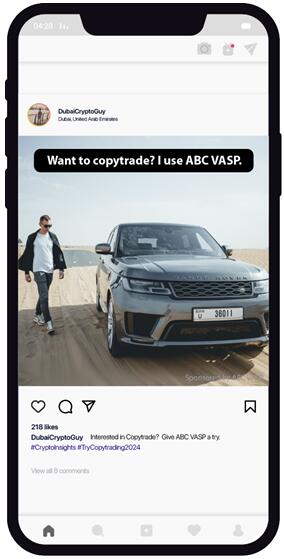
VARA guidance figure showing compliant vs non‑compliant influencer/social posts (examples of how sponsorship labels and disclaimers must appear) — useful because it visually demonstrates the prominence and placement VARA requires for paid crypto posts. — Source: VARA — Guidance on the Regulations on the Marketing of Virtual Assets and Related Activities (Guidance on Marketing Regulations)
Creative examples: compliant vs noncompliant
Short-form video ad (15 seconds)
Compliant: First frame shows “Ad — Sponsored by [VASP Name, VARA‑licensed]” plus on-screen disclaimer “Virtual assets are highly volatile. You may lose all the money you invest.” The label and disclaimer remain visible for at least 5 seconds, with the disclaimer returning on the end card. Caption starts with “Ad” and repeats the volatility warning.
Noncompliant: Hype intro with no on-screen label, a caption that says “collab,” and a 0.5-second microtext disclaimer at the end.
Static banner
Compliant: Top-right “Ad” tag, balanced claim like “Spot trade BTC with transparent fees,” and a visible line “Virtual assets are highly volatile; you can lose all invested funds.” CTA sits next to the disclaimer, not a screen away.
Noncompliant: “Guaranteed profits” headline, no ad label, and a legal line so small it disappears on mobile.
Influencer post
Compliant: Creator says on-camera, “This is a paid ad with [VASP], which is licensed by VARA for [activity].” On-screen “Sponsored” bug in the corner; caption starts with “Ad” and repeats the risk warning.
Noncompliant: Creator opens with “Not financial advice,” includes a profile bio note about partnerships, but the post itself has no label and no risk warning.
Cross-border and geo-targeting questions that trip up teams
One of the hardest parts is figuring out whether your content “targets” the UAE. VARA looks at substance, not intent. If your ad uses UAE geos, Arabic copy clearly aimed at local users, Dubai-specific references, or you run OOH in the city, that’s targeting. If your global post has no geo and gets organic reach in Dubai, you’re still in sensitive territory.
- Geo-fencing helps but isn’t absolute. If a campaign leaks into the UAE, expect questions. When in doubt, design to the stricter standard.
- Organic vs paid is not a shield. A paid post needs labels; an organic post that includes promotional offers or CTAs can still be marketing.
- Third-party affiliates matter. If your affiliates or referral partners push your offer in the UAE, you’re responsible for the outcome. Give them compliant templates and monitor them.
Bottom line: if a reasonable person in Dubai could see it and act on it, build it to VARA’s spec.
Frequently Asked Questions
Can an unlicensed overseas exchange run UAE-targeted brand ads without a call to action?
Not safely. VARA’s rulebook says marketing in or targeting the UAE must be done by a VARA‑licensed VASP or on their behalf with approval. Brand advertising that nudges users toward your platform still counts as marketing.
Is a profile bio disclosure enough for influencers?
No. VARA’s Guidance says each sponsored post must have its own clear, prominent disclosure. Bios help, but they don’t replace in-post labels.
What exact words should the risk disclaimer use?
VARA doesn’t mandate a single sentence, but the warning must convey that virtual assets are extremely volatile and you can lose all invested funds. Keep it plain and visible, sized properly for the medium.
Do platform “paid partnership” toggles satisfy the ad label requirement?
Treat them as additive, not sufficient. VARA expects obvious, legible disclosure. Use the platform toggle and put “Ad” or “Sponsored” directly on the creative and in the caption.
How do agencies prove compliance if asked?
Archive the licence verification, approvals from the VASP, final assets, screenshots of live posts (showing labels and disclaimers), and media plans with geo settings. If you can show what ran and where, conversations go smoother.
Are educational posts exempt if there’s no offer?
Pure education without a call to action is safer, but if the content nudges toward a product or includes referral links, it looks like marketing. Build to the higher standard if there’s any doubt.
Can small disclaimers sit only at the end of a 15-second ad?
That’s risky. VARA expects disclaimers to be unmissable and appropriately persistent. In short spots, keep them visible for a meaningful portion of the runtime, not a blink-and-you-miss-it flash.