



Here’s the odd thing that caught a lot of desks off guard this week: money rushed into U.S. growth funds while tech sector funds bled. Same market, same week, very different flows. If that sounds contradictory, you’re in the right place.
We’ll unpack why this split is happening, what it says about rate expectations and risk appetite, and how to read competing datasets without getting whipsawed. By the end, you’ll have a clear, practical way to interpret flows like these in real time.
And we’ll keep it grounded. No hype. Just what moved, why it likely moved, and what to watch next.
In the week through August 12, 2026, U.S. equity growth funds took in about $8.78 billion, the biggest weekly haul since late 2024, while technology sector funds lost roughly $4.62 billion. Bonds and cash also attracted money, a sign investors are getting selective rather than all-in risk-on. The divergence likely reflects profit-taking in concentrated tech names alongside a broader tilt toward diversified growth exposure as rate hike fears ease (Thomson Reuters (republished)).
- Growth funds: +$8.78B, largest since Nov 2024 (Thomson Reuters (republished)).
- Tech sector funds: -$4.62B, leading sector outflows that week (Thomson Reuters (republished)).
- Bond funds: +$9.4B, biggest in four weeks (Thomson Reuters (republished)).
- Money market funds: +$13.92B, a second straight week of inflows (Thomson Reuters (republished)).
Why are growth funds up while tech funds are down?
On paper, this looks contradictory. In practice, it makes sense. Growth funds cast a wider net than pure-play tech sector funds. They hold technology, sure, but also consumer discretionary, healthcare innovators, and sometimes communication services. That’s a broader bet on earnings acceleration, not just a handful of mega-cap platforms.
Tech sector funds, by contrast, are usually concentrated. They skew toward the biggest names that dominated the AI wave. After a long run, it’s natural to see redemptions there when investors rebalance or take profits. Selling a concentrated tech ETF doesn’t mean investors are abandoning growth altogether. They may simply be rotating into diversified growth exposure, spreading risk without giving up on the theme.
There’s also the psychological layer. A lot of allocators still want high-growth potential, but they’re wary of single-factor concentration. Growth funds tick the box without betting the farm on a small basket of AI winners. Net result: redemptions out of highly concentrated tech products and creations in broader growth vehicles at the same time.
Pro tip: Flows aren’t a moral verdict on a theme. They often reflect how investors choose to package the same view with less concentration risk.
Is this a real rotation or just housekeeping?
It could be both. Sometimes the cleanest explanation is the boring one: quarterly model rebalancing, advisors trimming overweight winners, and tax management around volatile names. That naturally hits sector funds first because they’re the purest expression of a crowded trade.
But the timing matters. The same week growth funds drew their biggest intake since November 2024, tech funds led outflows, and fixed income plus cash saw heavy demand (Thomson Reuters (republished)). That mix looks more like selective risk-taking than a broad risk-off. If it were full risk-off, you’d expect growth to suffer alongside tech. Instead, money favored diversification inside growth and kept a toe in bonds and cash.
Think of it as a “barbell of conviction.” Stay exposed to potential earnings upside, but pair it with duration and cash for optionality. That’s housekeeping with a view.
- Checklist to confirm a true rotation, not just noise:
- Do the flow patterns persist for 3–4 consecutive weeks across multiple data providers?
- Does relative performance favor diversified growth over pure tech on both up and down days?
- Is market breadth improving (more sectors and stocks participating), not just the top caps?
- Do implied correlations fall while volatility for mega-cap tech normalizes?
- Are earnings estimate revisions broadening beyond a few AI platforms?
What do rates and inflation have to do with it?
Almost everything. When rate hike concerns cool, duration-sensitive assets get a tailwind. Growth stocks, whose cash flows are weighted further out, tend to benefit as discount rates ease. That week’s flows lined up with exactly that narrative: easing rate anxiety and a tilt back toward long-duration equity exposure (Thomson Reuters (republished)).
But investors didn’t abandon ballast. Bond funds added $9.4 billion, the biggest in four weeks, and money market funds took in nearly $14 billion the same week. That tells you people still care about carry and defense even as they nibble at growth. Rates matter for both sides of the barbell: growth on the long-duration end, bonds and cash on the safety and income end.
One more nuance: if long yields move up again, the playbook can flip fast. Growth leadership can wobble, concentrated tech can get hit harder, and bonds can struggle. So the rate path isn’t just a footnote here; it’s the hinge the whole setup swings on.

How should I handle conflicting flow datasets?
Flows are messy. Coverage differs, cutoffs differ, and classifications differ. The Reuters-cited week through Aug 12 shows money market funds taking in $13.92 billion alongside big equity and bond inflows (Thomson Reuters (republished)). A few days later, EPFR’s week ending Aug 17 shows a different picture: equity funds up roughly $7.9 billion while money market funds actually saw outflows of about $4.9 billion (EPFR Global — Global Navigator).
Both can be true because they’re not measuring the exact same money at the exact same times. Some providers include only mutual funds and ETFs. Others have broader or narrower universes. Some capture creations and redemptions differently. And the “week” may end on Wednesday for one dataset and Friday for another.
The fix is simple: track trends, not isolated prints. If three different sources point in the same direction for several weeks, you probably have a real signal. If they don’t, assume noise and focus on price, breadth, and credit spreads to confirm or deny what the flow headline is telling you.
What separates growth funds from tech funds?
They rhyme, but they’re not the same song. Growth funds screen for companies with faster expected earnings or revenue growth across multiple sectors. Tech funds are sector-bound and, lately, top-heavy. That difference matters a lot for concentration risk and how a portfolio reacts to macro surprises.
| Feature | Growth Funds | Tech Sector Funds |
|---|---|---|
| Exposure Scope | Multi-sector (tech, consumer discretionary, healthcare, comms) | Single-sector (information technology; sometimes overlaps with comms) |
| Concentration Risk | Lower on average; diversified across industries | Higher; often dominated by mega-cap platforms |
| Sensitivity to Rates | High (duration heavy), but cushioned by sector mix | High (duration heavy) and more sensitive to factor swings |
| Typical Use Case | Broad growth tilt without single-theme risk | Pure-play bet on tech innovation/AI cycle |
| Drawdown Profile | Usually milder than pure tech due to diversification | Can be sharper in tech-led selloffs |
| Flow Snapshot (week to Aug 12, 2026) | + $8.78B inflows | - $4.62B outflows |
So if you’re bullish on growth but uneasy about a handful of names driving returns, a diversified growth fund is a cleaner expression. If you want maximum torque to the AI and software cycle, you’ll accept the concentration in a tech fund and live with the volatility that comes with it.
Where do bonds and cash fit right now?
They’re not background characters here; they’re part of the plot. Bond funds hauled in $9.4 billion that same week, their best in a month, while money market funds saw a second straight week of inflows at $13.92 billion (Thomson Reuters (republished)). Then, in the EPFR cut for the week ending Aug 17, cash flipped to outflows while equities still saw net buying (EPFR Global — Global Navigator).
What that says, in plain English: allocators are keeping optionality. When the macro looks a bit brighter, cash comes off the sidelines and into equities. When headlines wobble, the same cash parks back in money markets. Meanwhile, bonds provide carry and a partial hedge if growth equities stumble. It’s the modern barbell. And it’s rational in a world where the rate path is still the biggest single variable.
None of this guarantees smooth sailing. If inflation re-accelerates or term premiums jump, both bonds and long-duration equities can get hit at the same time. That’s the risk with a duration-heavy barbell. Position sizing and liquidity matter more than ever.
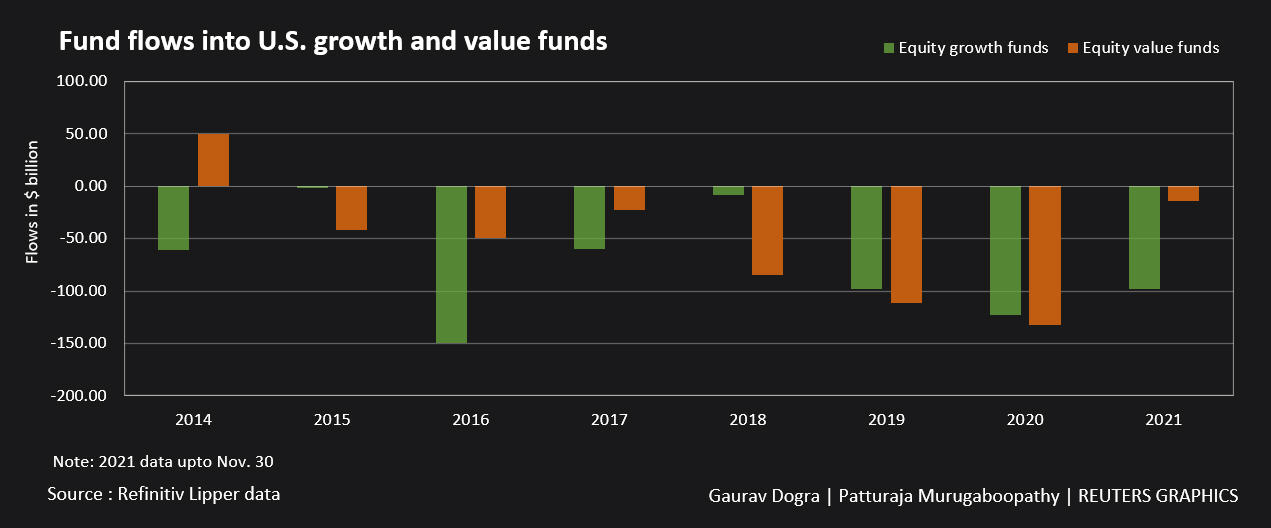
Weekly net-flow chart for U.S. growth vs. value funds — visualizes the magnitude and direction of investor flows and provides context for the $8.78B growth inflow versus tech outflows. — Source: Thomson Reuters Graphics (fingfx)
What could flip this trend next?
Three wildcards stand out.
First, earnings quality. If guidance broadens beyond the mega-caps and we see credible margin stories across more sectors, diversified growth keeps the edge. If, instead, earnings re-concentrate around a few tech names, sector funds could claw back flows fast.
Second, the rate path. A hawkish surprise or a sudden move higher in long yields will pressure duration trades. That tends to hit both growth and tech, but the more concentrated bucket usually takes it harder.
Third, positioning saturation. If everyone rotates into “safer growth,” the next crowded trade is... safer growth. That’s when smaller surprises can move flows dramatically in either direction. Stay humble about how quickly these tides can turn.
Common Mistakes
- Chasing one-week prints. Solution: Wait for confirmation across at least two independent datasets over multiple weeks.
- Ignoring concentration. Solution: Check top-10 holdings and weight caps before swapping tech for growth or vice versa.
- Forgetting the rate hinge. Solution: Track real yields and the front-end curve; they often lead flow inflections.
- Misreading cash moves. Solution: Money market flows swing on payroll dates, tax deadlines, and T-bill issuance. Don’t over-interpret.
- Confusing theme with vehicle. Solution: If you want growth exposure, pick the wrapper (diversified vs sector) that fits your risk tolerance.
Frequently Asked Questions
Are fund flows predictive of future returns?
Not reliably by themselves. Flows tend to be coincident to slightly lagging. They confirm what price and breadth are already hinting at. Use them as context, not a trading signal.
Does tech outflow mean the AI trade is over?
No. It could just mean the trade is getting repackaged. Investors might be taking profits in concentrated tech funds while keeping a growth tilt via broader vehicles. Watch earnings revisions and relative performance, not just flows.
Can one big redemption distort a week’s tech outflows?
Yes. A single institutional switch can move weekly prints, especially for sector ETFs. That’s why persistence and cross-checking with multiple providers matter before drawing conclusions.
How do sector ETFs differ from growth mutual funds in practice?
Sector ETFs give you pure exposure to one industry and are usually top-heavy. Growth mutual funds (and growth ETFs) screen across sectors for earnings acceleration, which lowers single-industry risk but still keeps you long duration.
Where do crypto and digital asset equities fit into this picture?
They often trade like high-beta growth. If risk appetite is improving and rates are cooperative, they can benefit; if yields jump, they can underperform. Treat them as part of your high-volatility sleeve and size accordingly.
What’s the best way to monitor these flows weekly?
Pick two reputable sources, track them consistently, and log the cutoff dates. Layer in price, breadth, credit spreads, and volatility to confirm the narrative. The method matters more than the specific vendor.
Should long-term investors change allocations on this news?
Probably not on a one-week print. If the pattern persists and lines up with your thesis on rates and earnings, fine-tune position sizes. But avoid wholesale shifts based solely on short-term flow headlines.