



Bitcoin UTXO age bands sort the currently unspent transaction outputs on the blockchain by how long they have remained unspent. They measure the age of an output, rather than directly measuring an investor’s personal holding period, identity or conviction. That distinction is central to using the data responsibly.
A Bitcoin transaction creates outputs that can later be spent. Until an output is referenced as an input in a subsequent transaction, it remains part of the unspent transaction output, or UTXO, set. When it is spent, that specific output leaves the set and the new transaction creates new outputs in its place, as outlined in the Bitcoin Developer Guide. Age-band charts follow that lifecycle across the supply that is currently unspent.
UTXO age measures an output’s last movement, not a holder’s identity
A UTXO is a discrete spendable output, not a wallet balance and not an individual. Its age is the elapsed time since it was created or last moved into its present output form. Analysts group those unspent outputs into time ranges, which can run from less than a day through intervals such as one week to one month, one to two years, and more than 10 years.
This approach is often described as a holding-time view of Bitcoin supply. It is useful shorthand, but it should not be mistaken for a census of holders. One person or institution can control many UTXOs of different ages; conversely, one age band can contain outputs controlled by many unrelated parties. The cohort framework described in Scientific Data is based on observable output history, not verified beneficial ownership.
That makes the unit of analysis unusually important. A person who has economically owned bitcoin for years may move it between wallets or custody arrangements, producing new outputs that begin at the youngest age. A long-lived output, meanwhile, may belong to an active investor, a custodian, an exchange-related address, or an owner who no longer has access to the keys. The blockchain records movement of outputs; it does not attach a definitive explanation to that movement.
For this reason, phrases such as “old coins” and “young coins” are best read literally. They describe the time since a UTXO’s most recent on-chain creation or movement. They do not, by themselves, establish whether the underlying bitcoin has changed hands economically.
How spending resets UTXO age bands
An unspent output ages continuously as long as it remains in the UTXO set, moving from a short-duration cohort into progressively older ones without any transaction. Once it is spent, its history as an unspent output ends.
The spending transaction consumes the old UTXO as an input and creates one or more new outputs. Those resulting outputs enter the youngest age category because they have just been created. This reset-and-maturation mechanism is the basic reason age-band charts change: supply either grows older while untouched or returns to the young end of the distribution after a transaction.
Consider a simplified sequence. An output is created and remains unspent for 18 months, placing it in whatever age range includes that duration. If it is then used in a transaction, the 18-month-old output is removed. The recipient output and any change output created by that transaction start again as new UTXOs, even if the same person retains economic control of some or all of the bitcoin.
That example also explains why a growing young cohort does not automatically mean new buyers have entered the market. It shows that outputs have been created recently. Those outputs may reflect a transfer to another owner, but they can also result from wallet management, exchange activity or a custody change. Glassnode’s documentation on HODL Waves describes the same process: spent coins reset the age of the outputs produced by the transaction, while unspent coins continue to mature.

HODL Waves turn UTXO cohorts into a supply distribution
HODL Waves are a common visualization of UTXO age bands. They show the proportion of Bitcoin supply represented by each cohort at a given point in time. Usually displayed as layered bands, the chart lets a reader see whether the share in younger or older ranges is expanding or contracting.
The stacked structure matters more than any one band in isolation. A rising old-age share can reflect outputs remaining unspent long enough to cross into that cohort. A swelling young-age share can reflect recent spending and the creation of replacement outputs. Looking across the distribution helps distinguish broad maturation from a change concentrated in one portion of the age spectrum.
Multiple cohorts are preferable to reducing the data to a single average holding time. Recent academic work on Bitcoin transaction flows found holding-time distributions to be heavy-tailed, extending from roughly one day to more than 200 weeks. That spread supports the use of several ranges because short-lived and very long-lived outputs coexist in the data, according to research published in Physica A.
The precise labels can differ by data provider or chart design, so comparisons should begin by checking the band boundaries. A one-week-to-one-month cohort, for example, answers a different question from a one-month-to-three-month cohort. Changes near a boundary can be caused simply by outputs aging into the next defined range.
What expanding old and young cohorts can indicate during market cycles
Age bands are often used as a market-cycle lens because they show whether more of the observable unspent supply has stayed dormant over extended periods or has recently been moved. A growing share in older cohorts generally indicates accumulation and a decline in liquid supply. In that context, the chart is capturing maturation: outputs were not spent before reaching the relevant threshold.
At the other end, a rise in young cohorts can indicate that older coins have been reactivated, transferred or distributed to newer holders. The possible readings are deliberately broader than “selling.” A transaction can create young outputs without proving the sender sold bitcoin, and an old output can be spent for reasons unrelated to a directional market view.
Used carefully, the comparison can add context to price-focused analysis. A supply distribution tilted toward longer-held outputs may be consistent with fewer coins being recently moved, while renewed growth in young bands may show more on-chain activity affecting the age structure. Glassnode’s research on Bitcoin on-chain market cycles frames these shifts as signals that can be associated with accumulation, reactivation and distribution.
The operative word is “associated.” Age bands describe the result visible on-chain, not the intentions behind it. They are more useful when considered as a changing distribution over time than when treated as a standalone verdict on whether a cycle has reached a particular stage.
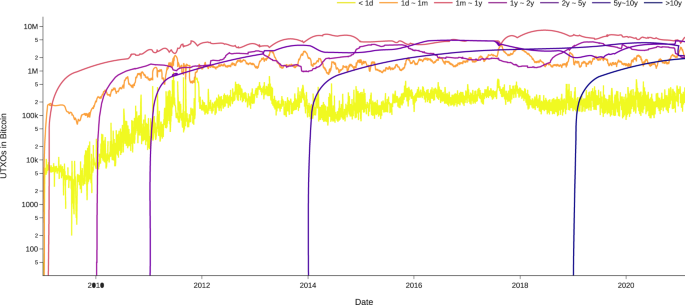
Cumulative distribution of Bitcoin UTXOs by age, showing how unspent supply is distributed across holding-time cohorts. — Source: Scientific Data
Why age bands lag and cannot confirm buying, selling or conviction
Long-duration cohorts have an unavoidable built-in lag. A coin accumulated today cannot appear in a two-to-three-year band until it has remained unspent for at least two years. An increase in that cohort therefore confirms that outputs have survived to the threshold; it cannot provide a real-time reading of today’s accumulation.
This lag is not a flaw in the calculation. It follows directly from the definition of the bands. But it means analysts should avoid treating an old-age band as an immediate signal, especially when the question concerns recent market behavior.
Ownership is the second major limitation. Blockchain data does not identify the person or entity controlling an output, and it does not prove whether spending an output represented a sale. Exchange transfers, internal wallet management, custody changes and lost coins can all complicate interpretation, as the cohort-analysis study in Scientific Data notes.
A very old UTXO may therefore represent deliberate long-term storage, operational inertia, or coins that cannot be spent because their keys have been lost. Likewise, a newly created UTXO may belong to a new buyer, but it may just as readily be change returned to the same controller after a transaction. The data establishes the age and movement of outputs, not the economic purpose of every transfer.
Age bands are consequently best treated as a blockchain-native supply and activity measure. They can help organize observations about maturation and reactivation across market cycles, but they do not independently verify demand, conviction, ownership changes or future price direction.
Frequently Asked Questions
Are old UTXOs necessarily held by long-term investors?
No. An old UTXO has remained unspent for a long time, but the blockchain does not identify its owner or show why it was left untouched. It may also be associated with custody arrangements or inaccessible coins.
Does a spent UTXO prove that bitcoin was sold?
No. Spending proves that an output was used as a transaction input. The transaction could reflect a sale, a transfer, wallet consolidation, a custody movement or another purpose.
Why can bitcoin appear young after an internal transfer?
Spending removes the prior output and creates new outputs, including possible change. Those newly created outputs start in the youngest age band even when economic ownership has not changed.
Why do long-term UTXO bands lag market behavior?
Each output must remain unspent until it crosses the band’s lower boundary. A two-to-three-year cohort cannot include a recently accumulated output before two years have elapsed.
Do UTXO age bands predict Bitcoin’s price?
They do not provide a direct price prediction. They describe how unspent supply is distributed by age and can offer context for market-cycle analysis, subject to ownership and transaction-purpose blind spots.