



For a few days, miner dashboards started tossing around the same headline: Bitcoin is brushing 1 zettahash per second again. Not the long-term average, but those short windows that make operators nudge a few more rigs online just to see.
At the same time, the next difficulty retarget looks like it will tilt a hair lower. As of Aug 19, CoinWarz has the Aug 22 window penciled in around a minus 0.04% move with difficulty near 127.43T, give or take the blocks still to mine CoinWarz.
It’s a weird combo: headlines flirting with 1 ZH/s while the algorithm quietly says, relax, we’re slightly over target on 10-minute blocks. Let’s unpack why both can be true.
Zooming out first helps. The 30-day mean hashrate actually spent most of 2026 sliding lower, not higher. According to BeInCrypto citing Glassnode, that 30-day mean fell roughly 19% over nine months, from about 1,108 EH/s in Nov 2025 to around 898 EH/s by early August 2026, marking the longest sustained decline on record BeInCrypto.
Even so, shorter-term measures perked up into August. Luxor’s Hashrate Index had the network’s 30-day SMA near 910 EH/s and the 7-day SMA jumping from 878 EH/s to 932 EH/s in its Aug 3 roundup. Miners collected roughly 3,222 BTC in block rewards that prior week, about $205 million at the time Hashrate Index (Luxor).
Short-window hashrate can kiss 1 ZH/s and still leave the 30-day trend below it. Difficulty reacts to the pace of blocks, not the tweet-friendly peaks.
Nine Months in the Rearview: How We Got Here
The story since late 2025 has been a grind. Power markets were unruly, hashprice compressed, and post-halving fee booms came and went. You could feel the push and pull in the weekly charts.
Weather, curtailments, and power prices
Summer heat in North America forced curtailments. When the grid gets tight, miners get paid to turn down. That pulls hashrate off, and the averages sag. Then a cool front hits, and rigs roar back. The seven-day averages catch the whiplash first. The 30-day smooths it out.
Hardware cycles and fleet mix
Another piece is hardware timing. Some fleets have already rotated into newer-generation ASICs, so they can toggle more flexibly and still stay cash-flow positive. Others are running older units that only make sense when difficulty dips or fees spike. July gave them a bit of that breather: difficulty fell twice in the month, by 5.00% on July 11 and 0.74% on July 25, for a net July decline of 5.71%, from 133.87T to 126.23T, according to Luxor’s monthly lookback. Luxor also noted the average USD hashprice in July rose to $31.21 per PH per day Luxor / Hashrate Index.
Price, fees, and the mood music
Finally, miner revenue has two levers outside their control: BTC price and transaction fees. Price needs no explanation. Fees are trickier. They ebb and flow with on-chain activity, inscriptions and arcane pockets of demand that sometimes appear, then fade just as quickly. That’s why weeks like early August can still show 3,222 BTC flowing to miners even as the longer averages look heavy Hashrate Index (Luxor).
What the Tiny Negative Retarget Actually Means
Let’s get crisp about the mechanism. A small negative read simply says the last epoch ran a touch fast. The algorithm wants 10-minute blocks on average. If the network produced them a little quicker, it nudges difficulty down. That’s it. No drama.
How Bitcoin’s retarget works, step by step
- The network watches a window of 2,016 blocks. That’s about two weeks if blocks average 10 minutes.
- It compares how long that window actually took versus the 2-week target.
- If blocks came too quickly, difficulty decreases a bit. If blocks were slow, it increases.
- There are guardrails on how much it can change in one go, so the system doesn’t overcorrect.
- Once the new difficulty is set, the process repeats for the next 2,016-block window.
As of Aug 19, CoinWarz shows roughly 492 blocks left until the next retarget, projected around Aug 22, with an estimated change near minus 0.04% and an estimated difficulty in the 127.43T ballpark. That estimate can drift as fresh blocks land CoinWarz.
The gap between headlines and averages
It’s worth stating plainly: a feed showing “1 ZH/s” doesn’t mean the 30-day trend is there. Luxor’s Aug 3 note had the 30-day SMA at 910 EH/s while the 7-day climbed from 878 EH/s to 932 EH/s. Different smoothing windows, different stories Hashrate Index (Luxor). When the market latches onto a big round number like 1 ZH/s, just check which window you’re actually looking at.

Current Readings That Matter Right Now
Let’s put the key figures side by side so you can see what’s moving and what’s not.
| Item | Latest reading | When | Source |
|---|---|---|---|
| Next difficulty retarget | Est. Aug 22, 2026; ~−0.04%; ~127.43T | As of Aug 19, 2026 | CoinWarz |
| Network hashrate (30‑day SMA) | ~910 EH/s | Aug 3, 2026 | Hashrate Index (Luxor) |
| Network hashrate (7‑day SMA) | 878 EH/s → 932 EH/s | Aug 3, 2026 | Hashrate Index (Luxor) |
| Miner rewards, prior week | ~3,222 BTC (~$205M) | Week into Aug 3, 2026 | Hashrate Index (Luxor) |
| July difficulty moves | −5.00% (Jul 11) and −0.74% (Jul 25) | July 2026 | Luxor / Hashrate Index |
| July net difficulty change | −5.71% (133.87T → 126.23T) | July 2026 | Luxor / Hashrate Index |
| July avg USD hashprice | $31.21 per PH/s/day | July 2026 | Luxor / Hashrate Index |
| 30‑day mean hashrate drawdown | ~−19% from Nov 2025 to early Aug 2026 | Nov 2025 → Aug 2026 | BeInCrypto (citing Glassnode) |
Two takeaways jump out. First, the market is living with a split screen: long-run averages that are still under 1 ZH/s while the shorter windows sprint closer to it. Second, the small negative retarget is consistent with a mild overperformance in block production, not a sea change.
Margins, Machines, and Market Narratives
If you’re running miners, you felt July’s relief. Difficulty was down and hashprice perked up. That $31.21 per PH per day figure isn’t some new golden era, but it moves the breakeven line for a lot of fleets, especially those with decent power hedges or flexible hosting contracts Luxor / Hashrate Index.
Small retarget, real dollars
A minus 0.04% retarget doesn’t look like much on a chart. In the ledger, it’s still a small tailwind. If you’re marginal today, you might be marginal plus one or two sats tomorrow. Not life-changing, but helpful.
Where the extra coins came from
The early August week that paid out ~3,222 BTC reflects both subsidies and fees. Fees are the swing factor. They’re hard to predict and can shift within hours. But when they pop, they can offset a lot of difficulty pain for a few days at a time Hashrate Index (Luxor).
Investors watching from the sidelines
If you’re not running a farm, the signal here is more about market structure. High-frequency hashrate pushing toward 1 ZH/s tells you capacity is ready to come back when conditions line up. The continued softness in the 30-day mean says plenty of rigs are still price and power sensitive. That mix tends to amplify volatility in both directions.
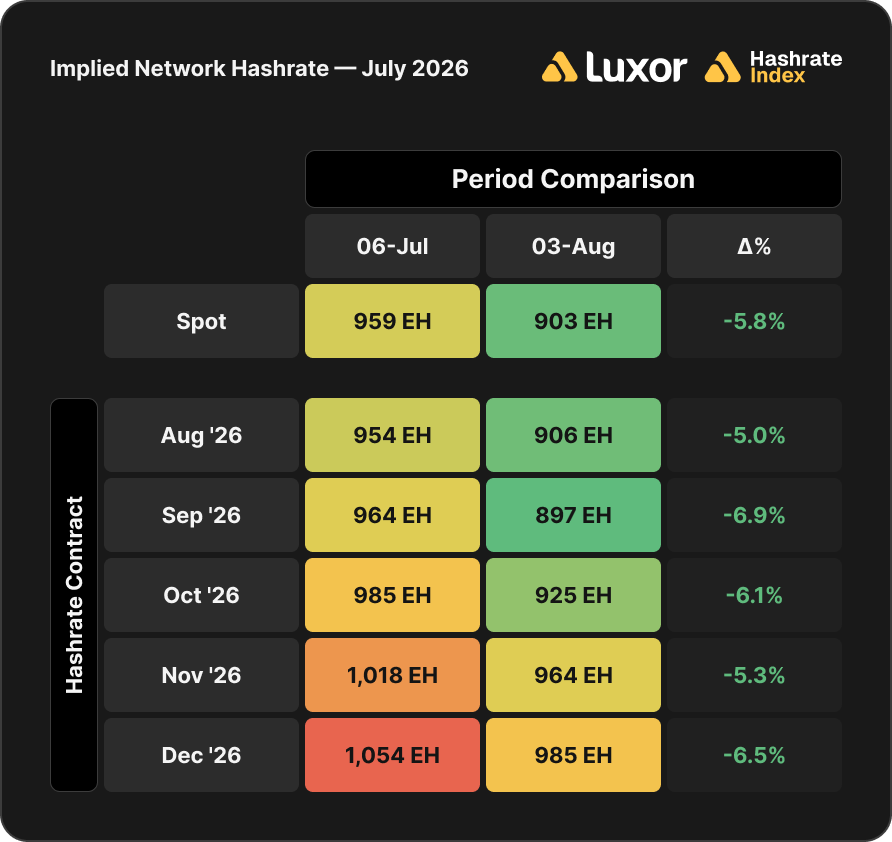
Luxor Hashrate Index chart (Implied Network Hashrate — July 2026) showing spot implied hashrate falling from ~959 EH to ~903 EH (≈ −5.8%) between the 06‑Jul and 03‑Aug readings — illustrating the hashrate contraction that underpins recent downward difficulty pressure. — Source: Luxor / Hashrate Index
What to Watch Over the Next Few Weeks
There are a handful of things I’d keep front and center as we head into the next retarget and beyond.
Short-term: block cadence and estimate drift
The minus 0.04% is a snapshot. If the remaining blocks in the epoch print faster or slower than average, the number can wobble. Don’t be surprised if the final move is a hair off the current estimate CoinWarz.
Fees and on-chain activity
Fees can make or break a week for miners. If inscriptions or any new use case kick up demand, that revenue shows up immediately. If they fade, the subsidy is all you have.
Power markets and weather
Hot days in the big mining regions still force curtailments. Cooler nights and shoulder-season weather should help the seven-day average hold gains, but September has its own power quirks depending on region.
Hardware deliveries
Any wave of fresh, efficient gear tends to push the shorter windows up quickly. Whether those machines stay online depends on power pricing and hedges just as much as difficulty.
Risks & What Could Go Wrong
- Fee drought: If transaction fees sag for weeks, miner revenue leans entirely on the subsidy, tightening margins.
- Power price spikes: Heat waves or grid stress can force curtailments, whipsawing the seven-day hashrate and squeezing operators without hedges.
- Difficulty snapback: A burst of sustained hashrate could flip the next retarget positive, eating the current relief quickly.
- Hardware lag: Delays in new ASIC deliveries keep older, less efficient fleets online longer, raising breakevens.
- Pool concentration: If a few pools dominate, variance and policy changes can ripple through payouts faster than expected.
- Regulatory friction: Regional rules on energy use or operations can sideline capacity with little notice.
- BTC price drawdown: A sharp price move lower can overwhelm any small negative retarget and push marginal rigs offline.
Hashrate headlines change fast; power bills and loan covenants don’t. Plan for the quiet weeks, not just the spikes.
Frequently Asked Questions
Did Bitcoin actually hit 1 ZH/s?
On short windows, some dashboards have shown hashrate touching the 1 ZH/s mark. The longer-term averages are still below it. Luxor’s Aug 3 roundup had the 30-day SMA near 910 EH/s and the 7-day rising from 878 EH/s to 932 EH/s. Round numbers make headlines, but averages tell you where the network truly sits Hashrate Index (Luxor).
When is the next difficulty retarget, and what’s expected?
Estimates as of Aug 19 point to Aug 22, 2026, with a very slight decrease of about 0.04% and a difficulty level around 127.43T. That projection can shift as the last few hundred blocks are mined CoinWarz.
Why did difficulty fall twice in July?
Network hashrate underperformed the 10-minute target window enough to warrant two downward adjustments during July: minus 5.00% on July 11 and minus 0.74% on July 25. Net for the month, difficulty slipped 5.71% from 133.87T to 126.23T, and hashprice improved to about $31.21 per PH per day Luxor / Hashrate Index.
How healthy are miner revenues right now?
The early August snapshot from Luxor shows miners pulled in roughly 3,222 BTC in a week, about $205 million at the time, reflecting both the subsidy and fees. That can change quickly with on-chain demand and price moves Hashrate Index (Luxor).
What could change the retarget projection before it lands?
Block arrival times in the final stretch. If blocks come faster than expected, the decrease could grow or flip positive if conditions reverse. If blocks slow, the negative move could enlarge. Projections always wobble in the last few hundred blocks CoinWarz.
Is the nine-month hashrate decline a red flag?
It’s a sign of tighter margins and power-related volatility, not necessarily a structural problem. BeInCrypto, citing Glassnode, put the 30-day mean drawdown near 19% from Nov 2025 to early Aug 2026, the longest sustained slide on record. That said, the seven-day uptick into August shows capacity is quick to return when economics allow BeInCrypto, Hashrate Index (Luxor).
What should long-term investors take from a tiny negative retarget?
Not much by itself. A small negative move says the last epoch ran a bit fast. The more useful signals are how fees trend, how the 30-day hashrate behaves into shoulder season, and whether difficulty keeps stepping down or snaps back. This isn’t investment advice, just context for reading the tape.