



Bitcoin hashprice is the expected revenue produced by a standardized amount of Bitcoin mining hashrate over a set period. The commonly used convention is daily expected revenue from operating 1 petahash per second (PH/s) for one day, quoted either in bitcoin or U.S. dollars. It is a benchmark for mining revenue, not a statement of what an individual miner earns or keeps as profit.
Luxor’s Bitcoin Hashprice Index documentation defines the measure as the expected value of 1 PH/s operated for one day. Standardizing the hashrate unit gives miners, pool participants, hardware buyers and financiers a common way to discuss the revenue environment even when their fleets differ substantially in size and efficiency.
Hashprice measures daily revenue per petahash
A hash is a computational attempt used in Bitcoin’s proof-of-work mining process. Hashrate expresses how many such attempts mining equipment produces over time. One PH/s represents one petahash per second, or a standardized slice of computing capacity large enough to make industry comparisons practical.
Hashprice asks a narrow question: if that 1 PH/s is pointed at Bitcoin mining for a day, what revenue should it be expected to generate under prevailing network conditions? The answer is an estimate, because a given unit of hashrate has a probabilistic chance of contributing to blocks and their rewards rather than a guaranteed daily output.
The metric can be shown in BTC terms or USD terms. BTC-denominated hashprice isolates the expected bitcoin revenue from mining. USD-denominated hashprice translates that expected revenue at Bitcoin’s market price. Both views are useful, but they answer slightly different questions: one tracks expected coin output, while the other tracks the value of that output in dollars.
For a rough fleet-level illustration, a miner operating 100 PH/s would use the prevailing daily hashprice as a starting benchmark and scale it by 100. That is only a revenue estimate before considering whether all machines are running, how the operation is connected to a pool, the pool’s terms, and the costs required to produce the hashrate.
Block rewards, fees, difficulty and Bitcoin’s price set hashprice
BTC-denominated hashprice is driven by three core inputs: the block subsidy, transaction fees and network difficulty. Mining rewards are made up of the subsidy paid with a block and the transaction fees included in that block. More reward available to miners, all else equal, raises the revenue pool from which hashrate is compensated.
Transaction fees can move independently of the subsidy. A period with higher fees increases the rewards attached to blocks and can support BTC-denominated hashprice. Conversely, lower fee conditions reduce that component of the available reward. This is why a mining-revenue benchmark should not be treated as a simple reading of the subsidy alone.
Difficulty determines how hard it is, on average, for miners collectively to find valid blocks. As network competition rises and difficulty adjusts upward, a fixed 1 PH/s represents a smaller share of the work competing for available rewards. That generally puts downward pressure on expected revenue per unit of hashrate.
For a USD hashprice quotation, Bitcoin’s market price becomes a fourth input. The expected BTC revenue may be unchanged over a short interval, yet its dollar value can rise or fall with Bitcoin’s price. A dollar-denominated improvement, therefore, does not necessarily mean a miner is producing more bitcoin.
| Input | How it affects hashprice |
|---|---|
| Block subsidy | Sets a major portion of bitcoin rewards available to miners. |
| Transaction fees | Add to block rewards and can change with network fee conditions. |
| Network difficulty | Changes the expected share of rewards earned by a fixed amount of hashrate. |
| Bitcoin price | Converts expected BTC revenue into a USD-denominated figure. |
This framing also clarifies why hashprice is best read as a moving benchmark. Its components do not all update on the same timetable. Bitcoin’s price can change continuously in the market, fees vary with activity and block composition, while difficulty follows a protocol adjustment process.
Difficulty turns more network competition into lower revenue per hash
Bitcoin adjusts mining difficulty every 2,016 blocks, approximately every two weeks, to target an average block interval of 10 minutes. The adjustment is part of the protocol’s effort to keep block production near that target as the amount of mining power participating on the network changes.
If more hashrate joins the network, blocks would tend to be found faster without an adjustment. A subsequent rise in difficulty makes valid blocks harder to find, restoring the intended pace on average. The total rewards from subsidies and fees are then spread across a more competitive environment, reducing the expected reward attributable to a fixed amount of hashpower.
This is the key link between network hashrate and hashprice. A miner cannot infer expected revenue from its machine’s nominal output alone. It must also account for the denominator: the difficulty and competition faced by that output across the Bitcoin network.
The relationship is not a rule that hashprice always falls whenever competition rises. Changes in transaction fees or the Bitcoin price can offset, exceed or lag the effect in a particular period. But holding rewards and price constant, greater difficulty means each PH/s has a lower expected share of the available mining revenue.
Difficulty is also distinct from an individual miner’s operational performance. The network setting applies broadly; a machine’s uptime, its efficiency and a pool’s payout method determine how an operation experiences the revenue environment in practice.

Halvings reduce the subsidy while transaction fees become more consequential
The block subsidy does not remain constant. Bitcoin cuts it in half every 210,000 blocks. The fourth halving occurred on April 20, 2024, reducing the subsidy to 3.125 BTC per block, according to Bitcoin.org’s halving information.
Because the subsidy is a component of mining rewards, a halving can sharply alter the revenue side of hashprice unless other variables change enough to compensate. It is a protocol-scheduled change rather than a change in a miner’s electricity bill, fleet quality or pool arrangement.
Fees are already part of every block reward, but their relative weight increases as the subsidy becomes smaller. That makes transaction fees increasingly consequential to the revenue available to miners over time, and requires hashprice users to monitor fee conditions alongside difficulty and Bitcoin’s market price.
Whether mining remains viable for any given company depends on more than the halving itself. Post-event revenue is shaped by fees, difficulty and, for dollar-based accounting, Bitcoin’s price; the operator’s cost structure is a separate and equally important part of the calculation.
From benchmark revenue to a miner’s actual economics
The most important distinction is straightforward: hashprice is revenue, not profit. It indicates the expected gross value generated by a standardized amount of hashrate. It does not subtract the expense of generating that hashrate.
Electricity is a central cost, but it is not the only one. A miner’s profitability also depends on ASIC efficiency, hosting, labor, financing, pool fees, downtime and other operating costs. Two operators can face the same network hashprice and produce very different margins because their machines consume different amounts of electricity or because their contractual and operating costs differ.
Energy-adjusted hashprice is one way to bridge the gap between revenue and power economics. It converts revenue per unit of hashrate into revenue per unit of electricity, allowing an operator to compare that revenue measure with its power cost. As Hashrate Index explains, it is designed to connect the hashprice benchmark to electricity consumption rather than to replace a full profitability calculation.
ASIC efficiency matters in that comparison because it determines how much electricity is required to deliver a given amount of hashrate. A more efficient machine may have a stronger position at the same power price than a less efficient one. Yet even energy-adjusted revenue does not capture every expense, including hosting arrangements, labor, financing and machine availability.
That is why “high hashprice” should not be read as shorthand for “profitable mining.” It may signal a more favorable gross-revenue environment, but it cannot reveal an individual operator’s break-even point without information about its equipment, power agreements and execution.
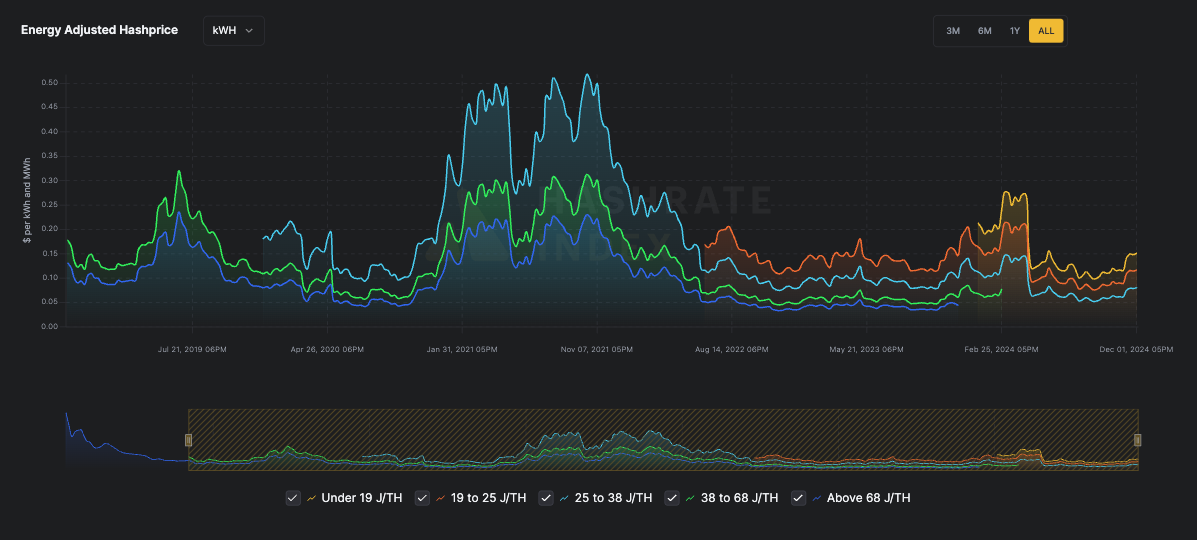
Energy-adjusted Bitcoin hashprice chart showing revenue per kWh across ASIC efficiency bands from July 2019 through December 2024. — Source: Hashrate Index
How pools, hardware buyers and mining-finance contracts use hashprice
For a mining pool participant, hashprice offers a reference point for what a unit of contributed hashrate might be expected to earn. Pools reduce payout variance by distributing block rewards and fees among participants based on contributed hashing power or accepted shares. That pooling structure makes revenue less dependent on the chance that a single miner finds a block on its own.
It does not make payouts identical to a headline benchmark. Pool terms, pool fees, uptime, stale shares and variance can cause realized revenue to differ from hashprice. A machine that is offline generates no hashrate during that period, while stale shares may not be credited in the same way as accepted work.
Hardware buyers can use hashprice as a common revenue input when comparing possible fleet output, then layer in each ASIC’s efficiency and expected operating costs. The metric is useful precisely because it keeps the network-wide revenue assumption separate from machine-specific assumptions. Conflating those layers can make a hardware comparison look more certain than it is.
Mining operators and counterparties can also use the measure in fleet economics and mining-finance contracts. In each case, it is a standardized reference rather than a guarantee. The relevant realized result remains dependent on the terms of the arrangement and the operation’s actual performance.
Bitcoin Developer Documentation describes how mining pools distribute rewards and fees among participants. For users of hashprice, the practical lesson is to compare a benchmark with the specific payout method, deductions and operational record that apply to the miner or contract under review.
Frequently Asked Questions
Is BTC-denominated hashprice different from USD hashprice?
Yes. BTC-denominated hashprice reflects expected bitcoin revenue per PH/s per day and is driven by subsidy, transaction fees and difficulty. USD hashprice adds Bitcoin’s market price, so it can change when the dollar value of bitcoin changes.
Why does Bitcoin difficulty affect hashprice?
Difficulty changes the expected chance that a fixed amount of hashrate earns a share of block rewards. When network competition and difficulty rise, the expected reward per PH/s generally declines if other inputs are unchanged.
Does a high hashprice mean Bitcoin mining is profitable?
No. It indicates a higher expected revenue benchmark, not an operator’s profit. Profitability depends on power costs, ASIC efficiency, pool fees, uptime, financing, hosting and other expenses.
What is energy-adjusted hashprice?
It expresses mining revenue in relation to electricity use, enabling comparison with power costs. It can help assess energy economics, but it does not include every cost involved in running a mining operation.
How do mining pools affect realized hashprice?
Pools reduce the variance of payouts by sharing rewards among participants, but the amount actually received can differ from the benchmark. Pool terms, fees, accepted or stale shares, uptime and residual variance all matter.