


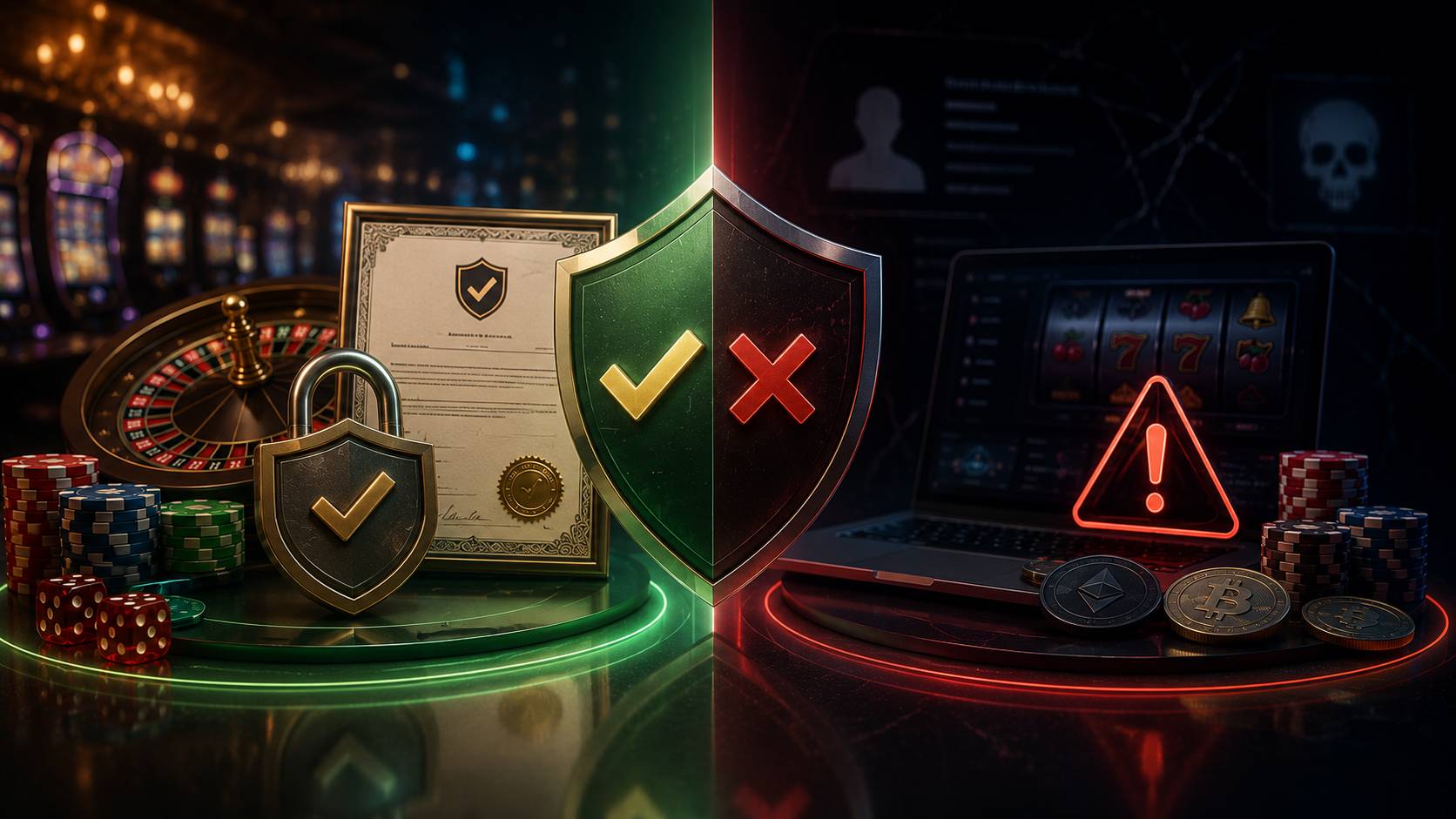
Picture two crypto casinos side by side. Same slot titles from the same providers, same coins accepted, same welcome offer, same interface. One holds a gaming licence, and the other does not.
Nothing you can see on the screen differs. Everything that matters when something goes wrong does.
The Difference Is Structural, Not Visible
A licence does not improve a game, sharpen a price, or speed up a payout. It creates a relationship between the operator and an authority that can compel behaviour, and it puts a named legal entity behind a brand name.
For a player who never has a problem, the licensed and unlicensed casino are functionally identical. The whole value of the badge sits in the scenario where a withdrawal stalls, an account is frozen, or a bonus is voided on a term nobody mentioned at signup.
|
Question |
Licensed operator |
Unlicensed operator |
|
Who is legally responsible |
A named company in a stated jurisdiction |
Frequently unclear |
|
Who can you escalate to |
The issuing authority |
Nobody with any power |
|
Are AML duties mandatory |
Yes, a condition of holding the licence |
Voluntary if present |
|
Can the authorisation be removed |
Yes, through suspension or revocation |
There is nothing to remove |
|
Is the game code examined |
No |
No |
|
Is player custody decided |
No |
No |
The bottom two rows are the ones worth sitting with. A gaming licence governs how an operator behaves. It does not inspect the smart contracts a web3 casino runs on, and it does not determine whether your balance sits in your wallet or theirs.
Obligations That Attach the Day It Is Granted
The moment an operator is licensed, a set of duties becomes enforceable instead of aspirational.
A crypto casino licence obliges the operator to run anti-money-laundering procedures, which is why risk-based identity checks appear at withdrawal on platforms that asked for nothing at signup.
Those checks are not the operator being awkward. They are a licence condition, and a platform that ignored them would be putting its authorisation at risk.
Responsible gaming obligations attach in the same moment, alongside fit-and-proper assessment of owners and directors, and technical conditions on the fairness of its games.
None of that guarantees good service. It does mean there is a written standard the operator can be measured against, which is precisely what an unlicensed site lacks.
Three Things the Badge Leaves Untouched
Three things do not change at all, and conflating them with licensing is the most common error players make.
The house edge is identical. A licensed casino's slots pay back what the provider set them to pay back, exactly as an unlicensed casino's do, and no regulator adjusts that number in a player's favour.
Code sits outside the assessment. A gaming authority reviews the operator, not the smart contracts underneath a web3 platform, which is why independent audits exist as a separate layer worth checking on their own.
And custody is untouched. Whether your funds sit in an operator's account or in a wallet you control yourself is a platform design decision that licensing has no opinion about.
A Rulebook Rewrite Showed What the Badge Is Worth
The clearest demonstration came from Curacao, where most crypto casinos are licensed. The jurisdiction replaced its old arrangement, under which operators bought sublicences from intermediaries and oversight was largely nominal, with direct licensing carrying real investigative and revocation powers.
Operators had to requalify. Several well-known brands could not or would not meet the new bar, and left for other jurisdictions or shut down. That is the mechanism working: an authorisation that can be withdrawn is an authorisation with weight behind it, and one that can never be withdrawn is a picture.
It also explains why a current licence matters more than a licence that once existed. Anything predating that transition tells you about a regime that no longer applies.
What Dexsport's Licence Covers
Dexsport is licensed in Anjouan, which places it inside a genuine statutory framework with AML duties, responsible-gaming requirements and an authority holding suspension powers. It is a lighter regime than Curacao's current one, and that is a fair thing to know, not a detail to bury.
Where the platform is unusual is in the two rows the licence does not reach. Its smart-contract code has been audited by CertiK and Pessimistic, addressing the layer no gaming regulator inspects.
And it is non-custodial, so funds settle to a wallet the player holds instead of an operator balance, which answers the custody row that licensing leaves open.
Bets also post to a public on-chain desk, so a settled wager can be checked against a ledger instead of an account page. None of that is a substitute for regulatory recourse, and all of it addresses what a licence alone leaves open.
Reading the Badge for What It Is
A licence answers one question well: is there a named operator, bound by written obligations, answerable to a body that can act. It answers nothing about the code, the custody model, or your chances at the tables.
Which is why the badge is a floor and not a verdict, and why verification practices on a licensed site follow from the licence instead of contradicting it.
Confirm what is legal where you live, keep stakes within a set budget, and play only if you are of legal age, since KYC or AML checks may apply. Responsible gambling rests with the player under every regime, and more heavily under a lighter one.
Disclaimer: The information here is provided for general purposes only and is not legal, tax, investment, or financial advice. Licensing frameworks, obligations, and platform terms change over time, so confirm current details before depositing. A licence does not change the house edge. Betting carries risk, and rules vary by country, so check the law where you live. Please gamble responsibly, within your means, and only if you are of legal age.